
THE MISSILE AND THE SHOVEL, OR… THE MULTI-PURPOSE ARMY
The series dedicated to the Revolution – Part Four, in which we, the conscripts Angelo and George, tell you how and why the Romanian Army was a walking catastrophe in December 1989. Contrary to the official propaganda, which portrayed it as one of the finest armies in the world: a “multi-purpose army”.
A Multi-Purpose Army! My Arse!
In the 1980s, Ceaușescu imagined an immovable military force, the “people’s army”, as communist propaganda called it. Everything was perfectly organised on paper: defence plans, strategies, mobilisation procedures, speeches celebrating victory. In reality, it was one enormous dress rehearsal for nothing. A machine that operated with solemnity, confusion, and an incredible amount of stupidity and corruption at every level. And with an incalculable number of idiotic officers and commanders. At the same time, Ceaușescu had grandiose pharaonic projects to complete, but he did not have enough manpower. And so the army, with between 300,000 and 500,000 personnel, became indispensable to their construction. Most of them were young men called up for compulsory military service, aged eighteen or nineteen and already accustomed to manual labour because of the intensive “agricultural practice” they had been subjected to throughout their secondary-school years. There, then, was the “versatility” of the Romanian Army: a defence force completely incapable of fulfilling its supposed defensive role. Instead, it was the cheapest construction, agricultural and mining company in the country—and it worked for free. Ceaușescu’s Romanian Army performed “patriotic labour”. A sort of Romanian communist version of Hitler’s 'Arbeit macht frei'!

Patriotic Labour
Free labour, but performed with the obligatory smile of the happy soldier. Some soldiers wielded jackhammers across the nation’s construction sites; others pushed mine carts through underground workings, despite never having dreamed of becoming miners. The conditions of “patriotic labour”? Like prison, but without prisoners’ rights. The soldiers assigned to “patriotic labour” slept in filthy barracks and ate in makeshift canteens. Their only refuge was to make bitter jokes about their usefulness to the communist state. A state that no longer needed to purchase industrial machinery, tractors, or other agricultural equipment. Why would it, when it had an abundant supply of healthy young men whom it could send out with a shovel in their hands, a slogan in their heart,s and their heads filled with communist propaganda? What did they actually do? Some wielded jackhammers across the nation’s construction sites; others pushed mine carts through underground mines, despite never having dreamed of a career in mining. There was also a special category known as the railway soldiers, a legendary caste of uniformed young men responsible for maintaining the railway network throughout the country. Basically, you went into the army to do your duty to the motherland and emerged as a specialist in road aggregate, railway sleepers, and green peppers. Or in any number of other “specialisations” in agriculture or industry. Depending on how lucky—or unlucky—you happened to be.
Dilibau
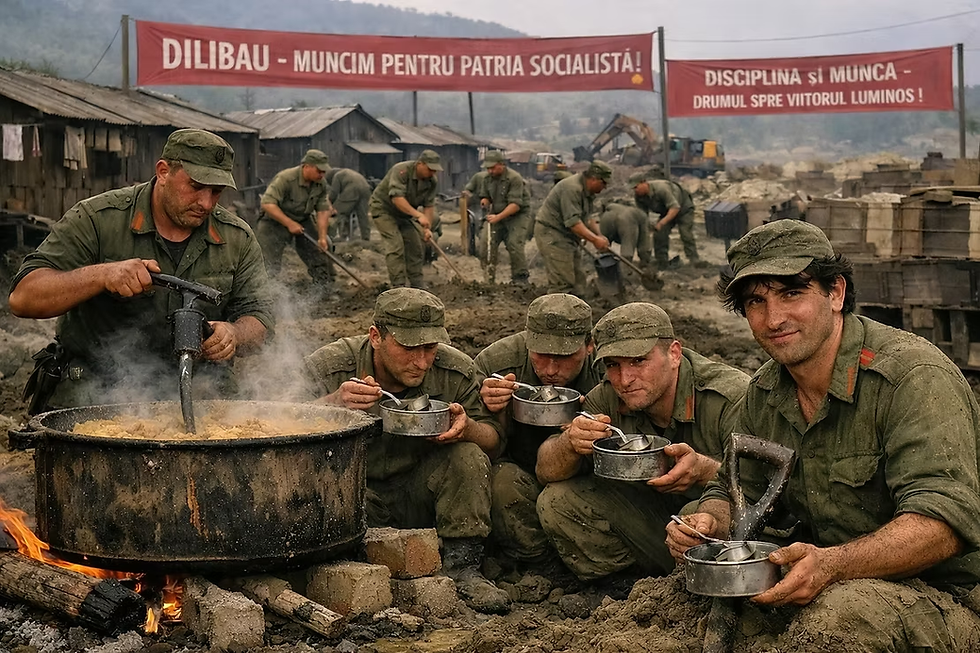
The slang name for the units that sent soldiers to forced labour - sorry, “patriotic labour” - was Dilibau. It was a mysterious institution about which nothing appeared in history textbooks, but which you immediately recognised when you saw the first field kitchen boiling food in the middle of nowhere and the first shovel leaning against a furrow. Those assigned there were affectionately nicknamed field rabbits - not because of their speed, but because they literally lived among furrows, soil and trenches, with about as much freedom as a rabbit caught in a snare. The shovel and pickaxe were their basic weapons, and their front line was the construction site. The great “titans of socialist construction”, the Transfăgărășan Highway, the Danube-Black Sea Canal, the House of the People and other monuments to the glory of the Party - were, in reality, built on the backs of these uniformed young men, paid in slogans and trained to believe that every blow of a pickaxe was another step towards radiant communism. In theory, you were there to defend the motherland. In practice, you defended the shovel against rust. There were, of course, victims as well - soldiers who never lived to complete their service, let alone see communism fulfilled. They died in workplace accidents, were buried in silenc,e and quietly erased from the record. Nothing was ever written about them, because in the press of the time, people did not die. There was merely “a minor incident recorded in the process of socialist construction”. Some were crushed by machinery, others buried in landslides or overcome by exhaustion. No cross. No memorial. Only a tick in an internal report and another “anonymous hero of labour”. Officially, nobody died in Dilibau. Unofficially, the soil of Romania still contains far more soldiers who fell on the altar of “patriotic labour” than any general ever sent into battles that were lost from the very beginning.
The “Lucky Ones”
We, however, were the “lucky ones”: assigned to agricultural labour, picking green peppers (George) and potatoes (Angelo). “The glorious vegetables of victorious socialism,” communist propaganda called them. When you found a particularly plump pepper, you felt as though you had captured a medal for production. We began our compulsory military service with an apprenticeship in the “school of the field”. Not just any field, but the vast agricultural front of the motherland. We were, admittedly, a “missile unit”, but the missiles sat quietly in their hangars while we harvested maize, potatoes and carrots. Beyond defending the airspace, the motherland needed young arms to feed its hungry communist stomach. In reality, we were a temporary agricultural army, with the missiles serving merely as decoration - like an expensive piano in a house where nobody knows how to play, but which looks good in photographs. Fortunately, this did not last very long, because we had to become “operational” as quickly as possible.

“Operational”
This was the word we heard most often during the first weeks of our military service. It meant that we had to learn, as quickly as possible, everything necessary to operate the complex systems of the anti-aircraft missiles. Through a bureaucratic failure of competence on the part of the army, Angelo and I had been assigned to air-defence units equipped with Volkhof missiles. They were the most modern missiles of their time, the equivalent of today’s Patriot systems. Once we arrived at the unit, the commanders urgently assigned us to key positions. I, Angelo, was designated a “launcher operator”: I was responsible for preparing the missile so that it was “ready for use”. George was a “plotter”: he calculated the possible trajectories of the target and determined the optimum moment for launching the missile in order to intercept it. A task now performed by computers, but which did not exist in that form at the time. Afterwards, we spent most of our time studying theory and carrying out practical exercises on the equipment. There were unexpected—and fortunate—consequences: fewer hours of “political and ideological” instruction and “patriotic labour” than was officially required. Once we became “operational”, we were assigned to our positions and told, in effect: “Get to work, comrades!” George remained in his original unit and became its principal “plotter”. I, Angelo, was sent to another unit after a few weeks. There I encountered anti-aircraft guns - modern ones, apparently? - of the sort one might have expected during the Second World War. Being cleverer than the average recruit, I avoided working with them and became an elite marksman, a sniper. What followed was…
ANGELO AND THE “TOUGH GUYS” UNIT
17 December. The People as the Enemy.
That day, we were all urgently summoned in front of our unit headquarters. It was Sunday, a day of rest even for communists. Normally, it was the day when we wandered aimlessly around the unit without doing very much. But that Sunday, the commander informed us, in a trembling voice, that we had received the “Radu the Handsome” combat alert: an imminent attack by a foreign power. According to the regulations, every unit was required to form an “intervention force”. A combat formation ready to enter action immediately and hold the enemy at bay until the entire unit was prepared for battle. That was the theory. In reality, such formations were used to suppress the Revolution in Timișoara on 17 and 18 December, and subsequently in Bucharest on 21 and 22 December. When the commander called for “volunteers”, several of my comrades and I—all of us from Bucharest—shouted at the top of our lungs: “Us! Us!” The officers were stunned. We were the first to take breaks and the last to work. We were the unit’s “skivers”. Absolute experts at “taking the piss out of the army”. But we came from some of Bucharest’s “finest” neighbourhoods: Colentina, Giulești, Pantelimon and Ferentari. Places where streetwise cunning was administered from the cradle, together with the bottle of milk. We had “smelled” the lie and did not want to “be taken for fools”. We did not want to march like sheep with the herd to the slaughter. We wanted at least a minimum degree of independence, a little freedom of action. And this was despite the fact that we were isolated from the outside world inside our barracks. We did not yet know that the Revolution had already begun in Timișoara. Nor did we know that Ceaușescu’s “enemy” was actually the Romanian people themselves, rising against him.
18 December 1989. Lieutenant “Cosmic”
We were supposed to undergo infantry training so that we would be prepared to repel the enemy attack. That was what our regulations said - as though the enemy were obliged to follow them! Lieutenant Nedu was appointed to command our formation. An artillery officer, he had forgotten - or perhaps had never learned - everything there was to know about infantry combat techniques. He had a magnificent head, worthy of a Roman emperor of your choice: Caesar, Trajan, or Octavian Augustus. Inside it, however, there was a cosmic void and perhaps a few neurons that had wandered there by mistake. But for us, he was the ideal commander. We could manipulate him as we pleased. The day began with what he believed was proper infantry training. In reality, it was a pale imitation of what he had seen in Russian films about the Second World War. What he wanted to teach us had nothing to do with the reality of a battlefield. Some of my comrades wanted to take over from him. At least they knew a few more modern combat techniques - Rambo and Mad Max, two famous American films of the period. I ordered them to keep their mouths shut and stop talking nonsense. Shortly afterwards, I told the lieutenant: “All right, we know what we have to do now.” He should take a break and get some rest because he looked rather “worn out”. Naturally, he was exhausted after a sleepless night spent with one of his mistresses. He spread his greatcoat on the ground, sat down on it “to rest for a little while”, and immediately fell asleep. We covered him with our own clothes to keep him warm and comfortable. We certainly did not want him to catch cold and wake up too soon. After he had rested, we rested too - but only physically. Our brains were working overtime, constructing thousands of hypotheses as we tried to work out what was hiding behind the mysterious “Radu the Handsome” alert. We did not discover the truth until that evening, when we heard it from the comrades responsible for radio communications.

19 December 1989. The “Rebels’” Parade
That day, our lieutenant made us practise the ceremonial marching step. He wanted us to march in front of Headquarters to demonstrate his professionalism to his superiors. According to our artillery officer, we were supposed to produce a marching step that would resound like a “cannon salvo”. In reality, everyone marched at his own pace, and the overall effect resembled a machine-gun burst. Driven mad, the man wondered what he had done to the gods of the communist Pantheon to deserve soldiers such as these. To make him leave us alone with his nonsense, we suggested that we march while singing. That way, everyone would hear the music—or rather, our shouting—and nobody would notice that we had no idea how to execute the ceremonial step. I chose the song specially: Romanian Battalions, Cross the Carpathians. Guaranteed success. It was about going to war to liberate Transylvania from the domination of the Austro-Hungarian Empire. It fitted perfectly with communist propaganda, which claimed that the Hungarians wanted to take Transylvania from us. The regime was also spreading rumours that the uprising in Timișoara was actually a Hungarian operation. For us, the song had a special significance because of the line “Transylvania, Transylvania is calling us”. In our minds, we replaced “Transylvania” with Timișoara and with the uprising against Ceaușescu. And so we spent the entire day doing nothing but musical rehearsals. Finally, we went out to march in front of the unit headquarters. We made only two passes. On the third, the commander came out of the building. He warmly congratulated our lieutenant on the “exceptional quality of our training”, but ordered us to stop. Nobody inside could work because of the noise we were making. Or, more accurately, because of the noise we were making while screaming and massacring the song’s melody.

20 and 21 December. “Chuck Norris” and Timișoara
On 20 December, the lieutenant attempted to teach us hand-to-hand combat techniques, drawing inspiration from what he had seen in films featuring Bruce Lee, Chuck Norris and other actors practising martial arts. The result was so embarrassing that my comrades asked him to give up. And to let me take over instead, since I had been practising karate for years. They very quickly came to regret the idea. I subjected them to extremely physical and brutal training. Hard training. No mercy whatsoever for their pain or exhaustion. When they tried to protest, I immediately silenced them by shouting: “Do what I tell you. When you fight someone, it will be his mother who cries, not yours.” Grumbling, they cursed and swore at me ten thousand times. In their heads, of course, because they understood perfectly well how right I was. And I kept them there, on the training field, until late afternoon. The same thing happened the following day. We returned to the dormitory exhausted, broken, but desperate for news from the country, which our comrades shared with us. After they told us what had happened at the rally Ceaușescu had called on 21 December, we hoped that we had reached the point of no return: the Revolution had reached Bucharest. That night, we went to sleep fully dressed, clutching our weapons tightly against our chests. I wished I could have been in Bucharest, with my rifle and a few crates of ammunition beside me.
22 December 1989. The Fall
That morning, we were ordered to go to the weapons store and wait there. An order had come from Ceaușescu’s office for us to be sent to Bucharest “to defend the country”. My arse! But the unit commander requested that the order be confirmed by his superiors. That confirmation never came. It was almost ten o’clock when someone—a soldier, an officer; time has erased his name and face from my memory—burst through the door and exclaimed between gasps: “They’ve killed Milea!” General Milea was the Minister of Defence, a complete stranger to us. Under normal circumstances, we had neither sympathy for nor respect for him. But at that particular moment, he represented “the Army”. And suddenly it became something like: us against them. Perhaps I shouted it. Perhaps somebody else did. Perhaps several of us shouted it simultaneously: “Cioroiu must pay!” Cioroiu was the “counter-intelligence officer”, the unit’s “Securitate man”. We searched everywhere for him, weapons in hand, bullets chambered, arguing among ourselves about who had the right to fire the first shot. We never found him. He had already fled and never returned to our unit. Our search ended around midday, when we heard the first screams in the distance. We ran towards them, prepared in our hearts to fire. But as we approached, we realised that they were not screams. They were cheers. Ceaușescu and Elena had fled by helicopter. The grotesque irony of history: they were abandoned in a cornfield, picked up by car, and then left behind like provincial fugitives, destined to be captured. A couple who had begun their rule in triumph were ending it in rural disorder, with winter mud on their shoes.

22–25 December. The Coup d’État and Electronic Warfare
Unfortunately, the joy was short-lived. Fearing that they would lose Romania, the Russians pushed their proxy, Ion Iliescu, to seize power through a coup d’état on the evening of 22 December. Romania subsequently became the theatre of a bloody conflict between the “Forces of Good”, led by Iliescu, and “terrorists”, supposedly loyal to Ceaușescu and allegedly intent on restoring him to power. In reality, Iliescu’s ally, General Stănculescu, the head of the army, was responsible for creating these “terrorists”. They were groups of soldiers from different units who had been sent to the same location without any coordination between them. When they encountered one another there, amid a generalised state of collective hysteria, they began firing at one another, each group convinced that the other consisted of “terrorists”. Angelo and his comrades narrowly escaped, making a pact with them at Fetești, 120 kilometres from Bucharest, on the night of 22–23 December (a story told in 'The Fall of the Mastodon'). In his unit, George fought against the “terrorists”, firing at random at freight trains passing nearby. Luckier than Angelo, he also experienced the electronic warfare initiated by the Russians to support Iliescu’s coup. This warfare involved the creation of phantom targets through sophisticated active and passive jamming techniques, signal interception, and manipulation of radar echoes. Defence systems were thus made to fight shadows, expending real resources against non-existent threats.
GEORGE AND THE LONG ARM OF MOSCOW
23 December, Late Afternoon. Their Helicopter. My Kalashnikov. The Pause.
The day began, remarkably, almost elegantly. I was becoming accustomed to the abnormal, as though the supernatural itself had been drafted into the army and had signed the attendance register. I knew that nothing I was experiencing was normal, but the communist soldier’s mind possesses a rare quality: it adapts to absurdity as naturally as it adapts to barracks life—with no complaints and a greatcoat pulled tightly around its shoulders. We were on combat alert. An alert that did not scream, but whispered softly, like a stray bullet moving through the frozen air. I knew nothing about my family. Nothing about Angelo. The silence between us was heavier than a fully loaded pack. I was isolated, like a sentry forgotten on a bastion of fog. And yet, the weather was beautiful that day. Suspiciously beautiful. The sun hung in the sky like a general satisfied with his inspection, and the light fell over the barracks with an almost insolent indulgence for a winter day. It was the kind of light that made you believe life could be simple—if only there were no orders, bullets and stupid commanders. I sat in the command centre, hoping for a quiet day. I stretched out on the two wooden steps that served as my “sofa”. One was narrow, the other hard; together they formed an ergonomic masterpiece approved by the Ministry of Survival. The wood creaked beneath me like a soldier complaining about an order but eventually falling silent, disciplined. My Kalashnikov lay beside me, resting there like a trusted comrade. I was surrounded by a silence made of dust and wooden boards. Each with its own kingdom. In the apparent calm, mystery floated like an invisible fog. I sensed that something was about to happen, that beneath this clean light a new story was beginning to boil. The Revolution was not asleep. It was merely changing its firing position. And I waited. With barracks humour, carefully camouflaged fear, and one eye on the sky. Because in those times, even the sun was not merely the sun—it was the spotlight illuminating a stage on which we were performing without rehearsal.

The Commander
At some point, the unit commander appeared. He had come from the officers’ mess—the sacred temple of fried potatoes and post-prandial optimism—with an elastic step and his sense of humour switched on. He stopped beyond my plotting board and made a barracks joke, one of those recycled from the War of Independence. He laughed at his own joke, satisfied, like a general who had awarded himself a medal. He could not see me, but he knew I was there. In Ceaușescu’s army, invisibility did not absolve you from being present. I watched him approach. I stood up immediately, my reflexes polished by countless commands of “Attention!” He looked at me briefly and, without preamble, told me to take my weapon and follow him outside. His tone was calm, which in the army was more dangerous than a shout. I buttoned my collar tightly, as though closing a door against comfort, took my weapon and magazine, and climbed the stairs towards the surface. Each step sounded like a step towards a story that promised nothing good. Above us, the sun burned with an almost tropical brightness, but we were sheltered beneath enormous camouflage nets. They looked like spider webs thrown across the sky, designed to catch not flies, but aircraft. The air smelled of winter and mystery.
The Order
I was ordered to keep my eyes on the sky and shoot down anything that moved. With “the weapon issued to me”. I looked at my battered AK-47. I held it like a rusty fishing rod and wondered what cosmic fish I was supposed to catch. I almost burst out laughing. What was I supposed to shoot down? The clouds? A sparrow with hostile intentions? An insect suspected of espionage? If a helicopter appeared, I could perhaps salute it according to regulations, but hardly intimidate it. In my mind, sarcasm was conducting front-line training. In his mind, presumably, a strategic battle with imaginary air forces was under way. I gave him a feeble but perfectly regulation-compliant: “Yes, sir! Understood!” Barracks humour whispered that if I fired hard enough, I might even shoot down gravity. I remained at my post. Eyes upward. Sentinel of infinity. If it had not been so ridiculous, I would have sworn I had dreamed it. But no. The entire episode was recorded in a subsequent investigation, complete with statements, signature,s and soberly worded conclusions. The results remain attached, neatly preserved, in the history of incidents recorded in my military notebook—a footnote to the chapter entitled “Tactical Absurdity”. And so, for several hours, I became the official defender of the sky.
The Helicopter
I stood there for a while, my eyes glued to the sky like a poor astronomer, and suddenly the miracle happened. Or, more accurately, the nuisance. I heard a sinister buzzing, an aerial screech, exactly like the crooked-wheeled contraption used by the scrap-metal collectors who passed along the street of our childhood, loaded with old iron and battered dignity. A sound announcing not technological progress, but its demise. I looked up. And once again I almost burst out laughing. Above us hovered—or if “hovered” is the right word, a helicopter that looked like a wreck pulled from a museum of improvisation. A flying ship seemingly detached from Jack Sparrow’s universe, only without the charisma and without the soundtrack. A contraption that kept coming, showing no sign of stopping or asking permission. The noise grew louder. The air began to vibrate. The camouflage nets trembled like pages of poorly bound history. And then, in a fit of lucid panic, I stepped out from beneath the camouflage. The sun hit me directly in the eyes. My heart pounded against my temples like an enthusiastic drummer. With immense fear - the cold kind of fear that straightens your back and narrows your thinking - I raised my weapon. For a fraction of a second, I wondered whether the order had been a bad joke. Whether anyone could genuinely believe that I, armed with my weary AK, could negotiate with a flying machine. And yet, the machine kept coming.

The Firing
I pointed the barrel at the metallic monstrosity. I took aim. At that moment, there was no philosophy between me and the sky. Only an order. And I fired. The regulation thirty rounds left the barrel with disciplined fury. Automatic fire. Their sound tore through the air as though I were trying to stitch the sky together with lead thread. It was an absurd and heroic gesture at the same time. Like throwing stones at a storm and hoping to persuade it to apologise. My ears rang with gunfire, my heart rang in my chest, and above me the flying wreck continued on its way. I was down below, armed with “the weapon issued to me”, defending the frontier between reality and delirium. Anyone watching the scene from outside would have sworn it was a military comedy. But for me, at that moment, it was the most serious battle with the sky I had ever fought. I watched my bullets leave the barrel in disciplined formation and, a few metres higher, suddenly become anarchists. They flew in every direction, like recruits who had lost their platoon. The sky appeared riddled with intentions rather than accuracy.
The Miracle
One stray bullet - perhaps the laziest one in the magazine - decided to discover the meaning of its existence. It struck somewhere near the rear rotor. I do not know whether it was ballistic physics or a purely divine intervention wearing khaki. What I do know is that this “miracle of Romanian military technology”, this masterpiece of aeronautical improvisation, began to tremble. The wreck passed over me, shaking at every metal joint like an old man who had left the pub too abruptly. It left behind a thick trail of smoke, carrying the unmistakable smell of kerosene and wounded pride. The rotor seemed to be arguing with the rest of the airframe. The air vibrated. The earth held its breath. This moment of soldierly courage mixed with sheer madness lasted, in reality, no more than ten seconds. Ten seconds in which I was simultaneously anti-aircraft artillery, an unofficial hero, and a candidate for arrest.
An Unexpected End
Then I heard footsteps. Behind the roar of my regulation burst and the howl of the flying wreck, two figures appeared: the commander and his deputy, both wearing faces that promised no promotions. They arrived abruptly, like prosecutors from the court of absurdity. They said nothing at first. They grabbed me by the sleeve and pulled me back towards the depths of the command post, as though I had personally triggered the Third World War with a thirty-round magazine. I descended the stairs almost on autopilot. The wood creaked again, but this time it sounded like a verdict. “That’s the end of me,” I thought. I could already see my military record acquiring a new chapter: “Attempted Duel with the Sky.” In the relative darkness of the bunker, the sun disappeared, heroism evaporated, and the remnants of adrenaline continued to pulse in my temples. Above, presumably, the wreck was looking for somewhere to make an emergency landing. Below, I was looking for a defence. Less than ten minutes later, the telephone rang. That short, metallic sound which, in the army, never announced good news, only official news. I knew it was about me. About my anti-aircraft “achievement”. And, ironically, I no longer cared. Once you have fired at the sky and watched a wreck tremble like mechanical jelly, every consequence seems like nothing more than a footnote. A woman’s voice—calm, protocol-driven—told the commander that she was putting him through to a general. Her tone was neutral, but to me it sounded like the prelude to an administrative execution. Then the conversation began: “Who is the idiot who fired at us, trying to kill us?” The wording was direct, without metaphor. Military to the bone. The idiot in question was me. Your humble servant. The accidental anti-aircraft gunner. My brain began shutting down, like a soldier who had just collided head-first with his own heroism. Yet the procedure came to an abrupt halt when I heard my commander’s answer: “General, your aircraft was reported to us as a legitimate target to be shot down.” I was so shocked that, for a moment, I could not grasp the meaning of the conversation. I would understand it several hours later.

The Missiles. Later, the Same Night
I was at my plotting board. Targets were coming in bursts, one after another. I placed them on the board, compared them, plotted them, all with a devotion which, in a normal life, ought to have been devoted to a nobler cause than chaos. Each target was an aircraft or a helicopter. Fortunately, since it was 1989, there were no drones yet. I was both soldier and scribe in an absurd electronic war. A war in which every point on the plotting board could mean life or death. Or, more likely, pure panic. The coordinates came from the radio room in a staccato torrent, accompanied by the trembling voices of the operators, as though even the radio waves themselves were suffering a nervous breakdown. On a normal training day, we would track two targets simultaneously, three at most. At that moment, I had no fewer than seventeen on my plotting board. Realising that something was wrong, I reported it to the commander. He answered tersely: “Electronic warfare, plotter! Do not stop. We are at war. Follow the procedures and do your duty!” He then telephoned Army Command to report the situation and request instructions. The order we received was unequivocal: “Continue monitoring and do not hesitate to follow the interception procedures.” A few minutes later, two targets entered our interception zone. I checked the manual again. My hands were trembling, my vision blurred, but I could read the text perfectly well: signal that the targets were within firing range. I knocked twice on the commander’s window to indicate that the targets had entered the perimeter. He was white as a sheet and gave the order: “Fire.” We fired. We launched two Volkhof M3 missiles into the Romanian sky. Russian missiles, heavy and precise only on paper. What did we launch them at? Shadows. False targets. My role in this scene was minimal, but real: I sent missiles against the ghosts of a war that should never have taken place. But it did take place because of Iliescu’s thirst for power, combined with Moscow’s determination not to allow Romania to leave its sphere of influence.
The Investigation
A few days later, things returned to their natural order and the inevitable investigation took place. Investigators who had come from Bucharest, from the Ministry of Defence, asked cold, targeted questions, trying at all costs to avoid the essential point. The conclusion? Sober, official and ridiculous: “The launch was provoked by electronic disinformation carried out by terrorist elements, involving coordinated jamming intended to sabotage the defence of the homeland against unidentified foreign state actors.” “Unidentified”, my arse! Not the slightest reference in the report to our “friends” in the East. The bloody Russians. The only people capable of doing it and interested in doing it!
Epilogue
A few days later, at the morning parade, the air was cold and solemn. The soldiers stood in formation, faces impassive, breathing in synchrony. The commander called my name. I marched forward. I expected a reprimand, a report, exemplary punishment. I prepared myself mentally for a moral demotion. And then came the surprise. Without explanation, without qualifications, without an epic preamble, I was congratulated for the “exact execution of orders”. Exact! The word fell upon me like a medal thrown from a passing window. I was promoted to corporal. Then, as though the absurdity were not yet complete, I was granted three days’ leave.
Instead of a Conclusion
That was my journey through the Romanian Army: it began in the compact grey landscape of communism and ended in what was known, with involuntary historical humour, as Ion Iliescu’s “original democracy”. I entered the army as a private in a regime that was beginning to collapse. I left it as a corporal in a country learning how to live again. Between the two: a battered helicopter and thirty rounds of ammunition. Two missiles fired at ghosts. The entire unit’s ammunition supply was consumed during one night of firing at “terrorist” trains. A promotion that defied every principle of military logic. And history, laughing beneath the camouflage nets. And so my story as a nineteen-year-old revolutionary soldier comes to an end. There, in the middle of the chaos, between plotting boards and helicopters, between absurd orders and dreams of freedom. Romania was awakening like a dazed elephant that still could not tell whether it was raining or the sun was shining. I, a tiny point in the vastness of history, learned that revolutions do not arrive with applause and dazzling lights. They arrive with smoke, dust, and bureaucratic absurdities, where official reports justify the impossible and make a mockery of heroism. And, ironically, it was precisely in the middle of this tragic theatre that I understood that freedom is won with sweat, fear and a little dark humour—for, in the end, if you cannot laugh at the absurdity of the world, you risk crying over its stupidity.



Comments