
TRUMPOCALYPSE 3: THE ART OF ELEGANT COLLAPSE
- angelogeorge988
- Apr 4
- 15 min read
Updated: Apr 14
Trump, from July 2025 to March 2026, analyzed with seriousness and sarcasm.

The executives of the famous television network, deeply entrenched in their dogmas of political correctness and convinced that form outweighs substance, serve him a perfect marmalade. Not made from citrus, but from carefully “reworked” news until it turns into a refined media dessert: zero fiber of truth, with an intense aroma of personal conviction.
BBC: The Documentary on Trump and January 6, 2021
Poor BBC! It resembles a surgeon entering the operating room with trembling hands, forgetting the scalpel inside the patient, only to suddenly remember that the procedure is being filmed for a “shocking” documentary. And to make matters even more embarrassing, we discover that the scalpel was plastic. Conclusion: not only does it get things wrong, but it is not even capable of causing harm worthy of the name. British professionalism on display: impeccable appearance, no substance. But intention is what counts—especially when competence shines through its absence. Indeed, the BBC admits that its documentary on Trump and January 6, 2021, was “adjusted.” Not manipulated—heaven forbid—but simply retouched, an “artistic adjustment” in keeping with its noble tradition of confusing journalism with Hollywood screenwriting.

A well-established tradition: journalism as a form of experimental literature, somewhere between fiction, fantasy, and public funding. The executives resign—a moving, almost theatrical moment; in reality, it is merely a pause in responsibility, perfectly synchronized with tea and biscuits, where guilt is served hot and swallowed without effort. Meanwhile, Trump demands money and threatens to file lawsuits. A perfect Pavlovian reflex: where there is scandal, there is profit. It doesn’t matter who is right; what matters is issuing the invoice as quickly and as loudly as possible. Trump does not seek the truth; it doesn’t pay. He seeks the receipt—preferably gilded, signed, and broadcast publicly in capital letters. With the rigid dignity typical of empires that still believe the world reads their official statements, the BBC solemnly declares it will not yield. Of course not. They are far too busy explaining that “this is not what it seems” and that “the editing is unfortunate.” They claim that “truth is fluid,” like London rain or the quality of a front-page article on a bad day. Reality was not misrepresented; it was simply “explained.” Reinterpreted! A kind of journalistic jazz: wrong notes, played with confidence. Most likely, Trump will lose the case. But the BBC’s victory carries that familiar hospital-room taste: the operation was successful, the patient is dead, the doctors congratulate each other, and the family is handed a form to express satisfaction. We have seen this film before under communism in Romania: it is the fault of the deceased; the procedure was flawless. A remarkable performance: losing public trust without committing a single mistake. Officially. In the end, the BBC finds itself with exactly what it deserves: a reputation reduced to crumbs, then elegantly packaged in institutional colors, with the logo intact and the illusion of control. Ruin—but premium. With subtitles in multiple languages. And Trump? He doesn’t care. His reputation is already an amusement park where truth is merely an optional attraction, closed for permanent renovation. But if he has the chance to strike at the BBC’s pedestal, he does so with the enthusiasm of an accountant discovering an unpaid invoice—and with the same attention to detail. Then he publicly congratulates himself on his victory, regardless of the verdict. In his world, reality is negotiable, and applause is mandatory. In short, the BBC wins—and Trump sends the bill. And, as usual in their world, the truth was left too early. Before the end.

Trump and World Peace Between Putin and Ukraine
After driving the knife into the BBC’s open wound, Trump flashes a broad smile and moves on to the next item on the menu: world peace, generously offered. No Nobel Prize included, but with chocolate icing, glossy packaging, and an expiration date set for the next tweet. After all, if reality cannot be repaired, it can always be sold. On promotion. With fast delivery and no warranty. So much noise—noise 2.0, upgraded with hashtags and instant notifications—for absolutely nothing. The grand Geneva spectacle on peace between Putin’s Russia and Ukraine begins with a “28-point plan” that spectacularly melts down to “19 points” in no time. A revolutionary diplomatic regime: remove the substance, keep the title. After meetings, consultations, and other elegant forms of wasting time, the plan is adjusted again—shortened, stretched, retouched—until it becomes perfect: completely useless, yet impeccably presented. Trump, the Michelangelo of imaginary transactions, treats peace as a luxury good: describe it well enough, and no one asks whether it actually exists. In his world, wars do not truly end. They are declared over—with ribbons and applause—while continuing quietly in the background, like elevator music in a third-rate motel. Meanwhile, the tireless chorus of online “peace architects” fulfills its sacred duty: making noise. Endless threads, definitive analyses, recycled opinions labeled “Breaking News.” A true industry of sterile hope. Enlightened minds debate “windows of opportunity,” as if Putin had enabled notifications and were eagerly waiting to see what the latest geopolitical influencer has to say. They gather on television panels and across social media, posing as surgeons of truth—but without patients, medicine, or responsibility. On the ground, the “peace plan” remains unchanged: tanks, missiles, drones—and Putin, with a destructiveness that is almost poetic in its consistency. But that does not matter. The “choir of peace architects” continues, persists, analyzing every rumor like alchemists who solemnly swear they can turn mud into gold, yet forget to check whether gold still exists. Every “source close to negotiations” becomes a revelation. Every meeting is a historic moment. Every failure is a “strategic recalibration.” Peace does not arrive, but explanations multiply. Like bacteria. Or like experts. It would be moving if it were not almost comical. But never mind—we'll try again. Perhaps at the next panel. Or in the next podcast. Or in the next viral 47-point thread where someone will calmly explain, with charts and graphs, why reality is wrong. And above it all hovers Trump, the supreme negotiator, convinced that the world is nothing more than a vast deal in which peace can be obtained cheaply—provided one raises the voice and lowers the expectations. If it fails, it is not his fault, but the world’s—for not understanding the offer. Or for not paying the bill on time. In reality, however, things are far simpler—and infinitely more uncomfortable: one cannot negotiate with someone like Putin, who never wanted peace. But that is a difficult idea to sell. It has no catchy title, no viral potential. The rest is just noise. A lot of noise. Packaged, labeled, distributed, applauded noise. Noise so effective it almost manages to mask reality. Almost.

Playful Europe and the “Frozen” Russian Money
The absolute master of his alternative reality, Trump wakes up one morning convinced that a plot is unfolding against him. Not Russia. Not China. Too conventional, too predictable. Europe. That insolent Europe, with its old cities, cold cathedrals, overflowing vaults, and bank accounts that do not greet him. Three hundred billion euros of Russian money lie there—frozen, silent, insignificant—a personal offense of biblical proportions. At night, the money whispers to him, a chorus of golden ghosts murmuring: “Come and get us.” Europe holds them captive like confiscated works of art. And Trump, a martyr to his own grandeur, feels betrayed by the universe. The war in Ukraine? Background noise for his permanent spectacle. The dead? Statistics that ruin the charts. Destroyed cities? A post-apocalyptic film set—Instagrammable, but entirely useless for his accounts. Then comes the ultimate sacrilege: Europe proposes to give the money to Ukraine. Simply give it—no ego tax, no spectacle, no gold changing hands. Trump nearly drops his golden phone. And so begins the grotesque performance: he shouts, threatens, symbolically mounts NATO, and brandishes sanctions like luxury toys—useless, but essential for the photo. Negotiation becomes an exorcism ritual: the demons of logic, empathy, and responsibility are driven out, coated in chocolate icing and feathers, until the first billion is secured. It does not matter where it comes from. What matters is that it is displayed. Meanwhile, the world watches as international leaders become extras, journalists turn into a background chorus, and “peace plans” into sheets of paper that Trump folds into grotesque origami. He declares victory, signs imaginary contracts in the air, and walks away, leaving behind baseless promises, empty accounts, and a planet in disarray. Europe, Ukraine, Gaza—everything becomes scenery for his spectacle of egomania. Every tragedy turns into a prop, every unpaid bill into a cosmic farce. And Trump remains the absolute master of his delusion, ruling the Empire of Ego with an imaginary steady hand. In this Trumpocalypse, one certainty remains: the universe laughs, people suffer, money rots—and he triumphantly proclaims that he has saved the world. His grotesque caricature becomes the only real empire. And the planet? His personal stage.

Guberniya New York
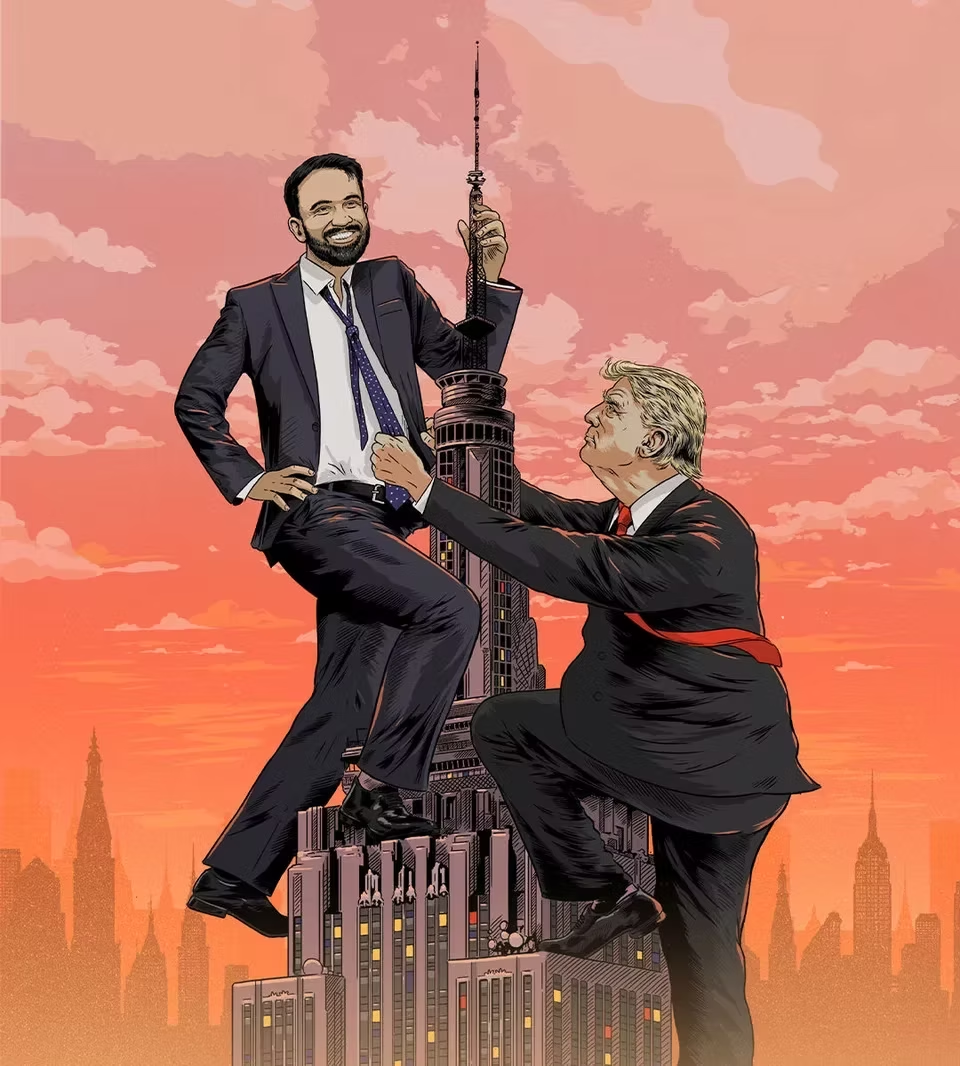
And now we arrive in Guberniya, New York, after the election of Mayor Zohran. It is a city that resembles a battlefield after a festival of nuclear fireworks decorated with Christmas garlands: buildings that now exist only in urban statistics, people trying to feign calm and optimism. Everywhere, Trump hovers like a golden tornado, wearing a tie and an ego in apocalyptic proportions. He strides along the sidewalks with grand gestures, signing imaginary “contracts” in the air and threatening sanctions like a five-year-old brandishing a plastic ball that has fallen into a stream: a dramatic, useless, yet perfectly photogenic scene. His promises burst like soap bubbles on the dry asphalt of reality. In return, he receives nothing but theatrical sighs, resounding threats, and symbolic gestures that stretch the limits of decency. Meanwhile, the region’s progressives and liberals—those who still believe they can save the world by posting colorful infographics and quotes on Twitter—become tragically ridiculous extras. They hold up signs proclaiming “equality” and “social justice” while reality explodes all around them. They speak of “redistribution of wealth” and “universal rights,” even as their city turns into an apocalyptic set for the narcissistic spectacle of a supreme clown. The other clown—Zohran! Their moral ideas are nothing more than shadows in a fire: visible only to those who view life through rose-colored glasses, and utterly useless in the face of concrete chaos. As New York slowly disappears, what remains is the grotesque spectacle: Trump triumphant in his chaos, and progressive politicians dancing on the ruins of their own theoretical utopias. Amid it all, ordinary people watch—frightened and amused—as the city transforms into a comic artwork where truth is optional and catastrophe desirable for ratings. At the center of the stage stands Trump—the walking apocalypse, god of golden chaos. On the margins, the progressive cohorts and Zohran raise their hands helplessly to the sky, like children trying to extinguish a fire with soap bubbles. Reality? Dead. Logic? On strike. The spectacle? Impeccable—for those who enjoy the grotesque. And yet, amid the ruin and the absurd, everyone smiles: Trump, because he survives his own delusion; the progressives, because they have posted messages of solidarity. The rest of the world, because it is still alive—and can laugh bitterly.
The moral? If the apocalypse were ever to become a dark comedy, Trump and the progressives of Guberniya New York would be its Broadway stars.
Berlin Stirs
With his new national defense strategy, Trump delivers such a kick to Europe that the old continent spins like a geopolitical top. The gentle drowsiness of decades finally bears fruit: a vulnerable Europe, exposed and caught off guard by harsh reality. Except for France, which possesses the peculiar talent of considering itself a category apart—something that irritates Trump immensely. Nothing annoys him more than seeing someone steal the spotlight while acting as if it were the most natural thing in the world. And Trump irritates, of course. Especially the Germans. Not because he says anything profound, but because he dares to say out loud what Berlin pretends not to see. Nothing unsettles the German capital more than a mirror held too close to the face—especially a mirror from Washington, where diplomacy has long ceased to be an art and has instead become a contact sport with minimal protection. As the United States redefines its security strategy, Germany responds with that studied, drawing-room elegance in which voices are never raised—only eyebrows. Yet behind the apparent calm, one senses the panic: someone has disturbed their carefully arranged display of progressivism, that socialism of yesterday, perfectly aligned, where everything is impeccable… until reality comes along and upends it all. Berlin’s reactions are a poem of hypocrisy: moral indignation, firm statements that say nothing, promises of “reassessment” that lead nowhere. An atmosphere faintly reminiscent of the League of Nations in the interwar period—solemn, yet inert and useless. All of it is written in such sterile language that it seems as though it were produced by an AI trained in etiquette, earning top marks in the exercise “Avoid conflict through long, empty sentences.” At its core, Trump presses precisely the buttons Berlin prefers to ignore. And it hurts.
Nothing is more disturbing than someone telling them, bluntly, that not only is the emperor naked, but he does not even seem in a hurry to get dressed.

Strategic Discombobulator
Bravo to Trump for what he did to Maduro, the dictator of Venezuela. Nothing better embodies “freedom” than a well‑measured show of force wrapped in heroic rhetoric and Hollywood‑worthy special effects: a true geopolitical blockbuster where reality is nothing but scenery. In the purest Stalinist style of the Theatre of the Absurd, Washington presses the red button marked “total rout,” a weapon technically called the “discombobulator.” The result: communications instantly fail, networks collapse like a house of cards, and satellites blink in confusion as if demanding a commercial break. In Caracas, such an ominous silence settles that even the fans stop humming. In that signal void, the CIA, the FBI, and special forces enter the scene with the synchronized precision of a Broadway musical. In less than 20 minutes, they “execute” Maduro in the most metaphorical sense of the word: they yank him out of bed like an actor late to a gala performance, “rip” him from his path to the bunker (or the refrigerator—details remain unclear), and “extricate” him from the country with an efficiency that would make any espionage film director jealous. In a whirlwind of metaphorical smoke and masterfully choreographed confusion, Maduro disappears from Caracas’s radar only to reappear in a host country’s high‑security prison, where he serves pancakes for breakfast. Pancakes—because in this absurd story, nothing makes logical sense, but everything is deliciously theatrical. A perfect ending to a geopolitical episode that shows that by 2026, international politics is no longer about strategy or diplomacy, but pure spectacle—with audiences, a public, and plotlines defying any rational logic. The reaction of major global players to this South American saga was incredibly funny: the planet seemed to enter a collective contemplation—not out of shock, but because no one quite knew what to do with it: laugh, applaud, or Google whether “discombobulator” is even a real term. In Brussels, officials adjusted their glasses and solemnly declared they were “monitoring the situation.” In reality, the only thing they were watching was whether there was coffee left in the hallway machine. For everything else, they awaited Washington’s next word to decide which purportedly “independent” position to adopt. In true BBC style, the British issued a statement so vague it could be interpreted in seventeen different ways. China raised a single eyebrow. The rest was silence—and green tea. Russia stated it “does not comment on the internal operations of other states,” which, in essence, means: “Too bad we couldn’t do it ourselves with Zelensky!” In Caracas, the government solemnly announced that Maduro is “resting!” In another country, in a high‑security prison, he is making pancakes with a skill worthy of a VIP brunch. Some say he has perfected his recipe; others claim he’s bound to ruin it.

Arctic Indifference
Trump asked for it, but Greenland politely declined. Denmark responded with the Scandinavian patience of a teacher watching a student incapable of understanding the multiplication table. But for Donald Trump, the idea that there exists a vast, strategic, and empty territory that cannot be bought is a personal offense of cosmic proportions. In his real estate logic, anything large, white, and marked on a map must have a price. Potentially negotiable. Otherwise, the universe is conspiring against him. This is where the subtle madness begins: not with bombs, but with Excel spreadsheets, PowerPoint charts, and the dream of a “rebranded” Greenland—somewhere between Alaska and a luxury shopping mall, with glaciers labeled “profit potential” and polar bears tagged as corporate mascots. Ice is no longer ice; it is a “strategic asset.” The Inuit are no longer people, but inconvenient statistics. The climate is not changing; it is being “optimized.” And Greenland’s refusal? A personal insult. How can anything exist on this planet that is not for sale, rebranded, and registered under Trump Inc.? Greenland resists with alpine stoicism: discreet, Scandinavian, supported by subsidies, calm—and without a single hysterical television flash. America, meanwhile, arrives with aircraft carriers, giant flags, and vague promises: “It will be great, the greatest island.” No one has ever seen anything like it. For Washington, Greenland is not a country—it is potential: a longer military runway, a bigger radar, and deposits of rare minerals. Denmark tries to explain that states are not bought like bankrupt hotels in Atlantic City. But Trump hears something else: “We didn’t insist enough.” Nothing is more “Trumpian” than trying to buy something that is not for sale, waving banners, organizing conferences, and threatening sanctions that, in reality, will never be enforced. In response, Greenland continues to do what it does best: remain still and slowly melt under the effects of climate change, ignoring American imperial enthusiasm. The island demands autonomy and respect, and refuses to be turned into a pawn in geopolitical Monopoly. It will remain what it is today: cold, silent, and very expensive. Trump will remain convinced it was a missed deal and will continue dreaming of glaciers generating fabulous profits in a parallel world where he could mark each iceberg with a red cross as if it were personal property. The moral? Not all territories can be bought—but that does not stop an autocrat whose ego is measured in billions from trying, insisting, and turning every “no” into a reality TV scenario.

Iran
In December 1989, Ceaușescu traveled to Iran for his final official visit, in a display of desperation so grotesque it would have deserved the award for “most awkward diplomatic tour.” In reality, he needed troops to suppress the revolution. Ayatollah Khomeini did not provide them, thus missing his appointment with Romanian history—and his entry into the pantheon of Orthodox saints. Had he done so, Romanians today would be lining up to kiss the relics of Saint Khomeini, under the watchful eye of the Securitate, allied with the ayatollah’s IRGC. A few days later, Ceaușescu was executed against a wall. The lesson? Dictatorships seem eternal—until they are not. Today, the situation feels disturbingly familiar to Iranians: exhausted by empty promises, crushed by inequality, and governed by a religious system that preaches morality while trampling human dignity. And it is precisely at this moment that Trump steps onto the stage to “execute” the ayatollah, the supreme dictator of Iran. Why did he do it? He himself no longer knows—if he ever did. But others know perfectly well how to label Trump a “dictator” in the press and across social media. It is normal, natural, easy, convenient—even therapeutic. After all, how could one write against repression in Iran? That requires courage, and courage is not always in stock—especially in times of moral and energy crises. In European capitals, the immeasurable tragedy caused by that fool Bibi in Gaza has been documented with near-obsessive precision: reports, analyses, charts, infographics, podcasts, newsletters. But when it comes to the tens of thousands of victims of repression in Iran, silence becomes poetic. A museum silence. European solidarity seems to operate according to a secret algorithm: some tragedies are amplified, others quietly archived. The same experts who fiercely criticized Trump’s actions in Venezuela now attack him for his operations against the Iranian theocracy. The question remains: where were they when Iranians were being killed by their own government? Most likely busy drafting reports on the “necessity of dialogue.”
Provisional Ending
In the Dogmatic Desert, the Council of White Beards and Dark Faces of the Iranian theocracy continues to govern its people with a blend of rigid mysticism and obsession with control, like a 1990's software still running simply because nobody remembers the admin password for the “Shutdown” command. They are eternal, not because they are capable, but because it is impossible to uninstall them without crashing the entire system.
In the Levant, Bibi the Eternal juggles crises like a sinister clown tossing flaming torches into the air, then theatrically marveling that the stage is on fire. Each time he promises peace, a new blaze erupts. A rare talent: starting the fire and showing up as the firefighter.
Trump’s America, the Overseas Empire, has acquired a historical, almost artistic skill: it enters any conflict precisely when it suits them—not too early to avoid fatigue, not too late to miss the final photo op. In the great planetary war pitting Israel against Iran, Trump takes the stage like a mafioso whose car was keyed in a parking lot: a personal tragedy that, of course, justifies a global intervention. He solemnly declares that he “was there from the very beginning,” with the conviction of a student claiming, “I did my homework, but I left it at home.” Like a volunteer firefighter tossing a lit cigarette into a fuel depot to test whether the sprinkler system works. Except today, the oil-price fire is engulfing the entire planet, and nobody knows how to put it out. Least of all the global arsonist, Trump.
Tragi-comic update
Jesus, likely weary of humanity’s geopolitical improvisations, decides it is time for a “soft” intervention: he descends to Earth and, instead of performing the usual miracles, opts to close the Strait of Hormuz. A modest blockade, discreet, almost timid—nothing to rival the grand ambitions of the Berlin Blockade or the ideological theatre of the Cuban Missile Crisis. Here, it is no longer about superpowers, but about an almost administrative gesture: we turn off the tap and see who screams first. Meanwhile, Donald Trump reflects—with the gravity of a man who has just discovered the mirror—that he would have liked to be a doctor. It remains unclear whether of people, of the economy, or of his own ego—but in any case, the diagnosis never moved beyond the level of a slogan. The prescription? Simple: two spoonfuls of self-admiration, a generous dose of alternative reality, and, when necessary, regular injections of applause. History, however, neither forgives nor forgets—especially when offered such abundant material. Thus, Trump will endure not as a healer, but as the architect of a personality cult so vast that even Kim Jong Un appears, by comparison, a quiet child still seeking maternal approval. If Pyongyang is theatre, then Mar-a-Lago becomes grand opera—with gilded sets, improvised lines, and a single actor who never leaves the stage. In this landscape, Jesus’s blockade takes on an almost ironic note: spectacular miracles are no longer required when absurdity already operates at full capacity. The world does not need saving—it merely needs to be left to look at itself in the mirror. And the image, unfortunately, requires no interpretation.
This article is part of the Trumpocalypse series and was preceded by the articles ‘Trumpocalypse 1: The Chaos of Our Era’ and ‘Trumpocalypse 2: The Planetary Chess Game with Pieces That Get Lost’.


Comments