
BRAN CASTLE – THE GOTHIC FORTRESS OF TRANSYLVANIA
The descent from the Europa Nova television car, in the village below Bran Castle, felt like the gesture of a pilgrim who had finally reached the promised place. It was one of those mornings when the mist did not conceal, but revealed: it clung to the towers and the rock like an unspoken promise.

Seen from the valley, the castle seemed suspended between sky and stone, and pausing for a few moments before the ascent felt almost necessary. Bran does not offer itself in haste; it demands patience, silence, and an unmediated first encounter.

Raised on the boundary between the historically divided provinces of Transylvania and Wallachia, the castle was not conceived as a prince’s palace, but as an instrument of strategic, economic, and military control. Only much later would it be invested with a global cultural aura through its—often forced—association with the legend of Dracula. Beyond this modern mythology, Bran remains a functional, austere structure, born from the need to control roads, goods, and people.

The earliest layers of the site predate the stone itself. In 1211, the Teutonic Knights erected a wooden fortification here, which was destroyed after their expulsion in 1225. The stone castle, towards which visitors now climb step by step, dates from 1377. At that time, King Louis I of Anjou of Hungary, suzerain over the Principality of Transylvania, granted the people of Brașov the right to build a fortress at Bran in exchange for commercial privileges. This is an essential detail: Bran was a fortress of merchants, not nobles, and this origin can be felt in every steep staircase and narrow corridor.

The journey here, by car along the route Bucharest – Ploiești – Sinaia – Brașov – Bran, functions almost as a geographical initiation. Bucharest, a city of historical and political contrasts, leaves behind its successive layers, from the Old Court to the scars of communism. Ploiești, an industrial city, bears the decisive imprint of oil and of the 1944 bombings that shaped its destiny. Sinaia, born from the quiet of a monastery and transformed by the royal splendor of Peleș Castle, announces entry into another Romania—one of dignity and elegance. Brașov, with its medieval walls and Saxon mercantile spirit, prepares the natural transition toward Bran, a town of borders and negotiation between worlds.

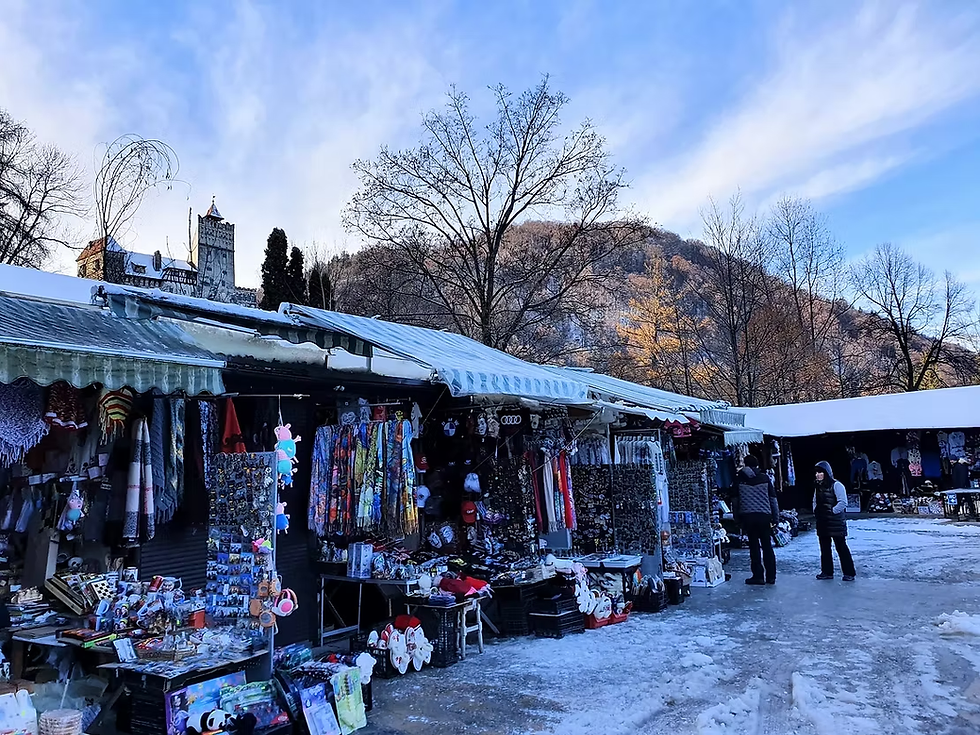
Arriving at the parking area, the contact with the present is abrupt. The bazaar at the foot of the castle, with its garish souvenirs and operetta vampires, reduces the figure of Vlad the Impaler to a plastic mask and a fluorescent T-shirt. It is still worth a careful look—not for shopping, but to understand how history is digested and rewritten by the market. The irony is evident: the voivode, who may have spent at most a single night here, is today omnipresent in kitsch.
Vlad the Impaler
Voivode of Wallachia, he fiercely defended the interests of his land. The merchants of Brașov suffered considerable losses due to his protectionist policies. The Ottomans, disturbed by his displays of independence, launched a campaign against him led by the sultan himself—yet it ended in a lamentable failure, following the psychological warfare masterfully conducted by Vlad, who relentlessly wore down the nerves of the Ottoman forces.

The Forest of Stakes
The climax: a forest of stakes on which were impaled, in the most painful manner imaginable, all the Turks he had captured up to that point. Ottoman chronicles describing how Vlad the Impaler shattered the morale of the immense Ottoman army were later read by Bram Stoker; his methods, marked by unparalleled cruelty, inspired the creation of the vampire character Dracula. Bran Castle, through its imposing structure and its position on the border with Wallachia, seemed the natural choice for the vampire’s residence.

The ascent toward the entrance, along the steep path to the right, brings a visible change in rhythm. The noise fades, footsteps slow, and silence begins to function as an unwritten rule. Once across the threshold, the castle imposes a discipline of movement and gaze. The weapons, armours, royal beds, and narrow passageways are not mere exhibits, but traces of a life lived under the constant pressure of danger.

The inner courtyard, dominated by the deep well, inevitably draws attention. It is a space where water, stone, and light gather into an ancient balance, and pausing here—even for a few moments—helps one understand the defensive and symbolic function of the castle. For centuries, Bran served as a major customs point between Transylvania and Wallachia. Taxes were levied here on salt, livestock, wine, and textiles, and the revenues sometimes exceeded those from local agriculture. Storage spaces for confiscated or in-transit goods confirm the fortress’s pragmatic commercial character.
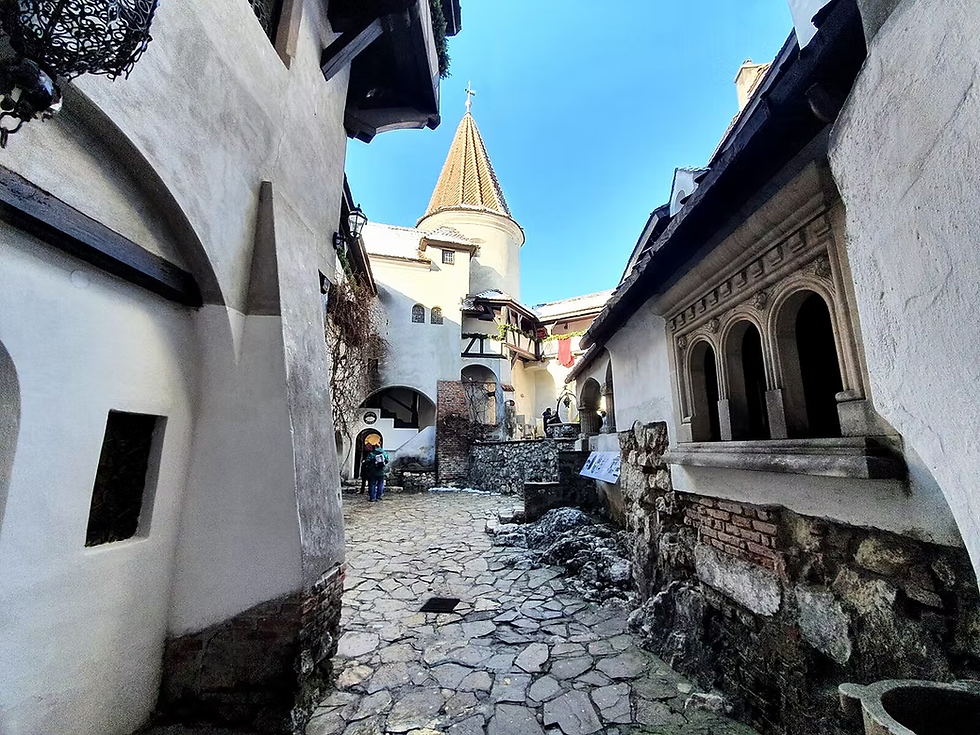
Relations between Vlad the Impaler and the merchants of Brașov were poor and generally unfavourable to the latter. Yet later generations embellished the story, placing Vlad at Bran—whether as fugitive or prisoner—within a castle owned by those same merchants. As a result, today the legend of his presence hovers over the castle walls, although documents do not confirm that he ever lived here.

Then “Dracula” entered the scene. And at that point, it was no longer only historical marketing—the “selling” of the site’s past—but also vampiric marketing. Consequently, his real absence contrasts with his symbolic presence, which has turned absence itself into attraction.

A beneficial turning point came in 1920, when the castle was offered to Queen Marie. Under her influence, Bran became humanized: electricity, running water, Art Nouveau and Oriental furnishings, and terraced gardens were introduced. The fortress became a residence, and the stone acquired an intimate dimension.

The view from the balconies, opening toward the Bucegi Mountains and Piatra Craiului, completes this transformation, inviting contemplation rather than defence. Queen Marie’s legacy is thus a more human castle, one that has lost none of its grandeur but has gained in splendor. She is also present in the childhood memories of my friend Irina.

Childhood Memories
In the 1980s, my friend spent several holidays in the village at the foot of the castle. Together with her parents, she was accommodated by the castle’s caretaker—a stroke of luck, as at that time only a few rooms arranged as a medieval art museum were open to the public. She, however, was able to wander everywhere, accompanying the caretaker in his daily tasks. She spent long hours in Queen Marie’s rooms, playing with dolls: she was the queen, and the dolls were the ladies of her court. Sometimes, even the caretaker joined in; he would play the messenger bringing the queen news of her king gone to war to defend the country. At other times, he took on the role of captain of the castle guard, leading her to inspect the walls and fortifications.

The Secret Tunnel
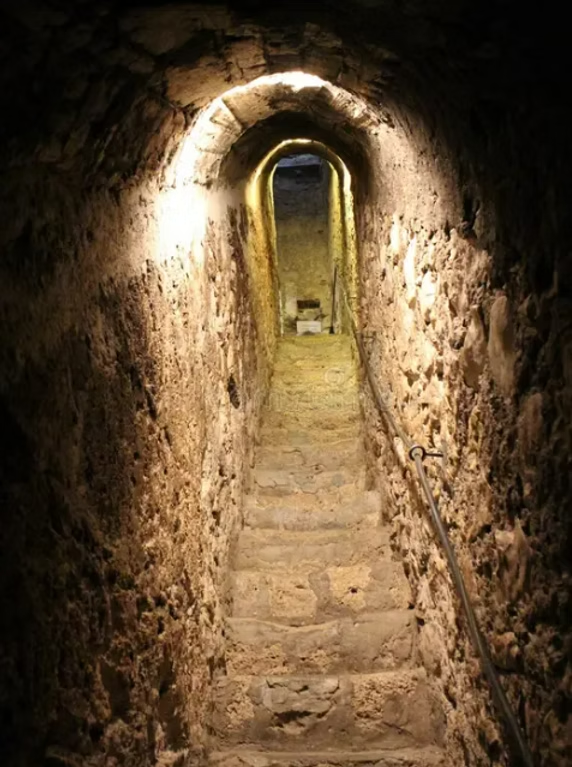
The caretaker also handled minor repairs, and this is how he discovered a secret passage. While fixing a wall, he noticed that it sounded hollow in one place. Continuing to tap around that area, he sensed the outline of an entrance. The next day, he returned with a larger hammer and a pickaxe and broke through the wall. To his great surprise, he uncovered a staircase leading to the queen’s chamber. According to a legend, a secret tunnel allowed her lovers to visit her, and this seemed to be that very passage. The caretaker, however, was convinced it was a ruse—that the passage had in fact been used to admit spies or other such figures in secrecy.
The Haunted Castle
The villagers—and especially the caretaker—firmly believed that the castle was haunted. Once, they lost track of time and night fell while they were still inside. The caretaker insisted they leave immediately. To shorten the way, they went through the forest; it was already pitch dark. Several times he looked back, saying he saw a ghost. My friend looked as well, but at first saw nothing. Then she, too, thought she saw a woman dressed in a white nightgown or perhaps a white ball gown. They grew more frightened and quickened their pace, almost running. When they finally reached home, they were breathless and deeply shaken.

Today, the castle is open in its entirety: 57 rooms connected by narrow staircases and secret passages. Some walls exceed four meters in thickness; the courtyard functions as a natural rainwater collection system; and the footprint remains surprisingly compact, at around 2,500 square meters. With over one million visitors annually, Bran is the most visited tourist site in Romania, receiving up to 8,000 people per day during peak season, most of them from abroad.

Bran Castle does not need vampires to impress. Its strength lies in the constant tension between truth and myth, between documented history and literary and cinematic fiction. A visit becomes truly memorable when experienced slowly, with measured steps and a willingness to leave space for questions. Perhaps this is the best way to conclude: not with certainties, but with the sense that history continues to be written each time it is traversed.

Comments