
PUY DE SANCY, THE GREAT VOLCANO
Summer of 2021: the moment has come to set out on a hike up the highest of France’s volcanoes. The most majestic, the most impressive. Their ‘chief’! The one we would come to call ‘The Great Volcano’: Puy de Sancy, 1,885 meters in altitude.

The name ‘Sancy’
Every year, on August 6, the inhabitants of the surrounding villages would climb up here, to the summit, in a pilgrimage held to honor the memory of Saint Sixtus (pope between 257 and 258). Around the year 1786, they began saying they were going to the ‘Puy de Saint-Sixte’; pronounced ‘Pè de San Chi’ in the local dialect, this eventually became ‘Sancy’ when it passed into French. Previously, this peak was called ‘Mondor’ or ‘Mont Dor’, after the noble estate on which it stood. Today, that name is carried by the village at the foot of the mountain.”

It is a magnificent mountain, famous throughout France. So we formed a wonderful team and set out on an expedition to discover its beauty on foot. Us: myself, Irina, my wife, and our children, Radu (the older one) and Vlad (the younger one).

Puy de Sancy: between geography and the reality on the ground
From a geographical point of view, Puy de Sancy is only the summit that bears this name, nothing more. But everyone — locals and tourists alike — firmly maintains that ‘Puy de Sancy’ is much more than that: it is the entire ridge that stretches around the village of Mont-Dore.

Geology proves them right, for Puy de Sancy represents the culminating point of the volcanic activity in the Dore Mountains, from which four volcanic peaks emerged, including this one. The formation process began 5 million years ago and ended around 250,000 years ago; at the end of this period, it is estimated that Puy de Sancy reached an altitude of 2,500 meters.

Later, massive landslides occurred, and erosion — especially glacial erosion — definitively shaped the summit. Today, it appears as a flattened cone, formed from a type of rock called trachyandesite. Geologists also call it ‘sancyt’, thanks to the renown of this wonderful volcanic mountain known and cherished under the name ‘Puy de Sancy’. Today, it is highly appreciated for its trails of various lengths and difficulty levels, and even more for its magnificent landscapes.

With and without fog
On the third day of our holiday, we arrived at the parking area at the foot of the mountain, ready for the ascent, well warmed up after the first two days (a story told in ‘The Waterfalls of Sancy’). Unfortunately, when we stepped out of the car, we were greeted by a… very beautiful fog!”

Stubborn and optimistic, we didn’t give up. We decided to take the cable car up to the summit, hoping that once we reached the top, we would be above the clouds and the fog. In four or five minutes, we covered a few kilometers and roughly 400 meters of elevation gain.
But at the end — surprise: it didn’t drop us off at the summit, but in front of a long staircase that reminded us of last year’s ‘Stairway to Infinity’ (a story told in ‘Puy de Pariou: The Magnificent’). Only this one was even bigger: 864 steps compared to 555 for the other, and an elevation gain of more than 100 meters.

No problem,’ we told ourselves. Well prepared and well rested, we began to climb with confidence and quickly realized it was going to be easier: the steps were wider and longer than on the other staircase; we could climb them more comfortably. Unfortunately, we were stubborn — but so was the fog. It refused to leave us alone, not even at the top of the mountain. So we took some very beautiful photos of ourselves and… of the fog!

After finishing our photo session, we set off on the trail toward Super Besse (a ski resort highly appreciated by the French, much like Sinaia is for Romanians). Our goal was the ‘Gros’ peak, located about 1.6 kilometers from Sancy. Be careful: on maps, its name appears as ‘Puy Gros’, but the locals insisted we should never call it that. Why? ‘Because here there is only one Puy: Puy de Sancy,’ they told us.

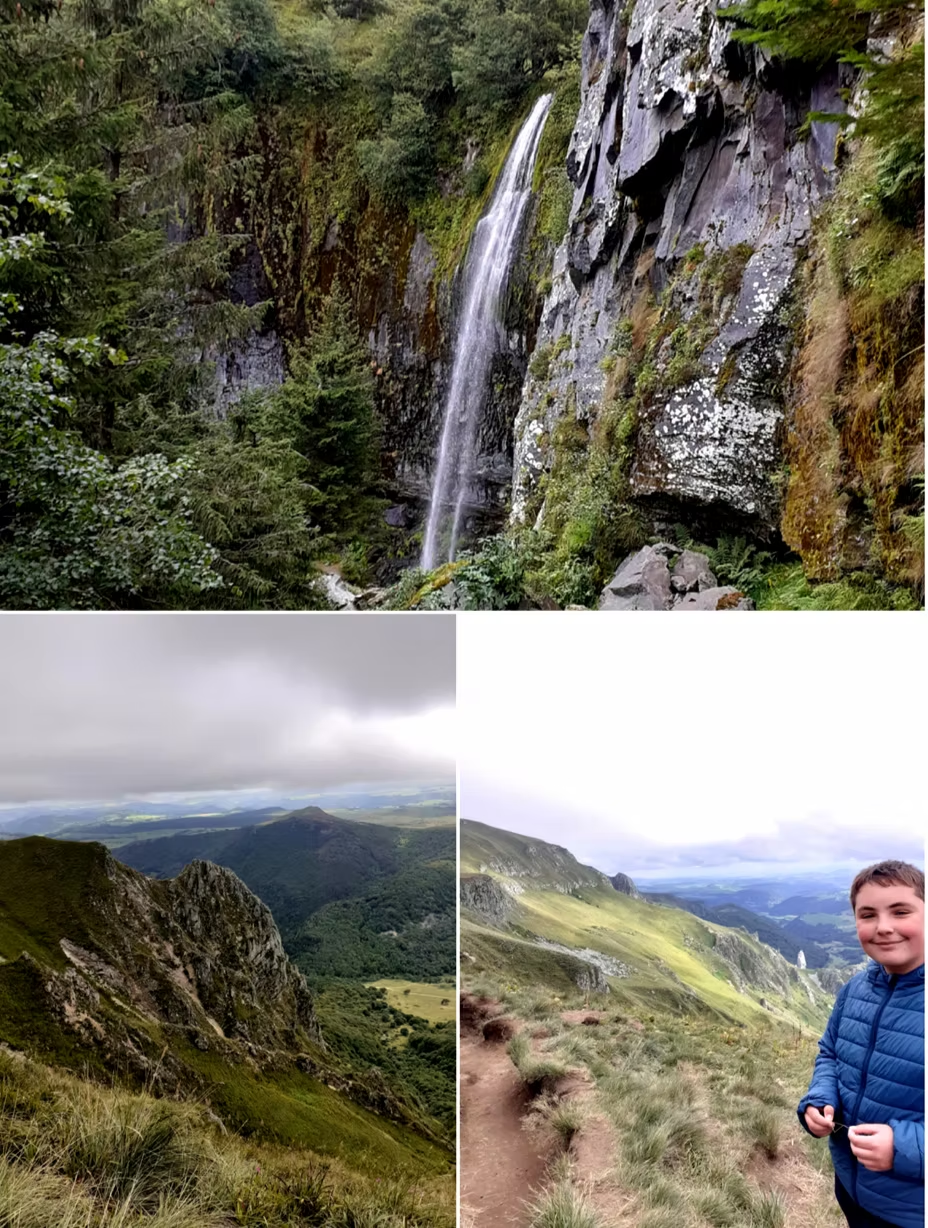
People say that fortune favours the brave. And it’s true: before long, the fog began to lift, bringing wider and wider smiles to our faces. Our eyes could finally delight in real wonders: magnificent views of the surroundings, especially of the Fontaine Salée valley and its lake, stunning even when seen from a great distance.

The trail was easy, with no technical difficulties: just a simple walk along a dirt path, with very few stones along the way and not a single rock block to climb over or go around. We could almost joke that there were more stones in the cairn marking the summit than on the path we followed.

An unfortunate incident reminded us that a mountain remains a mountain, even when it seems easy to walk, and that its rules must be respected in every situation. We must therefore pay attention to every step we take on these paths. The woman in a couple walking ahead of us had a bitter experience: one wrong step and a dislocation or sprain. We stayed with them for a while, lending her some of our clothes to keep her warm. Unable to continue her route, even with help, she had to be taken by a mountain gendarmerie helicopter and transported to the hospital for thorough examinations.

We returned to the parking area where we had left the car, on one of the ski slopes descending from the summit — a path scattered with plenty of stones. We walked it with our eyes fixed on the opposite ridge — tomorrow we would be hiking over there. Vlad even made a joke, inventing a new rule: that we should walk with one eye looking down, to see where we place our feet, and the other eye looking up, to admire the heights and the beautiful landscapes in front of us.

The long trail
The next day, we ventured onto what we would come to call ‘the long trail’: it starts from Puy de Sancy, more precisely from the cable‑car station, continues all the way to the ‘Grande Cascade’, then descends gently toward Mont‑Dore. A route of nearly 9 kilometers, with a positive elevation gain (uphill) of about 300 meters and a negative one (downhill) of roughly 1,000 meters. The path crosses the entire ridge between Puy de Sancy and the Grande Cascade (‘the Great Waterfall’).

Up to the entry point of the trail, we went by cable car; the posters at the lower station promised magnificent views as the cabin carried us swiftly toward our destination. A promise kept: on the way up, we were able to admire the wonders shaped by the mountain’s volcanic nature (!). Images of great beauty accompanied us as we climbed the staircase already mentioned above, the one leading toward the summit.

The route is described as the longest and most difficult in the massif. After completing it, we can confirm that it is indeed long. As for the difficulty, however, things need to be nuanced. Do not expect ‘difficulties’ like those you might encounter in the Alps: there are no stone‑covered paths you must step across, nor rock faces you need to climb to advance. Puy de Sancy is, after all, a volcanic mountain whose trails are mainly dirt paths, and the soil is prone to erosion — hence the need for protective structures.

Even so, for a volcanic mountain, our trail had its fair share of difficulties: climbs and descents that were more or less steep, and sections scattered with stones. There was even a rocky part that required a bit of agility and attention to cross, much to the great joy of our children. Later, while studying the maps, we discovered that it was a famous peak: Roc du Cuzeau, standing 1,737 meters high.

As we continued our walk, a strange rock formation seemed to say: ‘Hello. How is your day?’ it asked us. At first, we thought it was an artificial structure. After looking at it more closely, we understood that it had nothing to do with human hands, but with nature.
It was very likely the consequence of a volcanic eruption in the past — the result of a shower of stones expelled together with lava by a volcano. At the same time, it stood as a stone‑carved testimony that nature sometimes creates works that could make even a renowned sculptor die of envy.

As we approached the ‘Grande Cascade’, the terrain became less steep and less physically demanding. The vegetation, reduced to grass on the ridges, now gave way to bushes and small trees; they appeared timidly at first. There was even a staircase with built‑in steps on a fairly steep slope, designed to make the ascent easier and reduce the risk of slipping. Beautiful views of the surrounding ridges and of the town at the foot of the mountain were plentiful — a delight for the eyes, a balm for the soul.

‘La Grande Cascade’ is truly fantastic and impressive — a genuine work of natural art. We spent a pleasant moment there, admiring it and listening to it, amazed both by its grandeur and by the sound it produces: a powerful, resonant noise, yet soothing at the same time. Such a wonder can only be created by nature itself (a story told in ‘The Waterfalls of Sancy’).

Then we descended slowly, little by little, toward the town. Not because we were tired, but because we didn’t want to part too quickly from this majestic mountain and its thunderous waterfall.
“From Capucin to Sancy”
For our last hike in the magnificent Puy de Sancy massif, we set off from the “Funiculaire du Capucin” station. An industrial jewel from the late 19th century, declared a historical monument in 1984, this funicular embodies the charm of the Belle Époque (roughly 1871–1914, a period of spectacular cultural and artistic development).

The little train is still perfectly functional and climbs the mountainside at a speed of one meter per second — fast, dizzying, yet perfectly safe. It is the oldest electric funicular in France, and therefore ecological long before ecology became fashionable! Admire the Art Deco style of the departure station, and the large cogwheels that recall Chaplin’s film Modern Times, in the engine room at the upper station.

This time, the team was exclusively male, as Irina chose not to join us. She preferred to stay behind and rest in preparation for the last hike of our holiday, the one planned for tomorrow, which will take us to the summit of Banne d’Ordanche (a story told in ‘The Town and the Mountain’). Given the fog and wind that accompanied us the entire way shortly after we passed the Capucin peak, it was a wise decision!

From the funicular station, we needed about twenty minutes of walking to reach the ‘Salon du Capucin’. A branch of the main trail then leads us to the Capucin peak, located at 1,468 meters of altitude and accessible after an ascent of roughly 100 meters of elevation gain.

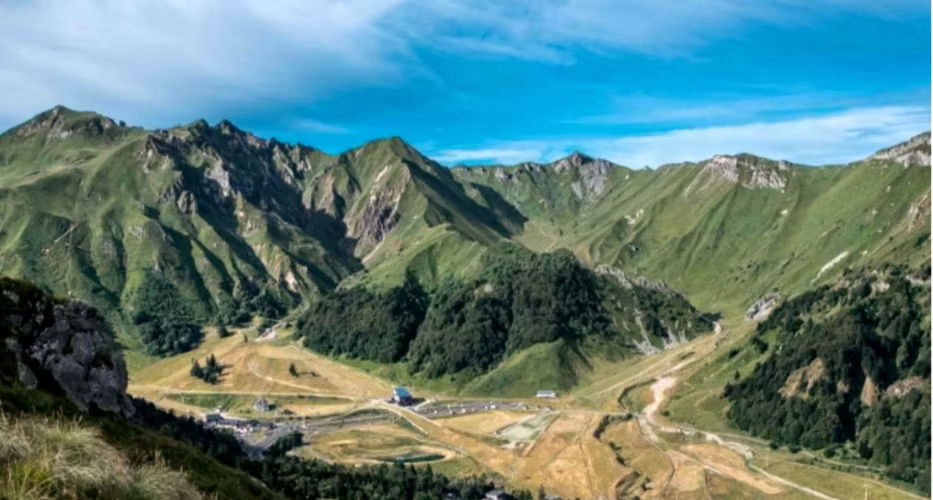
Of course, this ascent required a certain amount of physical effort. But it was worth it: from up there, we had a wonderful view of the town of Mont‑Dore, as well as of the Sancy ridge with its magnificent rock formations.

In short, we made a good trade: a bit of effort in exchange for visual wonders. And we came out ahead. It would later turn out that we truly needed such a reward, because what followed was… complicated. The fog enveloped us from the moment we began the ascent of Puy de Cliergue (1,691 meters), on a stony path protected by wooden palisades against falling rocks and landslides. It was so dense at the summit of Tour Carré, at 1,746 meters altitude, that we saw nothing of it except a vaguely pyramidal shape. Once we reached the ‘Pas de l’Âne’ pass, we decided not to continue toward Puy de Sancy, but instead to take the descent trail leading back to town.

We wanted to take a walk to traverse, discover, and admire the ridge from Capucin to Puy de Sancy, with the wonderful creations of nature we had admired so much in photographs and, a little, from afar when we were on Capucin. But the capricious weather hid them from us, offering fog and strong winds instead. What should have been a demanding but pleasant hike turned into an endurance test. We could have turned back, we could have given up, but we chose to continue, to keep moving forward. A mountain is not only sun‑bathed peaks and slopes covered in pure white snow. A mountain also means rain, wind, fog — unfavourable weather conditions.

And when you love the mountain, as we love it with passion, you love it in all its forms. So when we finished our hike, we took one last look toward Puy de Sancy and said: ‘Thank you from the bottom of our hearts, our dear volcano, for all the wonders you allowed us to discover and for all the beautiful moments we spent together.’

Comments