
GOAT ISLAND: THE MARINE SANCTUARY AT THE BEGINNING OF THE WORLD
We left Auckland early in the morning, at a moment when the city itself had not yet decided whether it wanted to become day or merely remain an extension of the night. The buildings stood frozen in an undecided light, and the asphalt still held the coolness of a rare urban silence. We packed simple things — a blanket, picnic food, snorkelling masks and tubes — like modest amulets, necessary for an encounter that was meant to be more than an excursion.

The children watched the road with a clear, almost physical impatience. It was their first visit to a marine sanctuary, their first entry into a space where life is not defended, but allowed to exist. In their eyes one could read that fragile mixture of curiosity and fear that precedes all true discoveries.

Toward a World Where Nature Sets the Rhythm
The drive north unfolded without haste, like a slow and methodical unlearning of the city, a gradual detachment from its metallic noise. We left Auckland behind and moved toward our destination on a flawless highway, smooth and self-assured, cutting through gentle hills like a well-matured cheese — without hesitation and without regret. Our first stop was the famous satellite town of Matakana, a place that does not assert itself, does not exhibit itself, but allows itself to be inhabited with an almost aristocratic discretion. Set among orderly vineyards and hills rounded by time, polished by repeated rains and summers, this corner of the Kiwi landscape seems to have grasped a rare and essential truth: authentic beauty is not explained or proclaimed — it is breathed in.

We stopped for a dense, warm coffee with a velvety bitterness, and for a few pastries chosen by the children with a sense of ceremonial importance that quietly moved me. Matakana was the necessary pause — a stop with an inner rhythm, a deep breath before the sea. Beyond it, the air changed almost imperceptibly. It thinned, cleared, began to smell of salt and promise. The ocean was not yet visible, but it was already present — insinuating, self-assured, like an idea that precedes form, like an old thought searching for its shore.

Te Hāwere-ā-Maki
Goat Island, known by its Māori name Te Hāwere-ā-Maki, is a tiny island — barely a hectare of land, two and a half acres of rock and grass — that seems to float at the edge of the world, suspended between water and sky. Shy in its placement off the coast of the North Island, north of Auckland, northeast of Warkworth and directly west of Little Barrier Island, it occupies less a position on the map than a precise silence in the landscape, a point of balance where the sea gathers its breath.

This marine jewel lies at the heart of the Cape Rodney–Ōkakari Point Marine Reserve, the first marine reserve in New Zealand — a territory of protected waters where human laws step back, and time is measured not in clocks, but in the pulse of currents, the migration of fish, and the slow patience of submerged rocks.

The Origin of the Name
The name “Goat Island” bears the mark of the harsh pragmatism of early European navigators — men of simple calculations and uncertain horizons — who left goats on the island as faithful survivors, a living pantry entrusted to time, for shipwrecked sailors. Feeding on wild foliage and wind-shaped shrubs, the goats turned the small island into a refuge of elemental life, a silent store of hope, where hunger and despair could, at least temporarily, be postponed.

The official name, Cape Rodney–Ōkakari Point Marine Reserve, reflects the rigor of ecological protection and the precise language of modern conservation. The local name, by contrast, preserves the echo of a rougher age, when goats wandered freely along the rocky shore like domestic silhouettes in a still-untamed landscape. The original Māori name, Te Hāwere-ā-Maki, reaches deeper still, carrying the layered memory of the place — its spiritual roots and ancestral presence, the enduring bond of the Ngāti Manuhiri people with this island, small in size yet vast in meaning.

The island is also a spiritual sanctuary. It is said that the ancestral waka of Ngāti Manuhiri, Moekākara, landed nearby, leaving invisible yet profound traces in the soul of the place — a memory that cannot be seen, but can be felt. In 1975, with the establishment of the Cape Rodney–Ōkakari Point Marine Reserve, Goat Island and its surrounding waters came under protection, becoming a territory where nature sets its own laws and dictates the rhythm of life. Beyond its marine status, Goat Island is also a scenic reserve: a sober, living tableau where sea, sky, and rock meet in an unhurried harmony, untouched by the impatience of the modern world.

Children Discover Marine Life
On the shore, close to the island, the University of Auckland established the Leigh Marine Laboratory, a place of quiet research and scientific patience, led by Professor John Montgomery, which would later become the nucleus of the South Pacific Centre for Marine Science (SPCMS). Here, dozens of marine biologists are trained — guardians of a fragile balance and of the submerged beauty of these waters, attentive witnesses to a world that breathes beneath the surface. The national and international fundraising campaign for SPCMS was launched at Leigh on 21 June 2008 by Prime Minister Helen Clark, a symbolic gesture of commitment extending beyond the island toward the shared future of the oceans.

In practical terms, Goat Island is a place of survival and layered memory: the goats that inspired its name opened the way through a brutally simple solution to maritime uncertainty; the dense and exuberant marine life consolidated the legend; and modern, lucid protection now guarantees the continuity of this fragile world. Takangaroa, another island in the same area, once bore the same name, reminding us that these seemingly insignificant fragments of land have been, and continue to be, silent witnesses to a history that is not proclaimed, but slowly written, between shifting waters and ancient winds.

At Goat Island, we chose not to enter the water immediately. First, we went to the Marine Discovery Centre, a modest yet indispensable space where the sea tells its story before revealing itself — a lesson in patience. There, the children encountered life in its quiet and vulnerable forms: sea urchins like miniature planets, soft and strange sea cucumbers, almost unreal in their fragility, starfish with their calm geometry, withdrawn crabs, shells and molluscs — fragments of an old, slow order, older than us and infinitely more consistent.

They held them in their palms with near-ritual care, as if touching a fragment of the sacred, a spark of life deserving of respect. Gradually, fear receded, and confidence rose like a gentle tide. Their gestures became steady, their gazes bright and open to the miracle of small beings. In this slow transformation, I recognized the essence of true learning: not the accumulation of information, but the birth of a relationship — fragile, attentive, and deeply connected to the rhythm of life.

Here, in this direct contact with primordial nature, lies real education — not in beautifully edited documentaries with perfectly coloured images, and certainly not in the cold, impersonal glow of screens. Here, in the delicate touch of a sea urchin or the contemplation of a motionless starfish, patience, respect, and wonder are learned — lessons no film can fully convey.

We learned many things about the reserve, but the children were struck by a single fact: it is the first marine reserve in the world. For us adults, the emotion came from another direction. We realized that we had arrived almost fifty years after its establishment, at a moment of maturity, when the reserve had received approval to triple its protected area.

News that makes no noise, yet quietly reshapes the future — like a stone thrown into a still lake, its ripples spreading slowly and surely. Then we descended to the water, ready to immerse ourselves in the world waiting for us with its silence and abundance.

The Transparent Waters of the Marine Reserve
The beach is small, harsh, devoid of aesthetic concessions or tenderness. But the water — the water is a clear alphabet, an unwritten code you read with both eyes and soul. Transparent, profound in meaning, threaded by silent currents, it dances continuously, carrying within its movements an order of its own. Fish pass beneath swimmers’ feet with disarming naturalness, as if humans were, for a few hours, a temporary and accepted presence — invisible guests who do not disturb the ancient rhythm of underwater life.

Faces submerged, breathing tubes like thin threads stretched between two worlds, people float and watch. They do not conquer. They receive. There are glass-bottom boats and transparent kayaks — instruments of a modernity that, on rare occasions, knows how to be humble and invisible before the silent spectacle of nature. Every movement becomes a discreet bow before a world that exists before and beyond us.

The Mysterious Kelp Beach
At a short distance, we discovered what the children called “the mysterious beach.” One reaches it through the water, crossing tall, wet rocks, as if passing a symbolic threshold — a gate between the familiar world and a hidden enclave, where kelp dances in the currents and light filters through shades of green and gold. Each step in the water seems to reveal another story, an unseen map of underwater life that patiently guards its mystery.

Here, marine erosion writes history directly into stone, carving slow and deep narratives, while the kelp forest rises dense and dark green, like an underwater cathedral, with its fluid spires and columns swaying to the rhythm of the currents. Each long, glossy frond resembles a living stained-glass window, filtering light and transforming the water into a silent, sacred sanctuary.

From this forest, stingrays emerge without haste, gliding beside you with indifferent grace, like elegant shadows that refuse to be possessed. In that moment, any illusion of control dissolves in the water; all that remains is a rare and fragile sense of temporary belonging — a tacit understanding between human and nature, between our fleeting presence and the eternal rhythm of underwater life.

At the end, I asked the children which fish had seemed most present to them. Their answer came simply, almost solemnly: snapper, trevally, mullet — a small list, yet enough to anchor a living memory, a fragment of the world carried forward in their minds and souls, like a precious stone lifted from the depths.

Where Time Slows, and Humans Learn to Receive, Not Conquer
Toward evening, we packed our things and carried them back to the car. We took one last slow walk along the nearly deserted beach as the light gradually withdrew, like the deep breath of the day, leaving behind long shadows and warm tones — a silent reminder of nature’s gentle rhythm. Each step on the sand seemed to gather all the encounters of the day — the sound of water, the children’s gazes, the grace of underwater life — and preserve them in a precious stillness, where humans do not rule, but allow themselves to be carried.
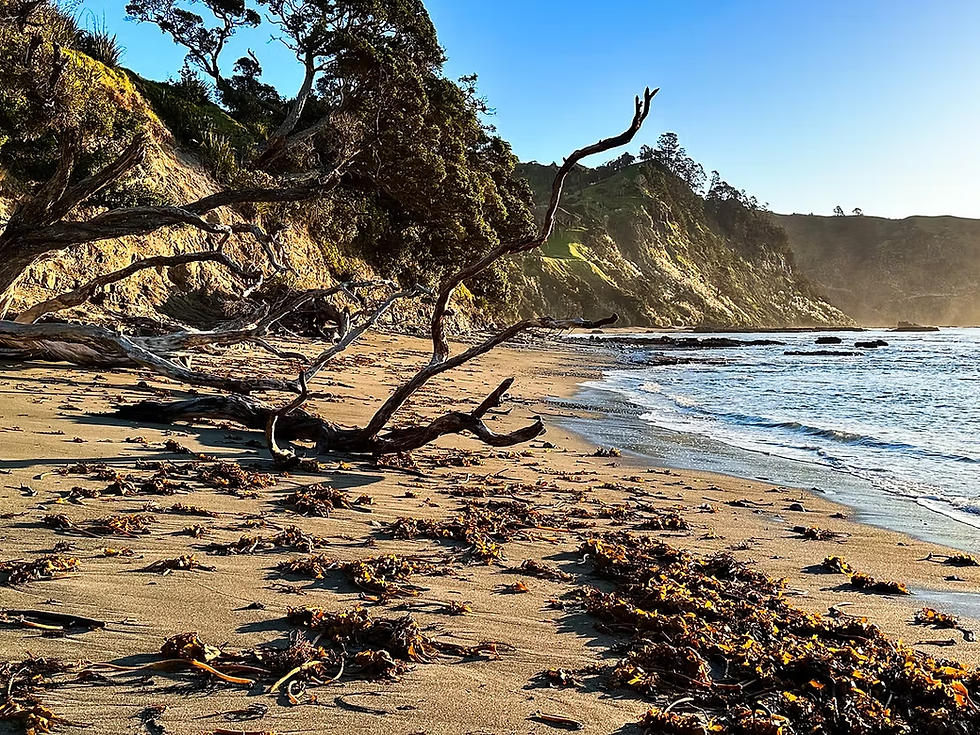
The place did not close abruptly; it allowed itself to be left with patience, like a door that shuts on its own, without noise. The road back to Auckland was long and quiet — an hour and a half in which no one felt the need to speak. Some places do that: they do not exhaust you, do not excite you with fireworks; they realign you, with a touch of nature that understands that true balance is gained in silence and time.

Perhaps true luxury lies neither in distance, nor in exclusivity, nor in the accumulation of spectacular experiences. Perhaps it is this rare moment when time slows, and nature receives you — for a few hours — with its silence and patience, allowing you to look at it as it is, without disturbing it, without conquering it.

And so we left with slowed steps, carrying with us not spectacular memories, but a rare calm, like an invisible thread binding humans to the sea. In the children’s eyes — and in our own — remained the echo of pulsing water, of swaying kelp, of fish passing undisturbed. Goat Island never truly disappears; it settles within you as a silent understanding: that presence need not dominate, that beauty does not demand haste, and that time, sometimes, pauses only to let you breathe alongside the living world.

Comments