
THE FILM “LICEENII” – A CHRONICLE OF OUR ADOLESCENCE
'Liceenii' is not just a film. It is a moving photograph of a generation caught at the precise moment when childhood retreats and adulthood has not yet learned how to speak. It appeared at exactly the right time: just as the two inseparable friends, George and Angelo, were turning sixteen and stepping for the first time into Year 9 at Mihai Viteazul High School, in 1986. The film did not accompany our adolescence—it opened it. The fact that the story was shot in one of our rival yet kindred schools, Mathematics–Physics High School No. 3, adds a subtle layer of urban mythology. The screen becomes a secret map of the Bucharest of our adolescence, and rivalry takes on the air of a blood bond: we quarrel, but we belong to the same world.

The corridors, the classrooms, the teachers—all seem borrowed from our daily reality, infused with the smell of chalk, poorly concealed emotions, and dreams still untouched by cynicism. Liceenii works because it forces nothing. Emotions are direct, naïve, sometimes awkward—exactly as we were then. Loves are overwhelming because they have not yet learned how to be small; conflicts seem final because time has not yet learned how to heal. The film neither moralises nor mocks adolescence: it takes it seriously. And that is its greatest act of respect. Seen today, the film has the innocence of an old diary. Seen then, it was a mirror. For our generation, Liceenii was not merely a cinematic success, but a rite of passage. A film that told us, without raising its voice: “This is where everything begins.” And the story begins like this.

To begin with, it is worth fixing a few brackets around this beautiful film, placed within a sentimental trilogy that definitively shaped our generation’s adolescence: preceded by 'Declarație de dragoste' (Declaration of Love) and followed by 'Extemporal la dirigenție' (Quiz with the Homeroom Teacher). 'Liceenii' was directed by Nicolae Corjos and features a cast that today reads like a handbook of recent Romanian cinema: Ștefan Bănică Jr., Mihai Constantin, Oana Sârbu, Cesonia Postelnicu, Tudor Petruț, Tamara Buciuceanu-Botez, and Ion Caramitru. The story follows the romance between two tenth-grade students—one year older than us at the time—Mihai Marinescu and Dana Vasilescu, an adolescent love told without grandiloquence but with disarming sincerity. Not by chance, the film ranks 25th among the most-watched Romanian films of all time, according to the Romanian Union of Film Authors and Directors.

A film review is usually meant to summarise the plot and spark the reader’s desire to watch the story unfold on screen. What follows does not obey that rule. It is less about the film and more about us. It is a return in time, a recollection of our adolescence, filtered through the images, lines, and emotions that Liceenii fixed forever in memory. The film becomes a pretext and a key—a key attempting to unlock experiences, feelings, and a tumultuous life lived between the harshest years of communism and, paradoxically, the most beautiful years of our lives.

After failing mathematics in Year 9, the “provincial” students Mihai Marinescu and Ionică Popescu—roommates at the boarding school—study all summer and manage to pass the autumn exam. A dramatic situation in the film, but one perfectly recognisable to us. At that point, my memory stirs with a tender pain and a pride hard to explain: how many times were we too threatened by the spectre of failing, thanks to our “love” for mathematics, physics, and chemistry. Because at Mihai Viteazul—just as at Math–Physics No. 3—the profile was clear and merciless: mathematics and physics. That is, Isoscel Munteanca at the blackboard, without appeal and without negotiations.

Unlike Ionică, who earns a decent, salvational, profoundly existential 5, Mihai gets a 10, with the air of someone solemnly swearing never to repeat the experience—especially with the ominous Second Level exam looming ahead, a miniature baccalaureate that haunted our dreams and shortened our nights. An exam that Angelo and I passed by the skin of our teeth, with pride, preoccupied—as was only natural—with far more serious matters: life, friendships, freedom, and the eternal question of whether we would still find tickets to the cinema.

The homeroom teacher of Class 10B is the philosophy teacher Mihai Gavrilescu, played with distinction by Ion Caramitru. Students nickname him “Socrates”. Here our inevitable personal digression intervenes: we were in Class J, not B, and this raises the first great existential question—how on earth had Ionică (our cinematic alter ego) ended up precisely in the second class of the school, the ultimate nest of swots? A pedagogical mystery unresolved to this day. But let us return, with due discipline, to the film. Mihai is secretly in love with his classmate Dana Vasilescu, to whom he periodically slips a carnation into the desk drawer—a romantic, discreet, and extremely risky gesture in a communist high school, where flowers could become incriminating evidence. I also remember the price of a carnation at the flower shop near Dristor metro station: 2 lei—a luxury that today feels both comic and nostalgic.

Dana, however, is the girlfriend of Șerban Pascu, the class’s prize student, and naturally assumes the flowers come from him. The plot quickly slides from the sentimental into the politico-administrative realm, as the film contains numerous propaganda elements—which, of course, meant nothing to us at the time. At a meeting of the UTC Youth Organisation Bureau, Șerban is accused of malice and individualism, while Dana, with an ideological zeal worthy of a socialist education manual, plays a decisive role in his removal from the position of secretary.

Replaced, humiliated, and betrayed, Șerban discovers that personal interest and collective interest coexist poorly, both in politics and in love. Love breaks, like a badly sharpened pencil, and adolescence continues its chaotic march among flowers, grades, meetings, ideals, and first great disappointments—but with a hidden smile and the sweet nostalgia of years in which every gesture, however small, seemed to mean everything.

In order to get closer to Dana, Mihai begins to study chess, hoping to impress her—she being a champion of the game. I remember fondly how we too played chess during our high school years. Mihai takes part in a simultaneous exhibition and is praised by Dana, a moment in which his shyness seems to dissolve under her approving gaze. But adolescent love knows no rational limits: Mihai offers to help with a paper for the literature club, while at the same time refusing the stern Baldovin (“Isoscel”)’s invitation to participate in the Mathematics Olympiad. Thus, dedicating himself to a lost heart and to cultural ideals, he neglects his lessons and begins to receive low grades, to the disappointment of his father (played by Sebastian Papaiani), who had hoped for flawless results.

Here I must intervene and explain that we, for exactly the same reason—out of profound dedication to Romanian culture and sheer respect for our great writers—spent entire days in the school bookshop, devouring books with an enthusiasm worthy of a nobler cause. Today, this dedication may seem both adorable and absurd. Returning to the story, the moment of reconciliation comes at the party organised by Șerban for his seventeenth birthday, when Mihai and Dana make up.

Yet Mihai understands, with a mixture of sadness and unexpected maturity, that Dana will never be more than a classmate. Life demands more serious choices. He dedicates himself to study, as his late mother would have wished, and his grades steadily improve, to his father’s pride. And, as in any Romanian high school charged with emotion, sporting incidents are not absent: during a football match, Mihai is struck by Vlad, and Ionică—convinced the aggression was intentional—trips the opponent, causing a leg dislocation. The homeroom teacher intervenes promptly, sanctioning Ionică with a warning and three weeks of confinement in the boarding school. Irony of fate: Vlad later wins first prize at the National Mathematics Olympiad, proving that strategies on the field and in life only coincide with delay.
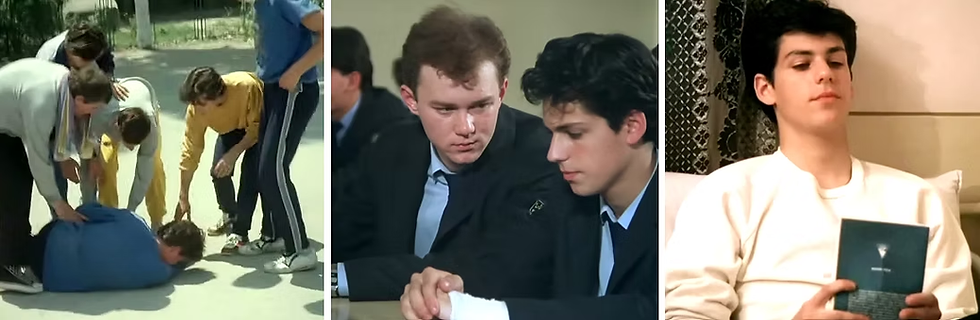
Years later—as a song by Compact B put it—I met Cătălin Păduraru and we became very good friends. This entire moment in the film carries the bittersweet blend of adolescence: love, ambition, excess, and life lessons, all condensed into a summer and a school year captured with a nostalgia that still makes us smile today. At the mathematics exam, Mihai refuses to help Ionică, after repeatedly trying to convince him to study instead of wasting time. Here I must again recall our famous classmate Mărgineanu, nicknamed “Mărgică”, who always saved us in important exams—Mathematics, Physics, and especially Chemistry—helping us secure that miserable yet vital 6 that allowed us to pass the term. Glory to you, Mărgică!

Returning to the matter, Șerban criticises Mihai for ignoring the interests of the class, while Dana realises that her boyfriend is selfish and individualistic, demanding from her classmates an attitude he himself despised. The two break up again, in a moment typical of confused adolescence: strong passions, pride, and helplessness. Soon after, Dana notices she is suffering from vision problems but refuses to confide in others. Mihai learns of her medical issues through Ionică, who, after secretly reading a few lines from Dana’s diary, informs Socrates. The teacher immediately speaks to her parents, demonstrating that responsibility and compassion are not merely lessons from textbooks. In the final week of the school year, Ionică is tutored in mathematics by Mihai and manages to pass, thus avoiding failure. In a gesture that closes the circle of small adolescent cruelties and tendernesses, he convinces his roommate to place a flower in Dana’s desk just as she enters the classroom. She finally realises who had been slipping her flowers throughout the year. All students pass the Second Level exam, and Mihai and Vlad obtain top marks. Dana congratulates Mihai, and he gives her a piece of jewellery that had belonged to his mother—a symbol of affection and maturation. They kiss, and the film ends like a small epic of adolescence: loves, ambitions, small victories, and life lessons, all unfolding under the sign of nostalgia and that inner smile only high school years can offer.

Beyond the immortal song Ani de liceu, which echoed like a warm breeze through the corridors of Mihai Viteazul High School, Liceenii remains the film of our hearts—the mirror of an adolescence in which every moment felt longer, more vivid, more magical. Skipping class was not merely an escape; it was a small act of freedom stolen from time, and walks through the park transformed familiar paths into territories of discovery, with laughter filtering like light through leaves. Parent–teacher meetings carried the unmistakable aroma of tenderness mixed with restrained fear: mothers smiled tensely, fathers cleared their throats, and we sat upright in our desks like minor defendants, convinced that any rustle of the grade book could change our destiny.

Meanwhile, our grand plans—bringing frogs to school for dissection or heroically procuring a few bottles of alcohol for legendary “tea dances”—inevitably turned into comic epics with predictable, moralising endings, which today provoke a broad, gently melancholic smile.

Escapes from the boarding school, Ionică’s memorable disguise as a woman, small adolescent conspiracies and innocent pranks cast a warm, nostalgic, almost tender light over the film. The music of our youth vibrated through classrooms and through our souls, blending with the smell of chalk, the emotion of stolen glances, and the impatience of breaks that were always too short.

Even the lathes, the patriotic labour, and the so-called “practical” classes—heavy and absurd at times—became opportunities to test our courage, our patience, and above all our imagination, the only true form of freedom we possessed.

Every scene in Liceenii pulses with humour, timidity, awkward first loves, and small rebellions that did not topple systems but shaped characters. It is the diary of days when time flowed slowly along school corridors, and classmates’ laughter mingled naturally with hurried footsteps and still-unformed dreams. Liceenii is not merely a film, but a discreet call to our own memory: to the years when high school was not just a building, but a complete universe—intense, sometimes ridiculous, often innocent—a place where we learned, without knowing it, what it meant to be young.

This simple yet extraordinarily relevant film for us turned forty this year. Four decades that burned like candles in the wind: they took away our childhood, our adolescence, perhaps even our loves or our smiles, but left us the memory of a beloved school and of a fragile yet incomparable freedom, even within the tightest cage of communism. Memories now flow like a burning river, full of golden reflections, where every smile, every book read, and every timid gesture of love remains immortalised forever—and nostalgia turns into a fire that still burns within us.



Comments