
THE GENDARME AND THE ALIENS (1979)
'The Gendarme and the Aliens' ('Le gendarme et les extra-terrestres', in original), directed by Jean Girault and released in 1979, is the fifth installment of the celebrated Gendarme series and once again places the incomparable Louis de Funès at its center, in the role of Sergeant Ludovic Cruchot. The film preserves the mechanics of French burlesque comedy that made the series famous, while introducing a theme that was unexpectedly modern for its time: an alien invasion, filtered through popular humor and absurdity.

The joy this film provokes is inseparable from de Funès’ acting artistry. If I had a dollar for every viewing, I could afford a trip to France, complete with an inevitable pilgrimage to the Gendarmerie of Saint-Tropez. Not out of tourist nostalgia, but out of an almost ritual respect for a cinematic universe that shaped childhoods and educated our instinct for high-quality comedy.

Louis de Funès was, is, and will remain one of my favorite actors—quite possibly the greatest comedian in European cinema. His performance is not limited to grimaces or nervous explosions, as superficial readings often suggest, but is the result of an extremely rigorous construction: impeccable rhythm, complete bodily control, gestural precision, and a rare comic intelligence. In this film, every twitch, every panicked or triumphant glance becomes a genuine lesson in acting.

“Fufu,” as generations of viewers affectionately nicknamed him, builds his characters out of a tense, choleric energy that seems inexhaustible. His strength lies not in memorable lines, but in the pure expressiveness of the body: the calculated grimace, facial spasms, bulging eyes, abrupt, almost convulsive movements. Dialogue often becomes secondary, merely a trigger for the visual spectacle of his performance. De Funès plays from pure tension. His characters always seem on the verge of a nervous breakdown, caught between the desire for absolute control and a world that constantly slips out of their grasp. This rage, pushed to caricature, is never chaotic, but meticulously choreographed, with an almost musical precision—like a jazz solo that only appears improvised.

In the Gendarme films, as well as in 'The Miser' or 'Wing or Thigh', the actor proves he can say everything while uttering almost nothing: a raised eyebrow or a mute explosion of fury is worth entire pages of dialogue. Cruchot is not merely a character, but a perfectly calibrated comic mechanism, which de Funès manages to reinvent from film to film without altering its essence. In his confrontation with the “aliens,” his genius perhaps shines most clearly: the real battle is not with the invaders, but with the absurdity of the world, with the disbelief of others, and ultimately with the human condition itself—all transformed into a comedy of contagious vitality.

The action unfolds, as in the previous instalments, in Saint-Tropez, which has become the mythological space of the Gendarme. The calm of the seaside resort is disturbed by mysterious appearances and rumours of beings from another world. Cruchot is the first to “sense” the danger, but, true to the comic logic of the series, no one believes him. From this premise arise delicious confusions and memorable gags, built on the contrast between rigid authority and the inexplicable UFO phenomenon.

Cruchot and his colleagues receive a mission as improbable as it is entertaining: saving the residents of the elegant Côte d’Azur town from an invasion of oil-hungry extra-terrestrials. Since there are no visible differences between the visitors from space and the local population, the gendarmes discover an identification method that is as simple as it is absurd: sound. When struck on the chest, the aliens produce dull, metallic noises, like empty canisters. From this discovery to the outbreak of general chaos, there is only one step. In their investigative zeal, the gendarmes end up frightening and irritating all the inhabitants of Saint-Tropez, turning the town into a theatre of confusion and unforgettable gags.

The extra-terrestrials are not threatening monsters, but perfect doubles of humans—cold, mechanical, almost lifeless—an ideal pretext for exploiting de Funès’ unmistakable facial mimicry. The scenes in which Cruchot desperately tries to prove that certain characters “are not human” rank among the funniest in the entire series.

From a historical perspective, the film captures the fascination of the 1970s with UFOs and science fiction, translated into an accessible comic key. It is also one of Louis de Funès’ final films, made during a period marked by health problems, which only increases its emotional value for admirers.

Scene of the Film
The film’s climax is undoubtedly the legendary scene in which “Fufu,” disguised as a nun, is hunted by his own colleagues under the suspicion that he has gone mad. It is a moment of pure comedy, in which Louis de Funès displays his entire acting arsenal: deliriously precise facial expressions, gestures controlled down to the millimetre, and that inner tension which explodes comically with every screen appearance.
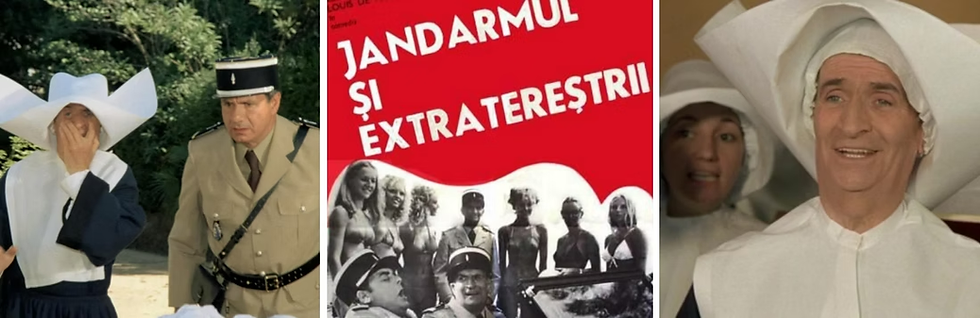
His performance is simply sensational. The encounter with the cardinal, culminating in the improvised song at the end of the meeting, reaches a level of refined absurdity that turns the scene into an iconic moment of European comedy. The “nun’s” escape by bicycle, the chaotic chase, and the successive mix-ups that follow push the sequence to a rare comic peak. Through this scene, the film secures a privileged place in the history of the series, and de Funès’ performance once again confirms his unique status: an actor capable of transforming a grotesque situation into a masterpiece of comic precision. For many viewers, this sequence is not only the best in 'The Gendarme and the Aliens', but one of the most memorable of the great actor’s entire career.

The Gendarme and the Aliens remains one of the most imaginative and enjoyable episodes of the series, proving that grand themes can be parodied without losing popular charm. The film was followed by 'The Gendarme and the Gendarmettes' (1982), which definitively closed one of the most beloved comedy series in European cinema.


Comments