
UNDER TIA’S CLOAK: A CRUISE ON LAKE TAUPŌ
- angelogeorge988
- Oct 1, 2025
- 7 min read
Lake Taupō stretches like an inland sea in the heart of New Zealand’s North Island, the largest body of fresh water in the Southern Hemisphere, covering 616 km² and reaching depths of up to 186 metres. It was born of cataclysm: a colossal volcanic eruption some 26,500 years ago, when the sky darkened and the earth was redrawn by fire and ash.

The article that follows will take you on an enchanting cruise across the tranquil, mysterious waters of this remarkable lake, where the sky’s reflections merge with the emerald shades of the shore. Every ripple seems to whisper ancient stories, and the breeze drifts like a gentle song caressing the traveller’s spirit, weaving a symphony of stillness and beauty. And if you wish to join this voyage, all you need to do is follow its film, which at the end will carry you into a tale that lingers in the heart.

The vast volcanic caldera left behind slowly filled with clear waters flowing down from the surrounding slopes, joined by the ceaseless current of the Waikato River, New Zealand’s longest. Thus was born a lake that at times feels closer to myth than to reality.

It is no accident that Jules Verne placed it in his pages as a geography of dream and adventure, showing that the grandeur of Taupō surpassed the borders of New Zealand and entered the realm of universal imagination:
“An unfathomable hollow, twenty-five miles long and twenty wide, was formed in a single day, long before historical times, by the collapse of caverns amidst the trachytic lava in the centre of the island. Waters rushing down from neighbouring heights poured into this enormous cavity. The hollow became a lake, yet it remained an abyss, for even now sounding lines fail to reach its bottom. Such is Lake Taupo, raised 1,250 feet above sea level and dominated by a chain of mountains 800 metres high. To the west, lofty rocky ranges; to the north, isolated forested hills; to the east, a vast plain crossed by a road and rich in limestone, glistening beneath the shrubs; to the south, volcanic cones rising beyond the first lines of forest. All these encircle majestically the immense expanse of water, whose terrifying storms resemble the cyclones of the ocean.” (Jules Verne, In Search of the Castaways, 1867)

That famous eruption of the Taupō volcano hurled clouds of ash into the skies, darkening them as far away as Asia and Europe. Centuries later, around 180 CE, another eruption—so powerful that it was recorded in both Chinese and Roman chronicles—reshaped the landscape again and enveloped the lake in an aura of mystery, making it a land of legend and eternal stories.

“The whole region boils like an immense cauldron suspended over subterranean flames. The earth trembles beneath the activity of the central fire. Warm vapours spurt out in places. The crust of the earth collapses with a roar, like a cake too heavily laden, and doubtless the plateau would sink into a fiery furnace if, twelve miles away, the imprisoned vapours did not find an outlet through the craters of Tongariro.” (Jules Verne, In Search of the Castaways, 1867)

For the Māori, Taupō-nui-a-Tia is more than a lake—it is a sleeping ancestor, a living presence pulsing beneath the deep blue waters. Its name means “the great cloak of Tia”, recalling the Polynesian explorer who discovered these lands and left his imprint upon them. Local myths tell that the lake is guarded by taniwha, mythical beings half-fish, half-spirit, who protect its waters and punish those who fail to respect their sacredness.

Some hidden islets were said to house lake deities, and the unpredictable waves and currents are read as signs of their power. Each lava cliff and volcanic sand beach hides a story handed down through the centuries: of heroes crossing the lake in sacred canoes, of warrior spirits defending the land from intruders. Even the hot springs along its shores are sacred places, where the earth’s gift of steaming water is used for healing and purification. Taupō is not merely a geographic site, but a living world where history, geology, and myth intertwine, where each ripple, each depth, each stone carries the echo of Māori legend.

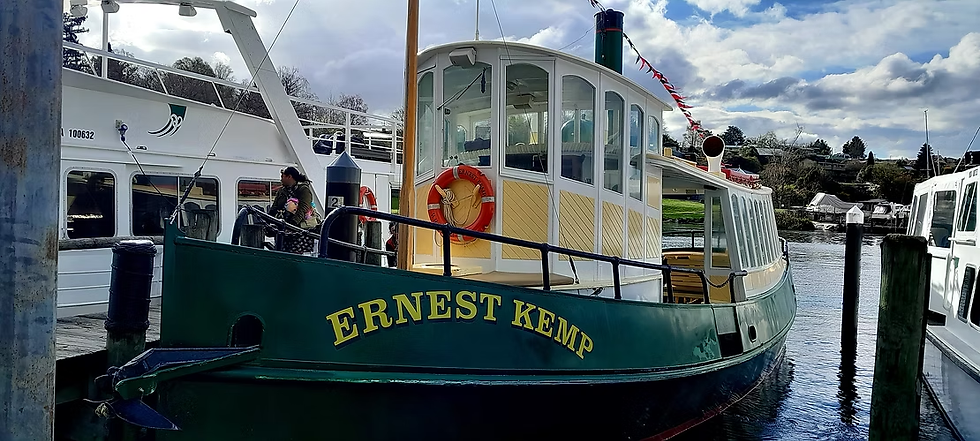
We discover the lake aboard the Ernest Kemp, a vintage vessel gliding serenely along the shores. In the hush of the waters, Taupō unfolds like an open book; the sheer cliffs reveal layers of petrified fire, silent witnesses of prehistoric eruptions. The wind stirs softly, and the sun’s reflections dance across the surface, each wave becoming a thread of story.

The experience is enriched by Captain and guide Peter and by Sascha, our hostess, who, over the two-hour cruise, led us through the legends of the lake, the history of its eruptions, and the secrets of each island and rock. Every tale and detail transforms the journey into a relaxation of mind and spirit, where time itself seems to flow more slowly on Taupō’s sacred waters.

On deck, Captain Peter recounts how the lake entered the human imagination. I am instantly reminded of Jules Verne’s captivating journeys, who, in In Search of the Castaways (1867), described this wondrous lake, struck by its vastness and mystery. For European readers of the nineteenth century, Taupō was not simply a body of water, but a window into the unknown, untouched by systematic exploration, a landmark of the exotic and the romantic dream.

In the distance, the mountains Ruapehu, Tongariro, and Ngauruhoe rise like frozen gods watching over the lake. The wind carries the scent of cold water and wet stone; short waves lap against the wooden hull of the Ernest Kemp, reminding us of the latent force that still pulses beneath. The lake feels alive, full of energy and mystery, each vibration of the water evoking its volcanic past and the legends that have cloaked it for centuries.

Jules Verne continues the adventures of his imaginary travellers upon Taupō’s waters:
“From the northern shore, the volcano seemed wrapped in smoke and flame above the smaller mountains. Tongariro appeared part of a complex orographic system. Beyond it rose Mount Ruapehu, solitary in the plain, its summit soaring nine thousand feet into the sky, its head lost in clouds. No mortal had ever set foot upon its inaccessible peak; no human eye had ever gazed into the depths of its crater…” (Jules Verne, In Search of the Castaways, 1867)

As the Ernest Kemp turns towards shore, we remain on deck, letting the cold wind carry the last glimpses of Māori carvings. Enormous faces, cut into the lava cliffs, depict ancestors, gods, and legendary heroes, each with expressive features and sacred symbols. They are stories in stone: each line speaks of courage, protection, and the deep connection of Māori with the lake and the land. The atmosphere is hushed, almost solemn, as though the faces still watch over us, guardians of memory and legend.

When the traditionally trained carver Matahi Brightwell paddled past a rock alcove on Lake Taupō in 1976, he had a vision: a tattooed face emerging from the depths of time. His grandmother, Te Huatahi Susie Gilbert, of Ngāti Rauhoto, Ngāti Tūwharetoa, Ngāti Maiotaki, and Ngāti Whakaue, had asked him to bring to life their ancestor Ngātoroirangi in a tōtara carving, binding the family forever to the sacred land. But when Matahi arrived in Taupō, the tree was not there. Seeking inspiration, he set out across the waters by canoe, letting the wind and reflections of the sun guide his hands and thoughts.

The alcove at Mine Bay thus became the canvas of destiny. Four years later, in 1980, under Matahi’s guidance, a team of four artists—Jono Randell, Te Miringa Hohaia, Dave Hegglun, and Steve Myhre—breathed life into the rock, carving Ngātoroirangi who seems to gaze toward the eternal horizon. With nothing more than protective glasses and swimsuits, the artists first traced the outline with chalk and string, then shaped it by hand, letting each touch vibrate with the energy of the lake and the echoes of ages past. Around Ngātoroirangi, the faces of ancestors and guardians—tūpuna and kaitiaki—rise like living shadows, watching over the stories of the local Māori tribe. Each line, wrinkle, and gaze carved into stone carries the echo of adventure, of water, and of time—a journey into the past that remains alive for all who pause to look.

Children gaze intently at the shore, curious as always about the history hidden beyond landscapes. In front of the carvings, past and present merge, and Māori legends come alive in each line and expression etched in stone. Excitement rises when they spot the great lizard figure, its body vanishing into the dark waters of the lake, a mythical presence pulsing with the energy of the place.

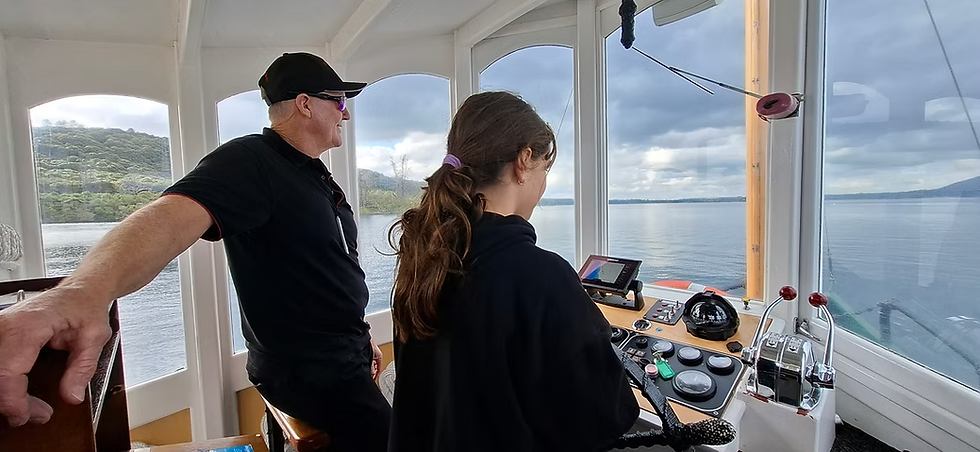
And that is not all! Their enthusiasm peaks when, under Captain Peter’s warm smile and sparkling eyes, they are invited to steer the ship back to shore. At the helm, like brave pirates from a tale, they grip the wheel with small but determined hands. The Ernest Kemp, with its sharp prow and the wind at its back, glides gracefully through the waves, spray leaping up like playful mermaids escorting their voyage. Each moment is an adventure, each wave a companion’s laugh, as if the whole world had become a magical realm for them alone.
Our guide explains that the Taupō region is not only a land of legends and volcanic eruptions, but also of living treasures hidden in its waters. It is world-renowned for trout fishing, both on the lake and in the rivers that feed it. The Tongariro River, with its swift, clear currents, is especially famed for rainbow and brown trout, glittering in the sun like living jewels. We learn that the first trout caught in the region, in April 1904, weighed 1.36 kilograms.

We drift slowly along the shore, discovering hidden bays and volcanic sand beaches strewn with glossy black stones. The wind stirs gently, and the sun’s reflections dance upon the water, turning each wave into a fleeting spark. Waterbirds—ducks and cormorants—glide quietly behind us, leaving us alone with the legend of the lake. At last, the Ernest Kemp
reaches the end of the cruise, docking gracefully in the small port.

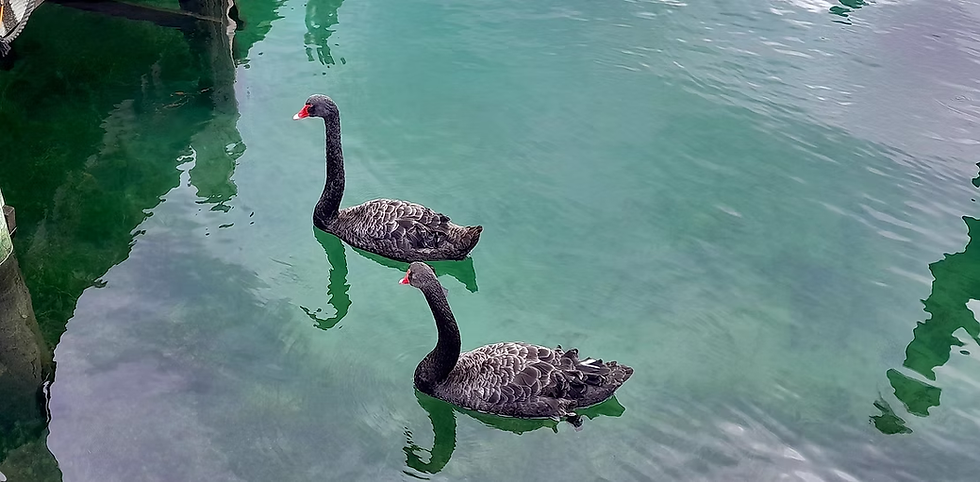
Here, black swans wait patiently, floating lazily upon the water, completing the image of a world where time flows differently—like an old story, written by nature and preserved with reverence by the people of the land.
Taupō remains more than a lake. It is a place where geology, mythology, history, and literature meet, where the visitor feels part of a tale stretching across millennia.
In its deep waters, in its sculpted faces, in the play of sunlight on its surface, Lake Taupō preserves the magic of the past and the promise of adventure, offering each traveller an experience that lingers long after the boat departs.


Comments