
MOUNT MAUNGANUI, THE LINE BETWEEN INFINITIES
We got into the car and set off toward Tauranga, on a summer morning that already seemed written under the sign of perfection. The light was clear, almost liquid, flowing over the asphalt like a discreet blessing.

Leaving Auckland still carries a trace of haste, but the city gradually retreats in the side mirrors, like a memory that no longer insists. Ahead, the landscape begins to breathe wide. The hills roll gently, rounded like petrified waves, covered in dense, saturated green, interrupted only by the quiet of grazing herds — a quiet that asks for nothing, yet teaches you how to look.

The road, once capricious, becomes steady and almost abstract with the Tauranga Eastern Link. It feels drawn with a calming precision, as if designed not only to connect places but to smooth time itself. Long bridges float over silent estuaries where the water lies still, a mirror broken only by the wing of a bird. Everything becomes faster, yet paradoxically calmer — a continuous glide, without hesitation, toward the coast.
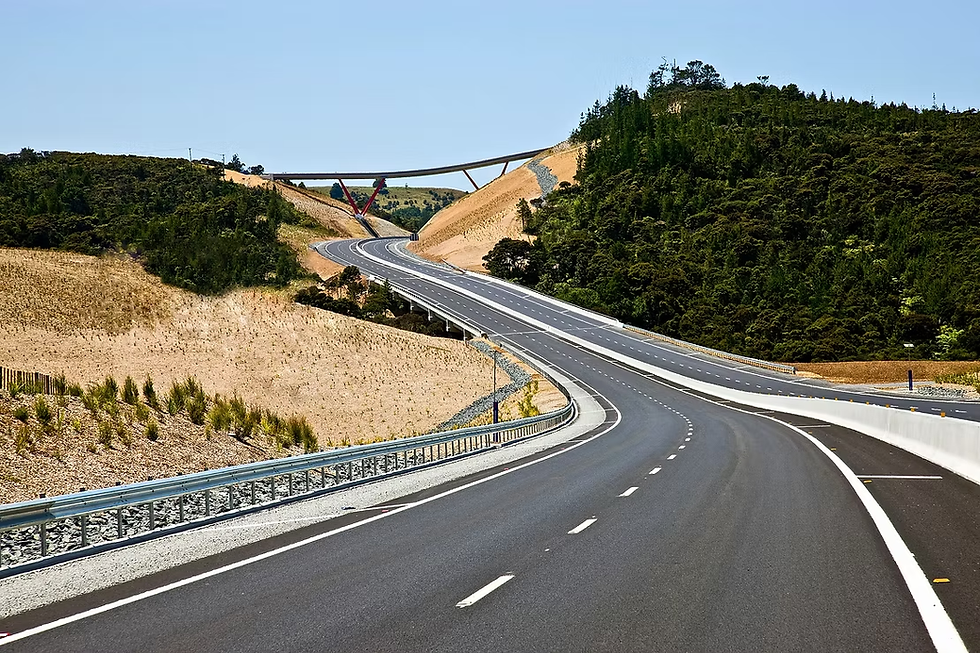
Here and there, the old and the new overlap without conflict: side roads disappearing among kiwi orchards, the sweet scent of sun‑warmed earth, the feeling that beyond the infrastructure, the country remains profoundly rural, faithful to itself.

As you approach the Bay of Plenty, the air changes. It becomes more open, more salty, and the light gains a fragile transparency. You know the ocean is near before you see it — a presence announced through absence.
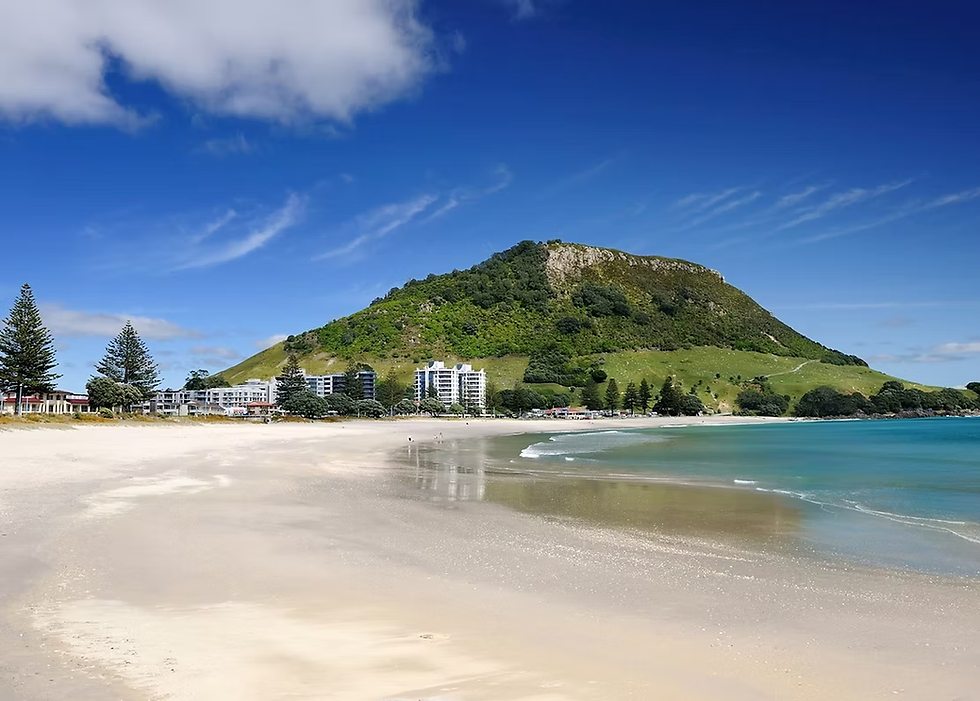
From Tauranga to Mount Maunganui, the journey compresses into a transition — short but dense, like a threshold between two rhythms. You cross the city with a slight urgency until you reach the Tauranga Harbour Bridge, the suspended link between two worlds. For a few moments, time seems to slow its own flow. To the left, the port — order, cranes, a cold geometry. To the right, open water — fluid, unpredictable, alive.

And then, at last, the silhouette of Mount Maunganui appears on the horizon — rounded, calm, almost unreal — and you understand that the road was never just a road, but a preparation. And then Mauao emerges.

He does not reveal himself — he asserts himself. He does not impress — he imposes. Rounded, complete, like a perfectly closed sentence. Not a dramatic mountain, but an inevitable one — a centre around which everything gains meaning.
As you descend from the bridge, the world shifts without noise. The air becomes lighter, saltier, the streets wider, time more permissive. Palm trees appear like discreet signs that you’ve arrived in a place where haste no longer has authority. The last kilometres feel almost ceremonial. Open cafés, people in relaxed clothing, bicycles, surfboards — simple details, yet charged with an active calm. And then, effortlessly, you reach the foot of the mountain, with the ocean only steps away — as if everything until now had been merely an introduction.
The legend of Mauao still floats over this place, like a memory unwilling to fade. It is said that once he was only a nameless hill, lost inland. He fell in love with Pūwhenua, but his love was not returned. Rejected, ashamed, he chose to leave — not out of courage, but out of a desire not to remain where he was not wanted.
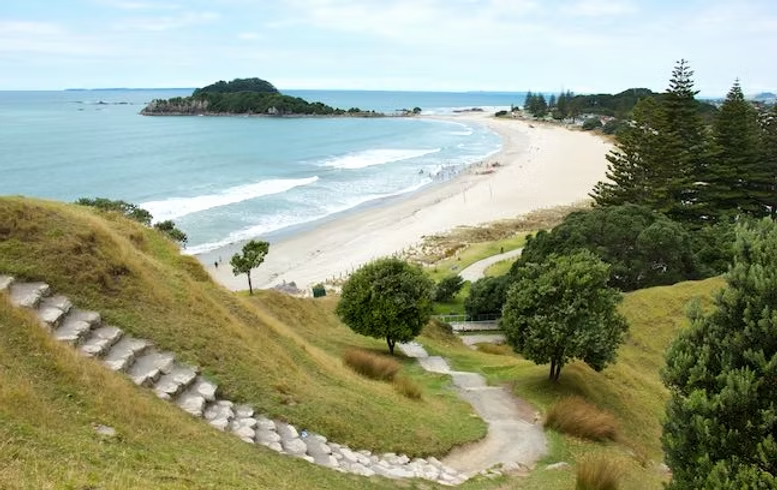
One night, he called upon the patupaiarehe, the forest spirits, and asked them to pull him toward the sea. They dragged him through the darkness, slowly, like a wound being moved from one place to another. But dawn caught them before their work was done. And so Mauao remained here, caught by the light, between departure and arrival. Since then, he has watched the ocean. Not with sadness, but with a calm that resembles acceptance.

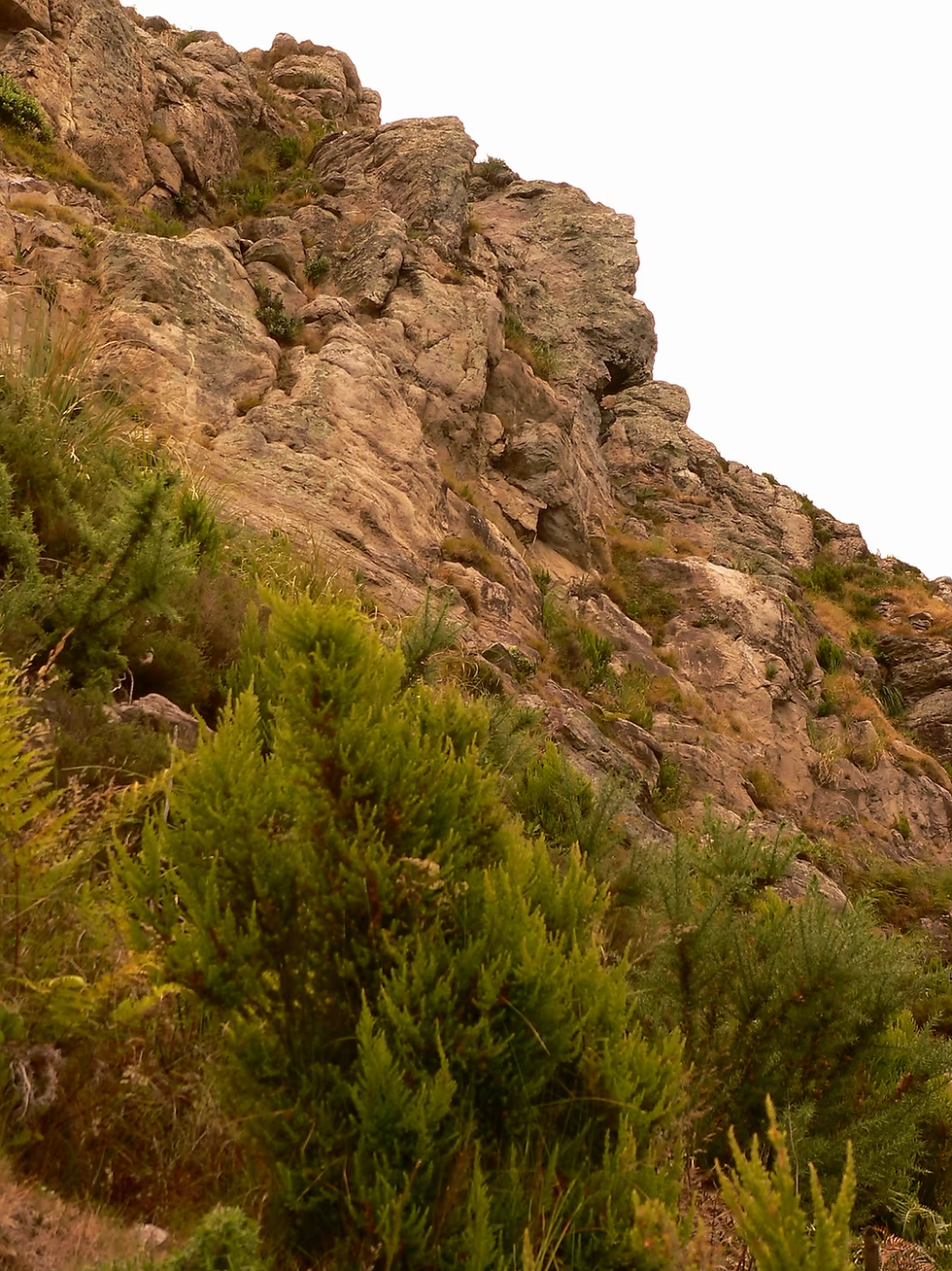
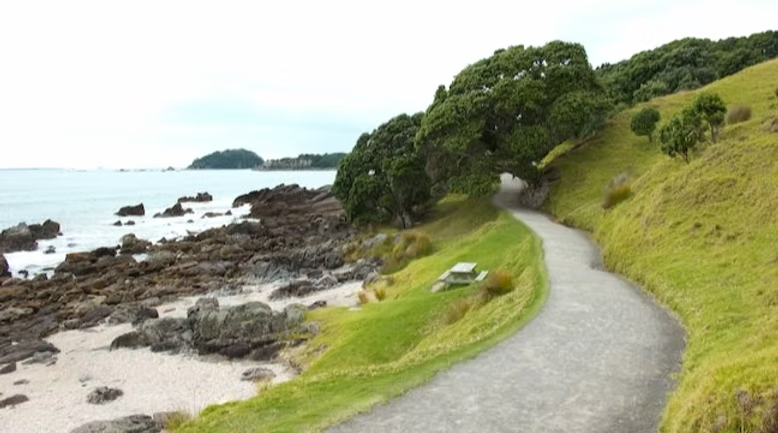
The climb begins under a sun that does not caress — it presses. The light falls heavy, almost material, and the path tightens around your steps like a repeated question. Each step is a negotiation. Each bend promises a pause and offers, instead, another small effort. But it is precisely this labour that opens the view.
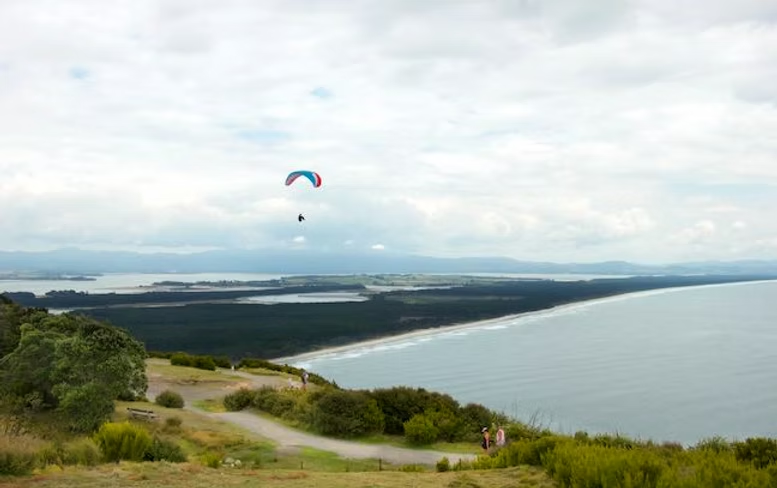
The ocean appears gradually — first as a patch of light, then as a total presence. From above, the beach at Mount Maunganui is no longer a place, but a perfect line between two infinities. The waves breathe steadily, people shrink into signs, and the world simplifies itself to essence. You are no longer looking at a landscape. You are looking at an idea of calm.

The descent comes as a quiet release. Steps flow, the air loosens, and the mountain seems to let you go without holding you back. Below, the hot sand greets you like a final test. Beyond it, the ocean — alive, restless, luminous. Entering the water is more than cooling off: it is a return. The waves wash away the traces of the climb, dissolve the fatigue, bring the body back to itself. It is a simple ritual, repetitive, yet complete.

And you remain there, between water and light, in a suspended summer afternoon where time no longer flows — it simply exists. And in that rare moment, you understand: you did not arrive here. The place was waiting for you.


Comments