
MURIWAI: BLACK SAND AND GANNETS
I am fortunate to live in the western part of Auckland, on the green and mysterious ridges of the Waitākere Ranges, in the heart of a suburb called Titirangi – which is, in truth, nothing less than a living forest. The houses seem to rise among giant ferns and ancient kauri trees, like hidden nests woven into the branches. Mornings are wrapped in the song of the tūī and kererū, while evenings bring the damp scent of leaves and the faint murmur of the ocean slipping through the hills. And yet, in this corner of seemingly untouched wilderness, the city is not far away: less than half an hour’s drive separates me from the heart of Auckland. In an instant, one crosses from the green universe where mist dances among the crowns to the pulse of the metropolis. Life thus unfolds between two worlds – primordial stillness and urban rhythm – and I feel myself a privileged traveler between them.

Around our suburb, the mysterious paths of the villages of Huia and Laingholm stretch, arranged like hidden necklaces between hills and shores, where time seems to flow by the rhythm of the sea and the forest. Their winding roads pass through ancient trees and open onto deep bays whose waters mirror the dark hues of the Pacific. At an equal distance from the city center lies the perfect escape: Piha Beach – a wild expanse of black sand where the waves charge relentlessly like white cavalcades, crashing against massive cliffs. Yet this essay does not seek to explore the mysteries of Piha, Titirangi, or Huia, but rather to guide you on an initiatory journey to one of New Zealand’s most picturesque and emblematic coastal landscapes: Muriwai Beach.

This place is cherished by both locals and visitors, who arrive in waves with the coming of spring. Muriwai is a corner of the world where the tides move like silent messengers, weaving the eternal story of sea and sand.

In recent years, tourism has surpassed the revenues of livestock and agriculture, becoming the economic heart of New Zealand. This comes as no surprise, given that more than four million visitors cross these lands every year—almost equal to the country’s population. And for many of these travelers, Muriwai Beach is not merely a place of leisure; it is a symbol of the irresistible allure that the wild nature and dramatic coastlines of West Auckland exert upon all who behold them.

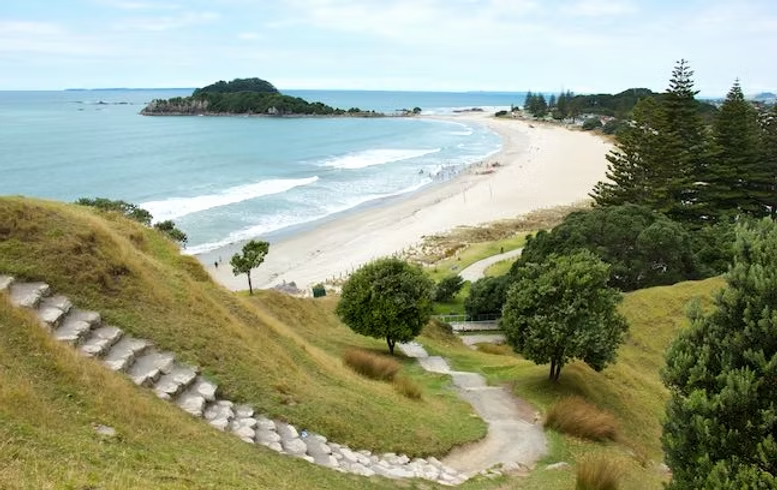
Muriwai stretches like a glorious ribbon of black sand, sixty kilometers long—one of the most extensive beaches in New Zealand. It is flanked by cliffs sculpted by time and tide, bearing the imprint of ancient geology: dormant volcanoes and sedimentary rocks shaped by wind and waves. Māori legends still haunt these shores: the spirits of ancestors watch over the coast, and the red pohutukawa trees—blazing like living flames—mark the threshold between land and sea, between the real and the mythical.

The dunes undulate like frozen waves, while surfers, stretched on their bright boards, play with the ocean’s energy. Overhead, the air is filled with the calls and commotion of the gannet colony, sharing this realm of freedom with humankind. Muriwai is not merely a beach; it is a place where geology, nature, and culture intertwine in living harmony, and where the traveler’s eye always finds a new story—a rock of impossible shape, a grove of pohutukawa bathed in sunlight, a bird soaring above the waves. Each visit becomes an initiation, a deeper approach to the wild spirit of Auckland’s western coast, where nature sets the rhythm, and humanity learns to follow it with reverence.

The road from Titirangi to Muriwai is itself a kind of ritual journey, linking the forest to the sea. As you ascend the ridges of the Waitākere Ranges, the rustle of kauri leaves and the shadows of giant ferns accompany you like guardians of the wild. Sunlight filters through the branches, painting the road with golden patches, while the air carries the moist scent of earth and resin.

As one descends toward the coast, the forest thins, and the silhouettes of bold cliffs emerge on the horizon, announcing the approach of the sea. The salty wind and the sound of the waves greet the visitor, and the gaze opens upon the vast stretch of black sand, like a silk carpet under a changing sky. Each kilometer traveled makes one increasingly aware of the profound connection between the hills and the sea, between the high ridges and the beach awaiting below in all its splendor and wildness. It is a path that teaches careful observation, attunement to the rhythm of nature, and preparation for the encounter with the magic of Muriwai.

Legend-Laden Places
The Muriwai area traditionally forms part of the territory of the Tāmaki Māori tribe, Te Kawerau ā Maki, and was initially known as One Rangatira (“Chief’s Beach”), recalling the visit of Rakatāura, the renowned Polynesian navigator and ancestor of many Māori iwi. The beach holds deep spiritual significance for Te Kawerau ā Maki, forming part of Te Rerenga Wairua, the path along which spirits travel toward Cape Reinga to depart the world.

In the past, Te Kawerau ā Maki and Ngāti Whātua contended for control of this area, and Muriwai became the boundary between the two tribes once peace was established by the Te Kawerau ā Maki chief, Te Hawiti / Te Au o Te Whenua. The area was subsequently inhabited by Ngāti Te Kahupara, a hapū of Ngāti Whātua with Kawerau ancestry, until the twentieth century.

Pohutukawa - New Zealand's Christmas Tree
Hidden within Muriwai’s wind-swept landscapes, the oldest pōhutukawa tree rises as a silent witness to the passage of time. Pōhutukawa (Metrosideros excelsa), often referred to as “New Zealand’s Christmas Tree” for its vibrant, torch-red summer flowers, holds a place of honor in Māori tradition. Its twisted roots cling to the cliffs like protective arms, while its sprawling branches provide shelter to birds and humans alike.

At Muriwai, this emblematic tree has withstood centuries of storms, salty winds, and human presence, standing as a guardian of the place. Legends speak of it as a landmark for early Māori navigators, its extended roots and thick trunk serving as a place of rest and a source of stories, songs, and guidance for generations; it is said to have been planted or tended by the ancestors of local iwi, who recognized its strength and resilience as a symbol of enduring connection to the land.

Today, visitors can glimpse this imposing tree along one of the trails, pausing to admire its twisted branches, sprawling roots, and vibrant flowers. Amid waves and winds, it preserves the memory of the place—a living witness to history, culture, and the passage of time. The oldest pōhutukawa at Muriwai is not merely a tree; it is a link between past and present, a symbol of survival and the enduring beauty of New Zealand’s native flora.

The Gannet Colony at Otakamiro Point
The Muriwai gannet colony lies just five minutes from the Pōhutukawa trail. Footsteps lead to an observation platform, seemingly suspended above a theatre of wildlife, where every movement is an act of nature. Offshore, the colony extends across two islands with vertical cliffs, rising from the waves like white fortresses sculpted by the ocean. Approximately 1,200 pairs of gannets nest here annually, from August to March, weaving a living carpet of life and down.

The nests lie mere centimeters apart, a fragile labyrinth of delicacy and risk, a true aerial ballet. Each landing requires skill: birds glide above the beaks of neighbouring gannets, and a single mistake can become a harsh lesson in the school of flight. These birds, weighing around 2.5 kilograms with a wingspan of two meters, master the air currents like artists in a symphony of wind and waves.

Each pair lays a single egg, with the parents alternating at the nest like devoted guardians of a fragile jewel. The chicks, once hatched, are covered with soft down, floating like tiny pillows, gradually developing juvenile feathers in preparation for their first spectacular flight—a leap that stretches to the sky. Young gannets then cross the Tasman Sea to Australia, like white arrows borne by the wind. Years later, the surviving birds return to the colony, reconnecting with their ancestral roots.

The view is truly breathtaking: Muriwai Beach stretches sixty kilometers northward, a ribbon of black sand between thundering waves and golden dunes. Below, surfers resemble playful seals, dancing among the ocean’s crests, and the entire scene breathes the wild energy of Auckland’s western coast.

Descending to the Beach
Descending from the gannet colony, one reaches a platform leading to the Fisherman’s Rock and sea caves, a gateway into the secret depths of Muriwai’s coastline. The beach itself bears the marks of millions of years of history: it was uplifted from the seabed approximately three to five million years ago, sculpted by volcanoes and relentless currents.

Much of the landscape is formed from the eastern remnants of the Waitākere Volcano, with “pillow” lava formations visible along the southern cliffs, relics of a tumultuous past.

The vegetation is lush and abundant, dominated by flax, whose long, rigid leaves sway in the wind like green ribbons carried by the air. This dense presence adds a wild, protected charm to the beach, like a natural hedge preserving the mystery and tranquility of the place. Sand and sedimentary rocks compose the beach soil, while the cliffs of southern Muriwai rise like guardians of time.

The black sand, akin to magnetic velvet, originates from the iron of ancient volcanoes, including the Kaipara Volcano, dormant off the Kaipara Heads, and erupted sixteen million years ago. The journey of the sand grains is remarkable: transported along the west coast of the North Island by longshore currents, they dance with the waves, shaping the beach through a process known as “longshore drift,” an invisible ballet of water and sediment.

Sheep Island – the Shining White Islet
Sheep Island rises from the ocean like a solitary pearl, approximately 1.4 km west of Muriwai, Maukatia, and Collins Bay. Covering only 0.14 hectares (1,400 m²) and ascending 25 meters above the water, it resembles a vigilant eye, fixed upon the boundless sea. It is likely an eroded remnant of Miocene lava flows from the Waitākere Volcano, a fragment of geological history that has withstood the fury of time.

The island hosts another gannet colony, established in the early twentieth century, a white orchestra performing life upon the rocky stage. Between 1940 and 1970, the population grew to 892 nesting pairs, transforming the cliffs into corridors of wildlife.

The flora consists of resilient plants, like green jewels carved by wind and salt—Disphyma australe (New Zealand ice plant), Chenopodium allanii, and Coprosma repens (taupata). Accompanying this vegetal oasis, marine insects and kekeno (New Zealand fur seals) visit the island as discreet guests, respecting the sacred silence of the site.

A special habitat is that of the korowai gecko (Woodworthia korowai), discovered in 1954 and recognized as a distinct species only in 2016, a mysterious and discreet creature, carefully preserved by the island as an ancient secret. The island’s traditional name, Motu-ō-Haea – “Shining White Island”, refers to the white guano mantle of the seabirds that swarm the rocks.

The Tāmaki Māori tribe, including Te Kawerau ā Maki, used the island as a seasonal food source: birds, eggs, and kekeno—a natural treasure for local communities. Today, Sheep Island remains an ecological and cultural sanctuary, a beacon of biodiversity and tradition, included in the migration routes of seabirds from Muriwai and northern Auckland, and designated by BirdLife International as an area of major importance for birds. It is a corner of the world where nature, culture, and time meet, preserving the memory and wild beauty of Auckland’s western coastlines.

The black sand stretches like velvet woven by time, and the relentless waves strike the shore like furious knights, together composing the grand tableau of this magnificent place.

The beach, freshly washed by the sea foam, extends its silvery sheen for tens of kilometers, like an endless ribbon of mirror. Here, we find our refuge for endless walks, hours upon hours, as far as our feet and spirits allow, losing ourselves in the dance of wind and water. As we proceed, the beach seems to hold within it the whispers of Māori legends, while the red pōhutukawa trees blaze like living torches along the edge of the sand.

Surfers dance upon the waves, which, like relentless sculptors, carve the eroded cliffs and shape the ever-shifting dunes. The water’s surface reflects the changing sky, while the gannets traverse the horizon like messengers bearing stories hidden in the ocean foam. Everything seems suspended between reality and legend, a tableau inhabited by time, wind, and waves, where every corner hides a story, and every breath of wind whispers the names of ancestors.


Comments