
RED LAKE, THE SUNKEN TEMPLE OF THE CARPATHIANS
I still remember my first visit to Red Lake (Lacul Roșu, Romania), a moment that left an indelible mark on me. The journey through the Bicaz Gorges, with their towering walls and the long shadows of the cliffs, seemed to prepare the soul for what lay ahead.

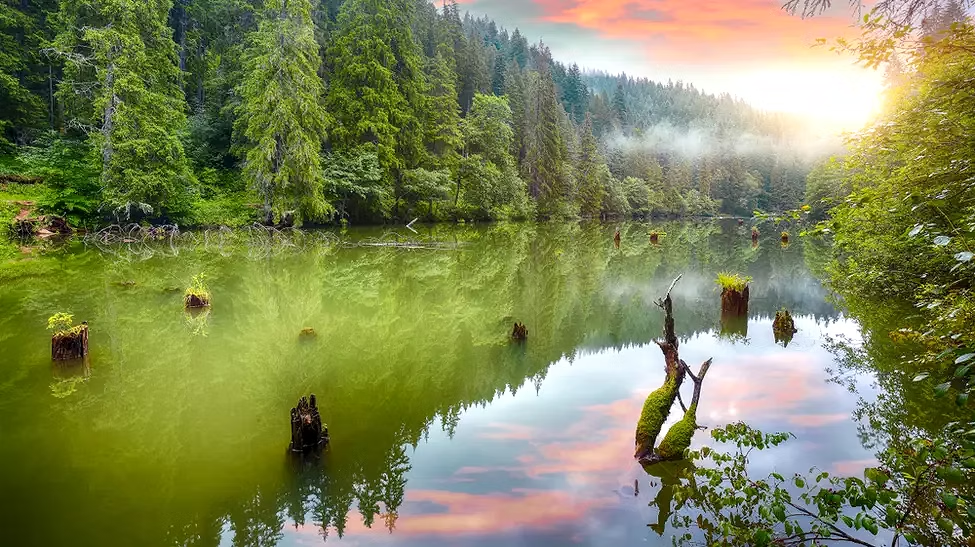
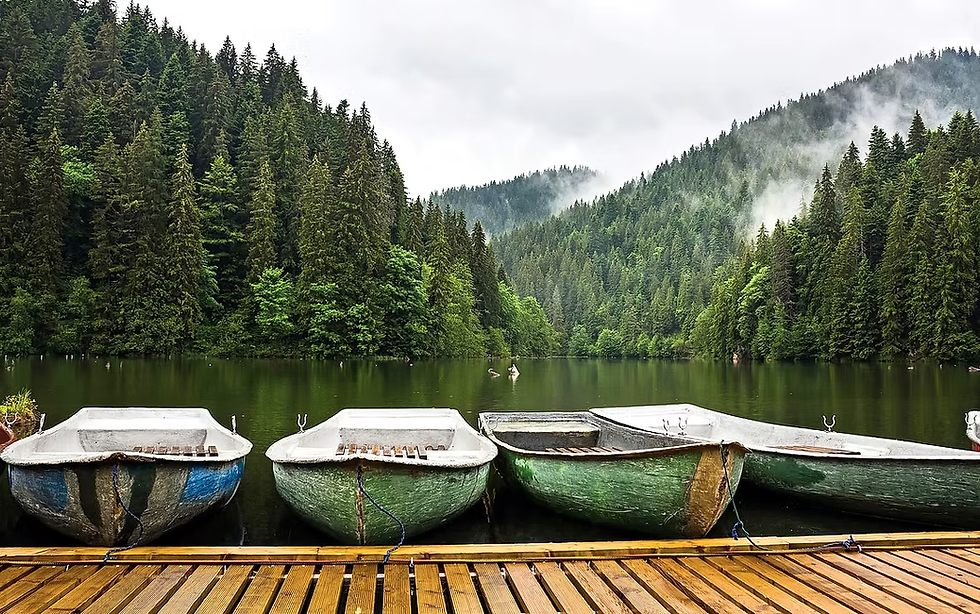
Arriving at the dock at the base of the lake, I rented one of the brightly painted rowboats and ventured onto the silent mirror of the water. The first shock was the sight itself: despite its name evoking blood and disaster, the lake shimmers in mysterious green hues, almost unreal in their clarity. Near the shore, the water is so clear you can see the lakebed, where fish dart among the submerged trunks of old firs, adding an almost magical dimension to the experience. Touching the petrified trunks, feeling their cold, dense texture, is electrifying; it takes your breath away and makes you feel part of a secret ritual of nature.

Red Lake is not merely an object of geological study or a story in books. The direct experience—rowing among the trunks, feeling the cool water, breathing the dense silence—merges legend with reality. Here, the history of earthquakes and landslides intersects with the myths of the sunken village, and names like Gyilkostó or Mördersee take on meaning in the shadow of the petrified firs. This is an extraordinary excursion: every paddle stroke, every touch, every step along the trails brings you closer to a place unlike any other. Red Lake is not simply visited—it is felt, breathed, and sometimes it watches you with a quiet gaze, as a memory that refuses to be forgotten.

Red Lake remains one of those rare places that exist on the border between geology and legend, between the precision of numbers and the whispers of Carpathian forests. Situated at the foot of Hășmașul Mare and silently watched over by the Bicaz Gorges, the lake was born in a violent instant: the earthquake of January 23, 1838, at 6:45 PM, when an entire slope collapsed, damming the valley and creating a new world overnight. Today, the calm surface betrays none of that original chaos—only the old trunks, raised like pale fingers from the depths, recall the forest buried beneath the waters.
The figures are cold, exact, almost inappropriate for such a place: a perimeter of 2,830 m, a surface area of 114,676 m², and a water volume of 587,503 m³, based on measurements from 1987. Beyond these numbers lies the direct experience of the lake: the sensation of stepping into a different altitude of time, at 983 meters, where the air is subalpine clear, the scent of resin is denser, and the light seems filtered through an invisible layer of memory.

A Natural Amphitheatre with Its Own Laws
The journey to Red Lake—whether ascending the Bicaz hairpins or coming from Gheorgheni, just 26 km away—builds a natural narrative tension. Until the last moment, the lake remains hidden. Then, suddenly, it opens like a stage set aglow: the color of the water shifts from deep green to muted turquoise depending on the clouds. The lake lives within an almost enclosed natural amphitheater. To the north, Suhardul Mic and Suhardul Mare bend toward the water like silent witnesses.

To the southwest, Podu Calului Mountain forms a compact barrier, while to the northwest, Licaș and Kis-Havas Mountains rise with dark ravines and hidden springs. Csíki-Bükk closes the horizon to the northeast, and to the east looms solemnly Muntele Ucigaș (“Killer Mountain”)—a name spoken only with a shiver, rooted deeply in local legend. This crown of peaks creates a unique acoustic resonance: sounds fade, the light softens, and silence becomes almost tangible—a veil stretched over the valley, a quiet that presses rather than protects.

The lake is fed by four main streams—Verescheul (the Red), Licaș, Suhard, and Oii—and twelve smaller temporary flows. Each descends with its own rhythm, bringing sediments, cold water, and whispers of the seasons. The Verescheul carries the reddish shadow of the lake’s name, the Licaș slices the forest in long, supple lines, and the Suhard plunges abruptly, echoing the ridge that births it.

Geology of Its Birth – Between Hypotheses, Earthquakes, and Mountain Silence
Though Red Lake is a young formation, its exact year of origin remains debated. Geologist Franz Herbich dates it to 1838, linking it to the earthquake of January 11 and the strong aftershocks in February. Ferenc Puskás, however, cites 1837, when violent storms destabilized the slopes. Regardless of the exact date, the mechanism is the same: a massive mass of glacial clay detached from the northwest slope of Ghilcoș, slid down, and dammed the valley. Then silence. Then water.

The forest of firs was submerged. The trunks trapped upright slowly petrified, forming what now resembles a sunken temple, a spectral forest rising fragmentarily from the lake’s surface. In the early years, the lake was much longer, extending a kilometer upstream. Over time, the natural dam eroded, and the water level stabilized. From the perspective of Romanian geology, Red Lake is the most significant natural dam lake in the country. Next in rank is Bălătău Lake—a rarely mentioned, almost forgotten footnote beside the grandeur of Hășmaș.

Legend Across the Waters – A Lost Village and an Unforgettable Name
Even reading Red Lake through the strict lens of science, the place cannot escape the magnetism of legend. In Hungarian, Gyilkostó means “Killer Lake.” The Germans called it Mördersee. The story is cruel and persistent: an entire village was supposedly swallowed by the landslide—houses, animals, people—and the water collected afterward bore a reddish hue, a symbolic overlay of blood and mud. The name preceded scientific explanation. It has been called “Lake of the Red Stone” (1864), “Killer Lake,” and, after 1936, definitively “Lacul Roșu.” The Red Stream, charged with iron oxides and hydroxides, symbolically carries this story in its pigment. Beneath the speculations lies something deeper: this place has never been only geology—it has always been memory.

Flora and Fauna – A World Breathing in the Mountain’s Rhythm
The landscape surrounding the lake is a living textbook of subalpine ecology. Forests are dominated by spruce (Picea abies), fir (Abies alba), and Scots pine; on the limestone cliffs, edelweiss, Carpathian carnations, and dwarf junipers emerge. Wet areas host large ferns, thick mosses, and sedges, while meadows bloom in spring with bellflowers and sweetwilliam. The fauna completes the picture with perfect discretion: bears, deer, foxes, wild boars, and lynx roam the forest edges, unseen by most hikers. The cold waters shelter native trout, bullhead, and grayling; ducks, herons, and occasionally large crows grace the lake, seemingly knowing the pulse of the place better than humans.

Climate – Between Natural Therapy and Heavy Calm
The Red Lake valley enjoys a unique microclimate: sheltered from winds and enclosed by mountain walls, it maintains a calm, dense atmosphere. The multi-year average temperature is 8°C, above the surrounding depressions. The air is pure, saturated with conifer aerosols, and the combination of altitude, silence, and resin produces a state of physical and mental regeneration difficult to match. Unsurprisingly, since 1900, the area has been a spa and recreational center. Initially, only a few visitors came “for the air.” Today, thousands arrive, yet the tranquility remains astonishingly intact.
Trails – Access to a Different Kind of Beauty
Travelers can climb Suhardul Mic for the most spectacular view of the lake. The journey through the Bicaz Gorges shifts the scene—from calm water to vertical cliffs and limestone arches. Towards Piatra Altarului, trails grow wilder, more technical, but the panorama rewards every effort.

Ghilcoș, the “guilty” mountain behind the lake’s creation, offers less-traveled paths, ideal for those seeking direct contact with deep forests, filtered light, and the steep slopes of the massif.

In the Mirror of Other Lakes
Natural dam lakes exist worldwide: Spirit Lake in the USA, formed after the St. Helens eruption, with floating trunks; lakes in Sichuan, formed after the 2008 earthquake, with submerged villages; and rare basins in Spain or the Himalayas. Yet none combines Carpathian intimacy, a petrified forest, and legends sedimented in the local language like Red Lake. It is not merely “similar”; it is unique, personal, laden with history and memory.

The Silence That Follows You
At dusk, light descends the slopes in long steps, and the lake suddenly darkens. Trunks in the water become silhouettes, then shadows, then simple presences. Silence. A silence that neither drives you away nor lets you forget. Red Lake is where mountain and story coexist without explaining each other—a space where catastrophic past and calm present share the same water. A landscape where every visitor feels, even unknowingly, that they have passed through a place where reality is only one layer among many. By the end of a day here, when the wind dies along the slopes, the water remains motionless, as a mirror stretched between two breaths. The mountain has turned a fracture into beauty, and nature has elevated a tragedy into a symbol. In the evening stillness, Red Lake teaches that between reality and story, there is no border—only the calm water that binds them.


Comments