
ROTOKURA AND THE PRIMORDIAL FORESTS OF AOTEAROA
The forest receives us without haste, as if it already knows who we are. The air is cold, dense, almost liquid, and the light slips between the trees in thin ribbons, like golden strands forgotten by the gods. Adina and I walk slowly, with small gestures, as though entering a temple where any sound too loud might awaken something that has slept for centuries.

The X‑Files, in the Heart of the Forest
Under our soles, dry branches crackle now and then, like fragile bones of time. The forest is dark, but not threatening — a warm, protective darkness, an old cloak woven from leaves, roots, and stories. The air smells of damp earth, bark, and life breathing slowly, patiently.

My wife walks a little ahead, her silhouette outlined in the filtered light like a figure from a Māori legend. Sometimes she stops, places her palm on a moss‑covered trunk, and seems to listen. The forest answers in its own way — with a barely perceptible rustle, a vibration in the air, a silence that is never just silence.

Through the Primordial Forest
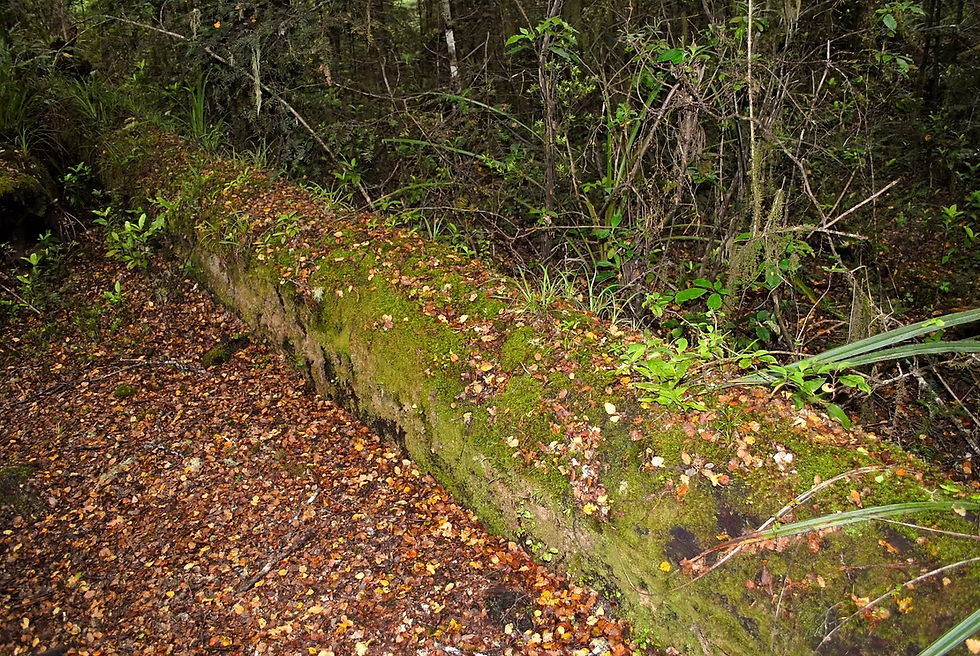
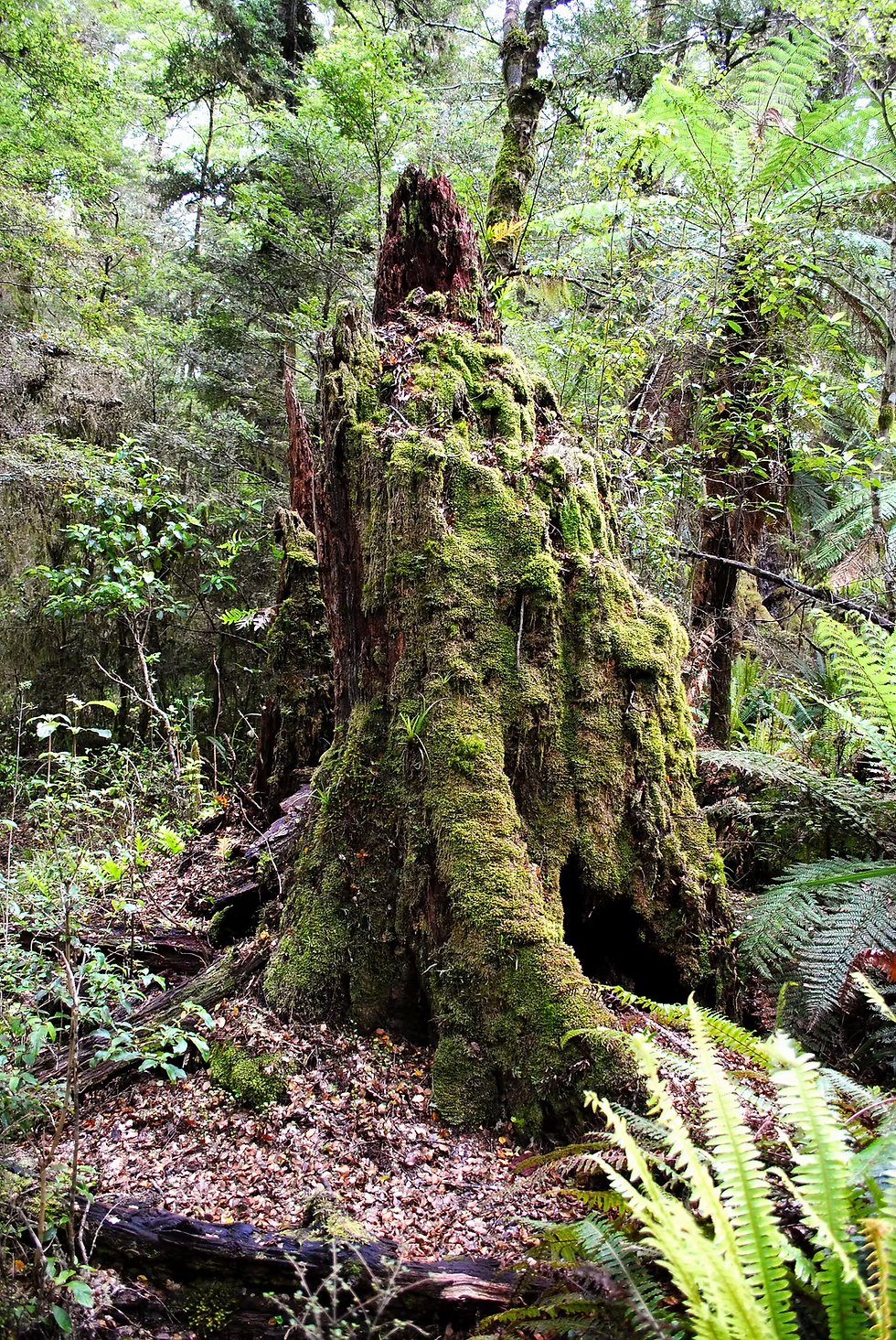
The forest from the beginning of time deepens around us, and the path begins to weave between fallen trunks covered in thick, green moss, like sleeping animals.

Some are so large we must walk around them; others are broken at strange angles, like giant arms that once tried to grasp the sky before collapsing. Each seems to carry the marks of a storm or of a time no one remembers anymore.

Among them, enormous mushrooms grow like oversized plates — white, red, orange — some glossy like lacquer, others matte like stone. They look like extraterrestrial creatures that chose this forest as their landing site. We touch them carefully, like fragile relics of a world unlike our own.

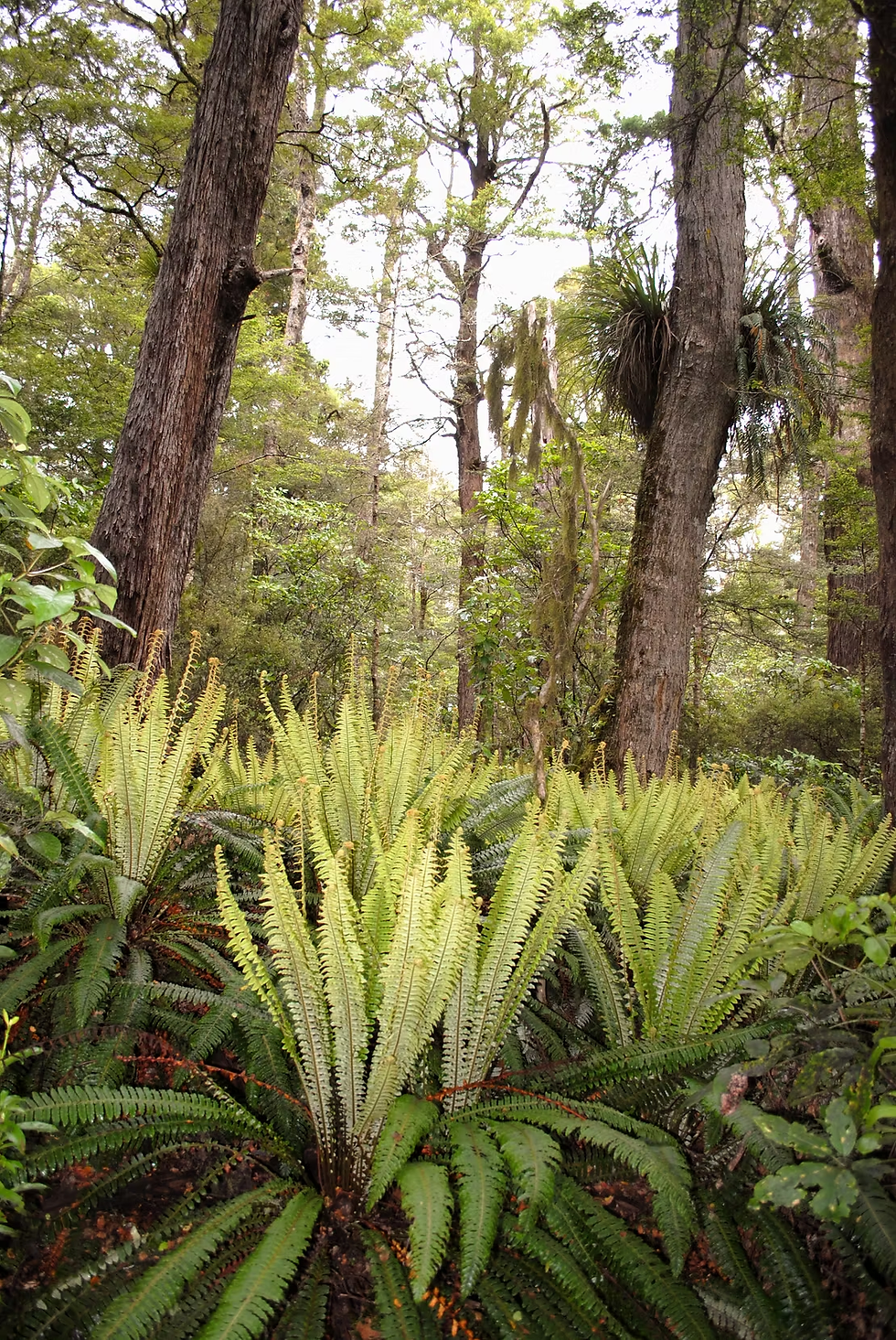
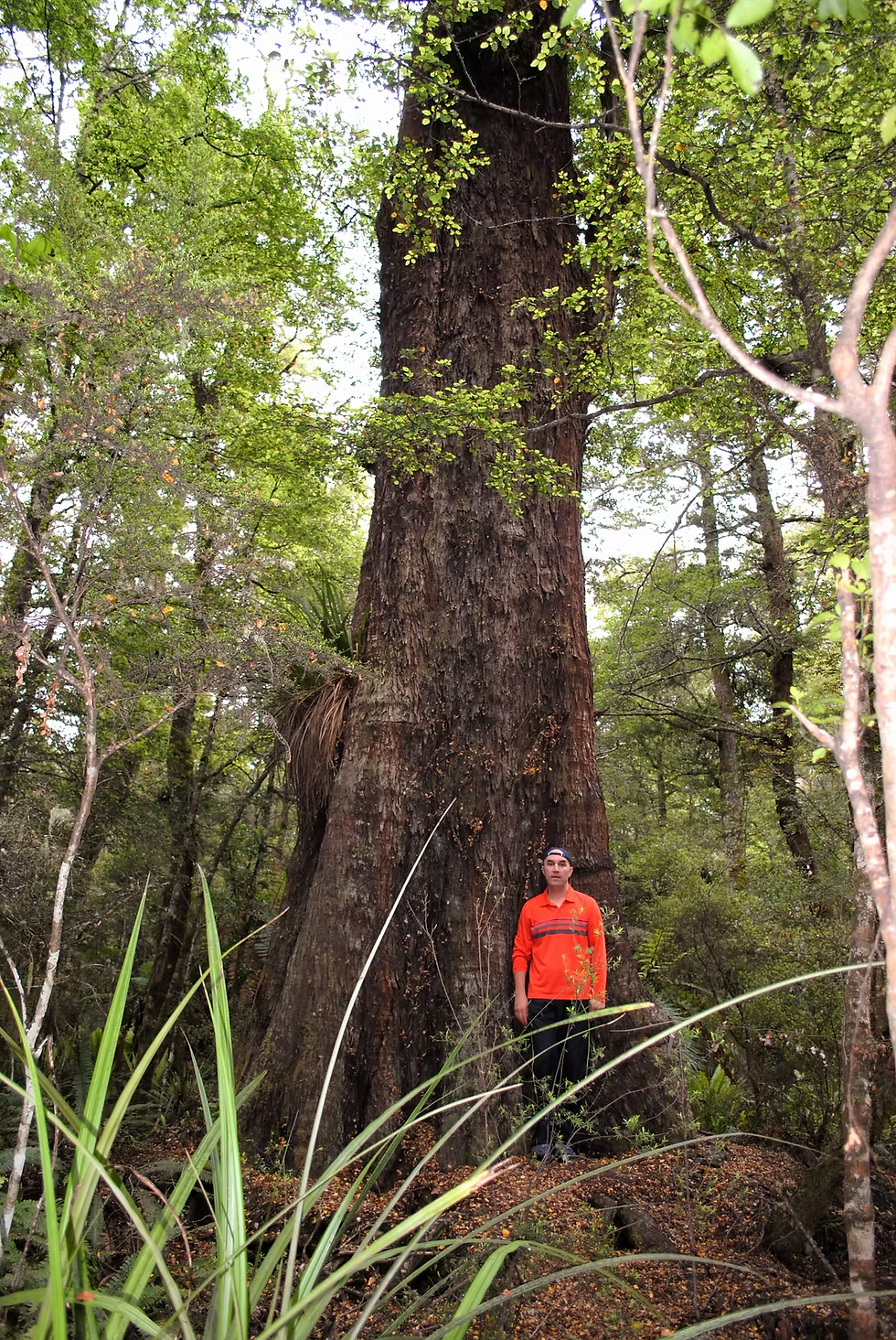
The tall trunks of rimu and rātā rise above us like the columns of an ancient temple. Rimu, with its rough bark and resin scent, and rātā, with its reddish trunk and twisted branches, seem like guardians of the forest.

They are primordial trees of New Zealand, close cousins of the mighty kauri — the oldest and most revered tree in the land. I feel their shared nobility in the air, a vegetal genealogy stretching back thousands of years.

As we pass between them, the forest seems to rise, to widen, to envelop us. Rimu rustles softly, rātā lets its leaves dance in the dim light, and somewhere deep within, one can almost sense the presence of an unseen kauri — like an ancestor keeping watch.

My wife stops beside a massive rimu and rests her palm on its bark. The trunk is cold, yet alive, and for a moment I have the impression it breathes beneath her hand. I watch the scene — her, the tree, the filtered light — and feel the forest adopting us, absorbing us into its ancient story.

The path continues, narrow, dark, magnificent. The air is unusual, dense, full of mystery, as if every molecule carries a secret. We walk on, two small humans in a vast world, welcomed with a gentleness I cannot explain.
Dry Lake
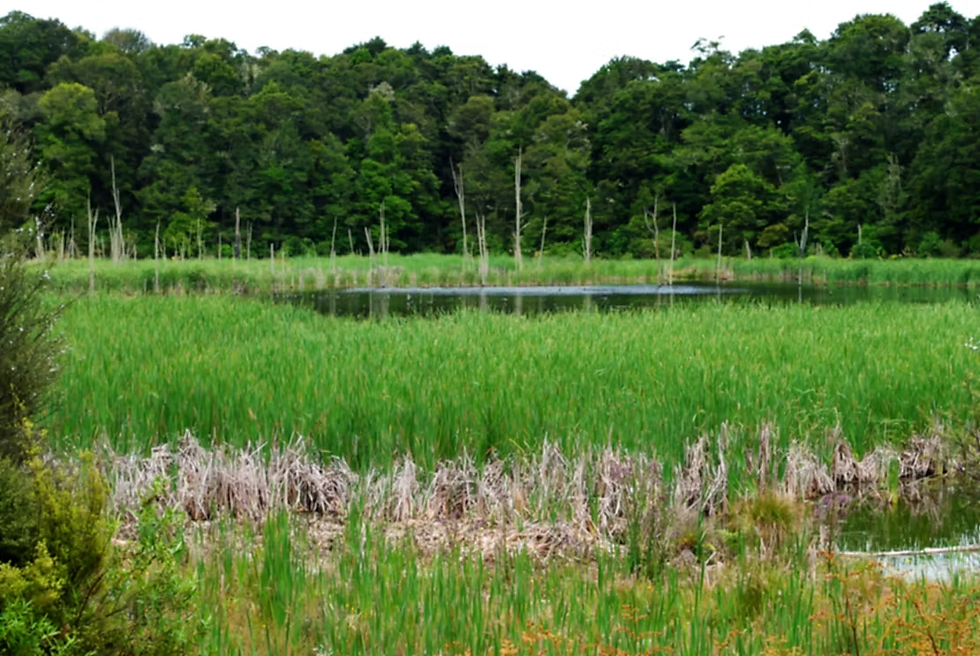
As we advance, the light changes, and the forest slowly retreats, as if pushing us toward another world. The air becomes drier, more open, and the shadows dissolve behind us. And then, Dry Lake stretches out before us.

It is not completely dry. In the centre of the basin, greenish water still lingers, gathered in a hollow like in the giant palm of the earth. It looks like tired water, water on the verge of fading, yet still clinging to light, to sky, to existence. Its surface trembles slightly in the wind, like a faint breath still present.
Short, wind‑burnt grass leans toward the water’s edge, as if trying to protect it. The sky opens above, immense, and the clouds reflect in that pale green patch like in an old, cracked mirror that remains somehow magical.

My wife steps forward and stops, fascinated. Her silhouette reflects in the pale water, and for a moment it seems the lake recognises her, holding her in its liquid memory.
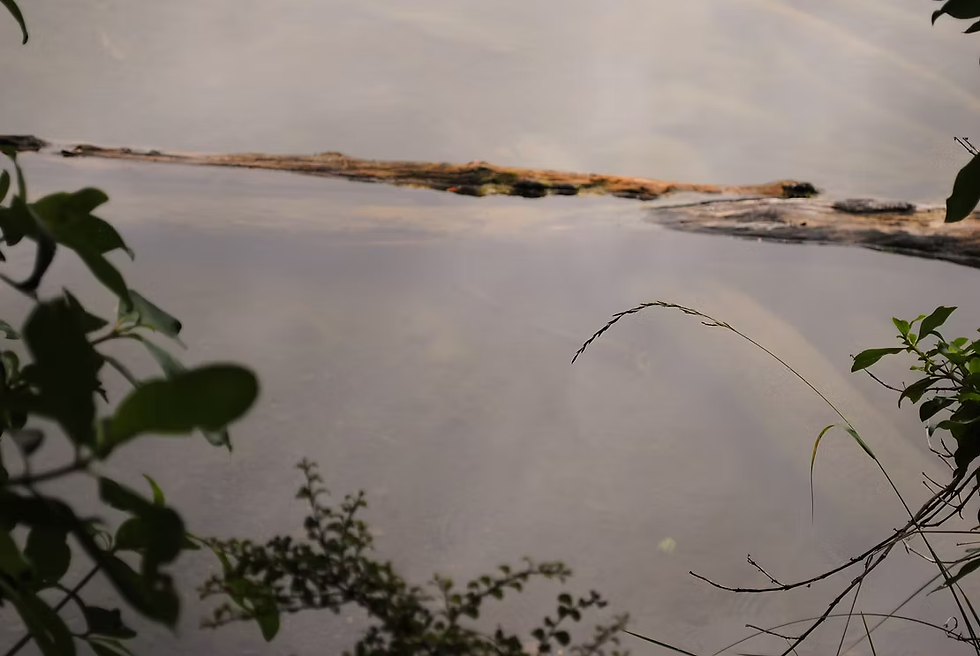
I stay a few steps behind and feel that Dry Lake is not a dead place — it is a place that fights, a place that breathes slowly, a place that does not give up.

The wind passes over the greenish surface and brings with it a strange sound, like a long sigh, as a story whispered. It is quiet, but a tense quiet, full of meaning, like a pause between two chapters of nature.

We remain there, before the water that is fading yet resisting, and feel we are witnessing something intimate, something not shown to just anyone.
Toward Rotokura
When the forest receives us again, it does so like an embrace. The light becomes green, soft, and the air takes on the scent of crushed leaves and cold water. The path descends gently, and the silence deepens, like a song without sound.

Behind us, Dry Lake remains with its pale green water — still alive, a patch of faint light breathing in the middle of the empty basin.
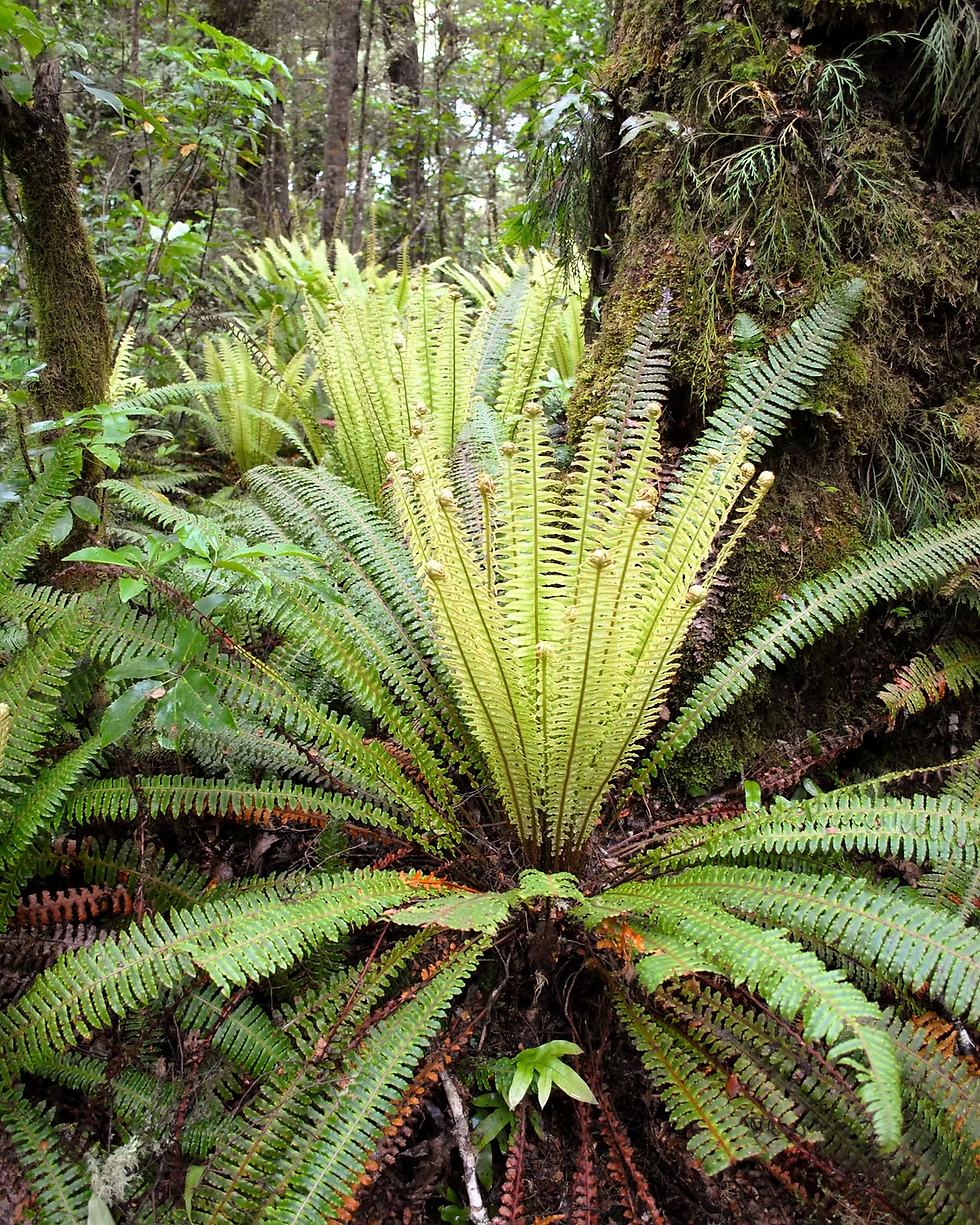
The forest absorbs us once more into its warm darkness, and the shadows gather around us like protective wings. We walk in silence, with soft steps, as if treading on an old, unwritten story. And then, without warning, Rotokura appears before us.

The lake is a perfect mirror, so still it seems unreal. Its colours — emerald green, warm red, hues shifting with the light — look as if taken from a dream. Trees reflect in the water like inverted silhouettes, and the sky seems to float in its depths, as though the lake holds the entire world in a single breath.
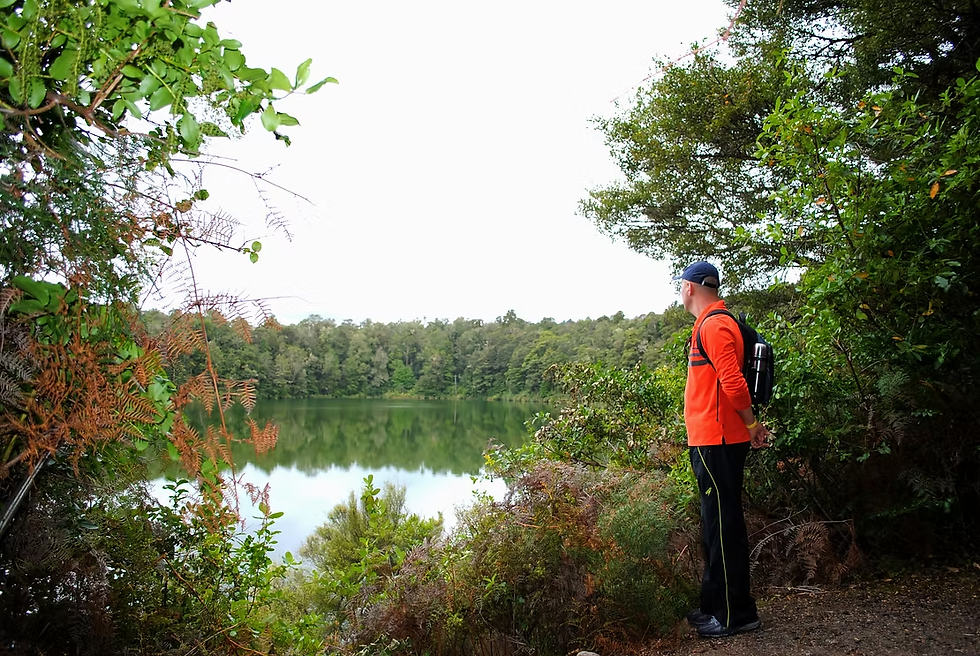
We approach the shore. We do not speak. We do not need to. The lake has a presence that fills everything, like an ancient spirit watching us gently. It is quiet, but a living quiet, vibrant, like a heart beating slowly beneath the water.

We stand there, before Rotokura, and feel the forest, the lake, the air, and the light gather into a single moment — round, complete, perfect.

Kōrako, the Spirit of Clear Waters
I sense, without seeing, the presence of Kōrako, the gentle taniwha Māori say watches over the lakes in this region. I imagine him stretched across Dry Lake, his white scales like river stone, protecting the greenish water that still endures. I understand why that lake never dries completely. I understand why, in the middle of the empty basin, water still exists. Kōrako is not a creature meant to frighten. He is a kaitiaki, a guardian. And I feel that, in a way, he has accompanied us too, from the shadows, along the entire path.

Hine Raukura, the Mirror Between Worlds
Rotokura, before us, seems to open its surface like a door. I remember the legend of Hine Raukura, the young woman who came here on a moonless night and saw not her future, but her courage. The lake does not show what will be. It shows what is already within you, but still hidden. We look into the water, and our silhouettes reflect perfectly. In that moment, Rotokura seems to speak — not in words, but in light, in colour, in that vibrant quiet pulsing like a heart beneath the surface. And I feel the lake shows us something too: that we are more present, more alive, more whole than we believe.

Te Wai Toitū, the Water That Does Not Give Up
My thoughts return to Dry Lake, to its greenish water, fragile yet stubborn. Māori say a small, shy spirit lives there, named Te Wai Toitū, “The Water That Does Not Give Up.” Dry Lake is the lesson of endurance. Rotokura is the lesson of clarity. Together, the two lakes are like two chapters of the same story: one about staying, the other about discovering yourself.
The Forest, the Living Ancestor
When we turn back toward the path, rimu and rātā rise above us again like the columns of an ancient temple. I feel in the air their deep genealogy, their connection to the kauri — the oldest and most revered ancestor of New Zealand’s forests.

Māori say every great tree has a wairua, a spirit. And now, after the entire journey, I feel it in every leaf, every fallen trunk, every giant mushroom growing like a miniature world. The forest is not just the backdrop of our walk. It is a living ancestor, a witness, a guide.
The Return
When we step out of the forest, the light changes again. The air becomes lighter, more ordinary. But within us remains something of Rotokura’s quiet, of Dry Lake’s resilient green water, of Kōrako’s protective shadow, of Hine Raukura’s courage, and of the deep breath of the primordial forest. And we understand that we have not simply walked a trail. We have passed through a story. And the story has passed through us.


Comments