
SĂPÂNȚA: THE VILLAGE WHERE DEATH LEARNED TO SMILE
We set off for Maramureș at first light, loading the car with tripods, filming cameras, batteries, cables, and all those objects without which a story cannot come to life. Our destination is one of the most extraordinary places in Romania: the Merry Cemetery of Săpânța—a place where death is not hidden beneath silence, but looked directly in the eye, painted in vivid colours, and transformed into a story. Along the way, the joke that is repeated every time has a slightly macabre quality, yet inevitably makes us burst out laughing: “Europa Nova Television is sending us to meet death!” This article is part of the series “Wonderful and Fascinating Romania.”

Said with theatrical gravity, as though in an adventure film, the sentence sounds almost like a mysterious sentence. It is as if we were explorers setting out towards a forbidden land, uncertain of what awaits us beyond the next bend. The difference is that we are not running from death—we are going to film it, listen to it, and perhaps discover why the people of Săpânța have chosen to smile at it. And so we set off cheerfully, cameras ready and enthusiasm difficult to conceal. After all, few film crews are given such a mission: to search for stories in a cemetery where the crosses sing, the colours dance, and death itself seems to have forgotten how to be sad.

In the northern part of Maramureș, where the Carpathians soften their severity and the hills seem to have gathered in council for centuries, there is a road that leads not merely to a place. It leads to an idea. The journey to Săpânța is one of those journeys in which distance is measured not in kilometres, but in the gradual detachment from a hurried world. As you move forward, the noise of the cities is left behind, and the landscape begins to speak in a language older than words.

Morning descends upon the valley in a pale, almost timid light. A thin veil of mist still floats above the meadows, caught between the hills like a white canvas abandoned by a painter before the work was finished. Beyond it, the first rays of sunlight touch the tops of the forests and slowly set the leaves aglow. Maramureș never reveals itself all at once. It allows itself to be discovered. The road winds through villages where time seems to have chosen to remain. Houses with steep roofs, massive wooden gates, and roadside wells do not appear to be relics of the past, but natural elements of the present. Here, tradition is not displayed in a museum. It is lived in.

In the yards of the households, flowers beside the windows sway in the morning breeze. Red geraniums brighten the porches, while the smell of freshly baked bread mingles with the aroma of wood burning in the stoves. An old man slowly sweeps the path in front of his house, unhurriedly, with the precise gestures of someone who has performed the same task thousands of times. Farther on, a woman dressed in traditional clothing walks towards the church. She does not look as though she has dressed for tourists. She wears the past with the same naturalness with which others wear an ordinary coat.

A horse impatiently stamps its hoof beside a hay-laden cart. And for a moment, you have the impression that between human and animal, between house and earth, between past and present, there still exists an understanding that the modern world has forgotten. Here, time does not run. Here, time walks. A few kilometres before Săpânța, the name of the village first appears on a roadside sign. A simple name. Yet behind it lies a story known throughout the world.

Săpânța. For most people, it is the village with the colourful cemetery. For those who arrive here, it becomes much more. It is the place where people have the courage to look death in the face and answer it not with fear, but with a smile.

At the entrance to the village, life continues quietly. A small wooden shop sells hand-carved objects. Spoons, little crosses, icons, and miniature gates remind us that here wood is not merely a material. It is a language. An alphabet. The memory of hands. An elderly craftsman sits on a chair beside his workshop. In front of him lies a piece of oak and several chisels arranged with care. The gentle sound of hammer blows can be heard rhythmically. Tap. Tap. Tap. It is not noise. It is a conversation. “How long have you been working with wood?” I ask him. The man smiles. “Since I was a child. My father taught me. And his father taught him.” He runs his hand across the grain of the wood. “The wood tells you itself what it wants to become. You only have to listen to it.” He looks at the piece of oak for several seconds. “People think that we carve the wood. But that is not quite true. We merely help it tell its story.” The sentence remains suspended in the air. Perhaps because, in Maramureș, people have learned something that many civilisations have forgotten: anything that carries memory deserves to be heard.

Near the cemetery, the number of visitors increases. Cars with Romanian, French, German, Japanese, and American licence plates stop one after another. People who have travelled thousands of kilometres are searching for a place they have heard is unique. Yet no one is truly prepared for the first sight. Our minds already contain an image of a cemetery. It is an image constructed from grey stone, silence, and sadness. Săpânța destroys that image. Not violently. Rather, like spring melting snow.

The cemetery gate appears before us. It is made of carved wood, decorated with traditional Romanian motifs. Every line seems to have a meaning. Every symbol appears to preserve a story. I place my hand on the wood of the gate. It is warm from the sun. And then an unexpected thought occurs to me: perhaps this is the secret of the place. Here, even the things that speak of endings are made from living materials. Wood. Colour. Story. I take the first step. And I enter the place where death learned to smile.

The first thing you feel when you enter the Merry Cemetery is not sadness. It is wonder. You have passed through the carved gate, left behind the discreet sounds of the village, and for a few moments you expect the world to transform into a place of silence. A cemetery, wherever it may be found on earth, carries with it the same expectation: slower footsteps, quieter voices, a certain gravity that people instinctively bring before those who have departed. But here, in Săpânța, the first impression is entirely different. Before you opens a sea. Not a sea of water. A sea of wood and colour.

Hundreds of blue crosses rise from the earth like unusual flowers, like the masts of a ship that has set sail towards the sky. Each has its own shape, its own story, its own voice. Seen from a distance, they resemble a silent army of sentinels guarding not the dead, but their memories. The morning sun falls upon them, and the blue changes with the light.

Sometimes it is the blue of the sky after rain. At other times, the deep blue of bottomless water. Towards evening, it becomes almost violet, as though the day itself were leaving its final signature upon the wood. This is the Blue of Săpânța. A colour that exists not only upon the crosses. It exists in the soul of the place. I walk slowly among the paths. No two crosses are identical. Like the people they represent, each possesses its own personality. Some are simple, with discreet images.
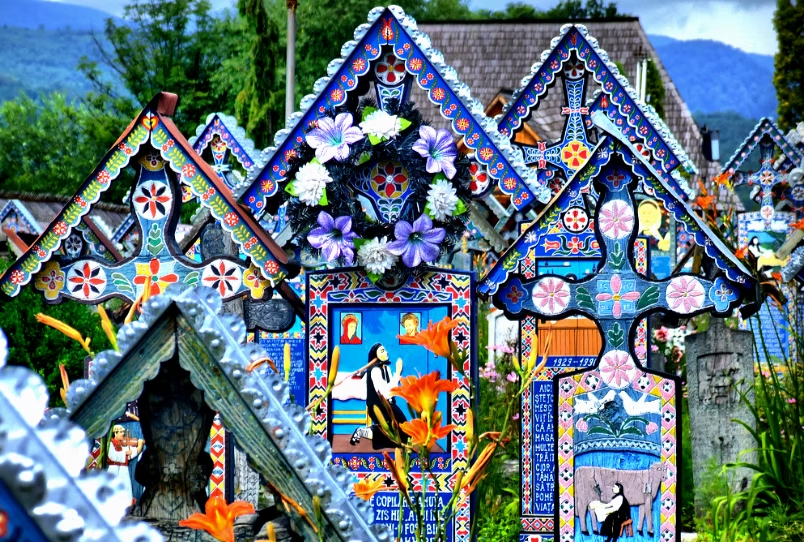
Others are richly decorated, with floral motifs rising towards the top of the cross like branches of a tree reaching for the light. Spirals, leaves, birds, and solar symbols come together in a geometry that combines Romanian folk art with a profound understanding of nature. Looking carefully, I realise that these crosses are not merely intended to mark a place of rest. They are created to preserve a presence. Here, a person is not reduced to a date of birth and a date of departure. The person is shown in motion. Working. Laughing. Loving. Living.
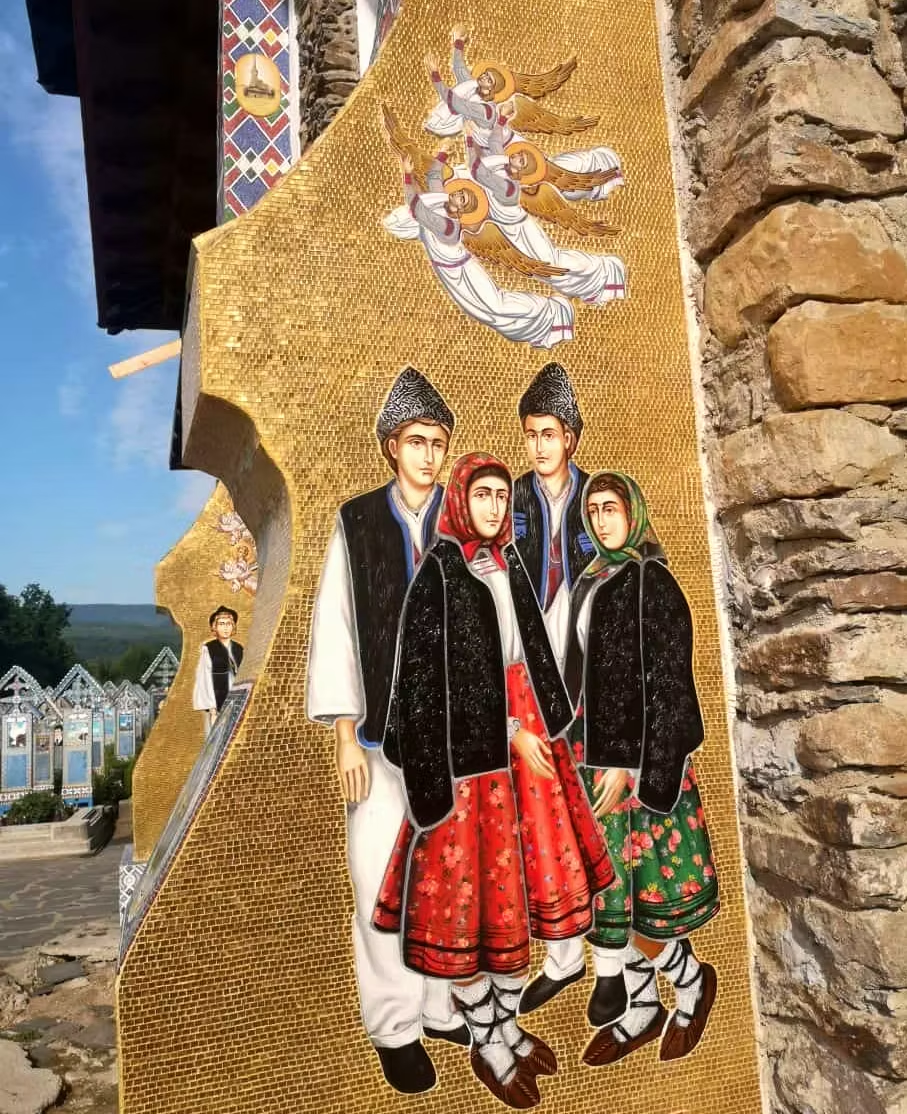
A peasant holds a scythe in his hand. A carpenter stands beside his workbench. A musician raises his violin. A woman prepares bread. A child looks at the world with the wide eyes of life's beginning. Each image is a window opening onto a moment that exists nowhere but in memory.

The story of this place begins with one man. A man who looked at death differently from most people. His name was Stan Ioan Pătraș. Born in Săpânța in 1908, he was a sculptor, painter, and folk poet. But above all, he was an observer of people. He understood that every life has a story and that the disappearance of a person need not mean the disappearance of that story. In 1935, he created the first cross in the style that would eventually transform the village into a place known across every continent.

The idea was simple. But revolutionary. Instead of a grave merely stating that a person had existed, the cross should tell us who that person had been. Not merely the achievements. Not merely the virtues. But the whole person. With their goodness. Their weaknesses. Their faults. Their humour. That impossible-to-repeat combination that makes every human existence unique. Stan Ioan Pătraș did not carve crosses. He carved portraits of the soul.

It is said that before beginning a work, the craftsman listened. He listened to people. He asked them about the person who had died. What were they like? What did they enjoy? What did they do every day? What made them laugh? What habits did they have? Because a person cannot be reduced to a few words. A person is made up of small gestures. The way they light their lamp in the evening. The song they hum while working. The jokes they tell their neighbours. The way they call their dog. The look on their face when they return home. And all of this must find its way onto the wood. Stan Ioan Pătraș understood a truth that modern society often forgets: people are not collections of data. They are stories. And stories need witnesses.
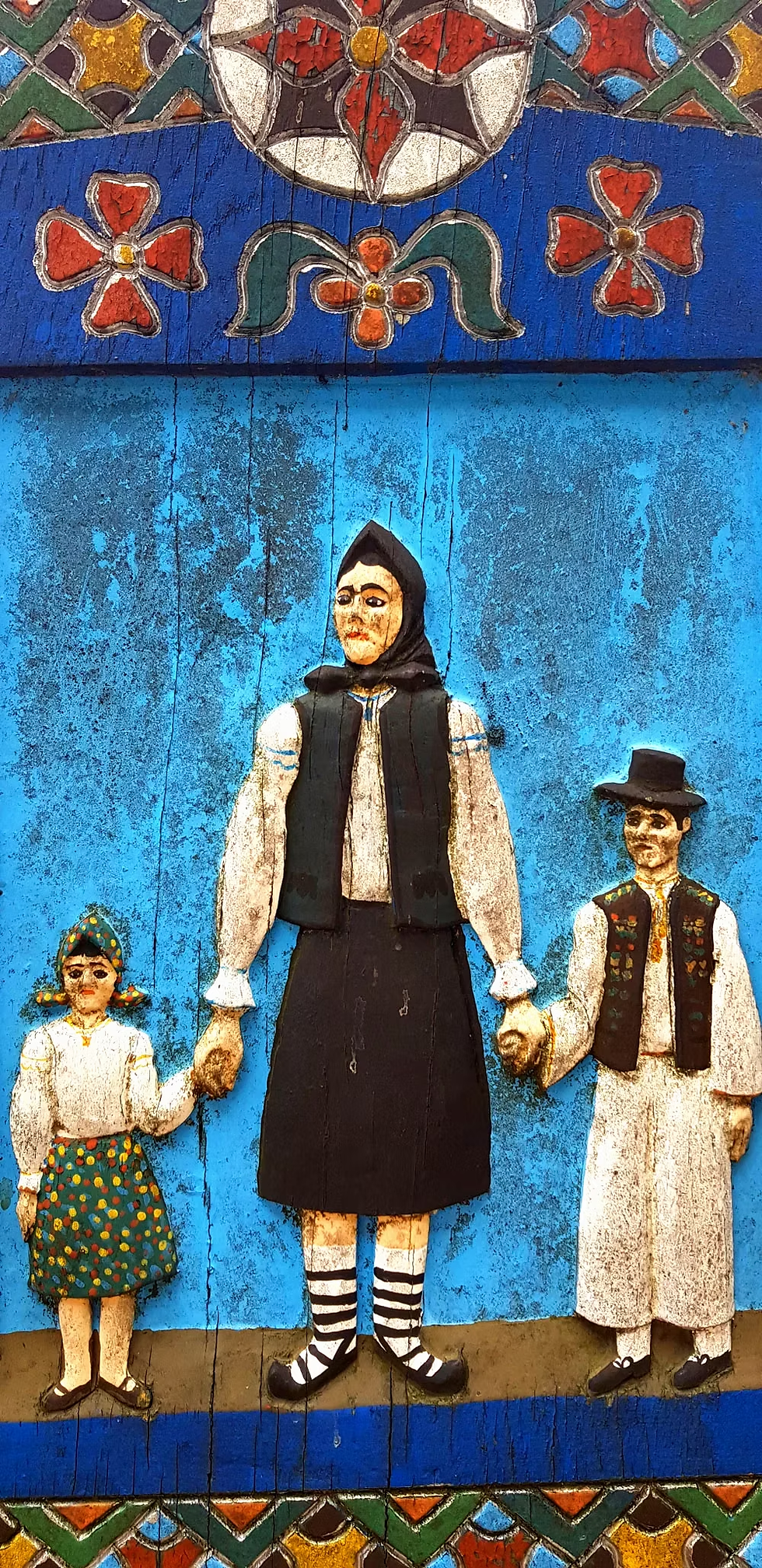
The Săpânța cross is, in itself, a small work of art. The process begins with the selection of the wood. Oak is not chosen by chance. It is one of the most durable natural materials in the region. Its dense grain enables it to withstand decades of heavy snow, abundant rain, and hot summers. But for the craftsman, oak also carries symbolic value. It is the tree of strength. Of deep roots. Of continuity.

After the wood has been carefully dried, the drawing begins. With a pencil, the craftsman traces the lines that will become the final image. Then the chisels come into play. Every blow must be precise. Too strong, and the wood splits. Too weak, and the story fails to come alive. It is a craft balanced between strength and delicacy. Between craftsmanship and prayer. The relief is carved by hand, centimetre by centimetre. Then the surface is prepared for colour. And this is where the magic begins.

In traditional Romanian art, colours are never chosen at random. They speak. Red is life. It is the blood flowing through human veins, love, passion, and energy. Green is renewal. It is the grass that returns every spring, the hope that nothing in nature ever truly disappears. Yellow is abundance. It is ripened wheat, sunlight, the fruit of labour. White is purity. And black is mystery—the space that human beings cannot cross with their gaze. But above all there is blue. The blue that unites them. The blue that looks towards the sky.
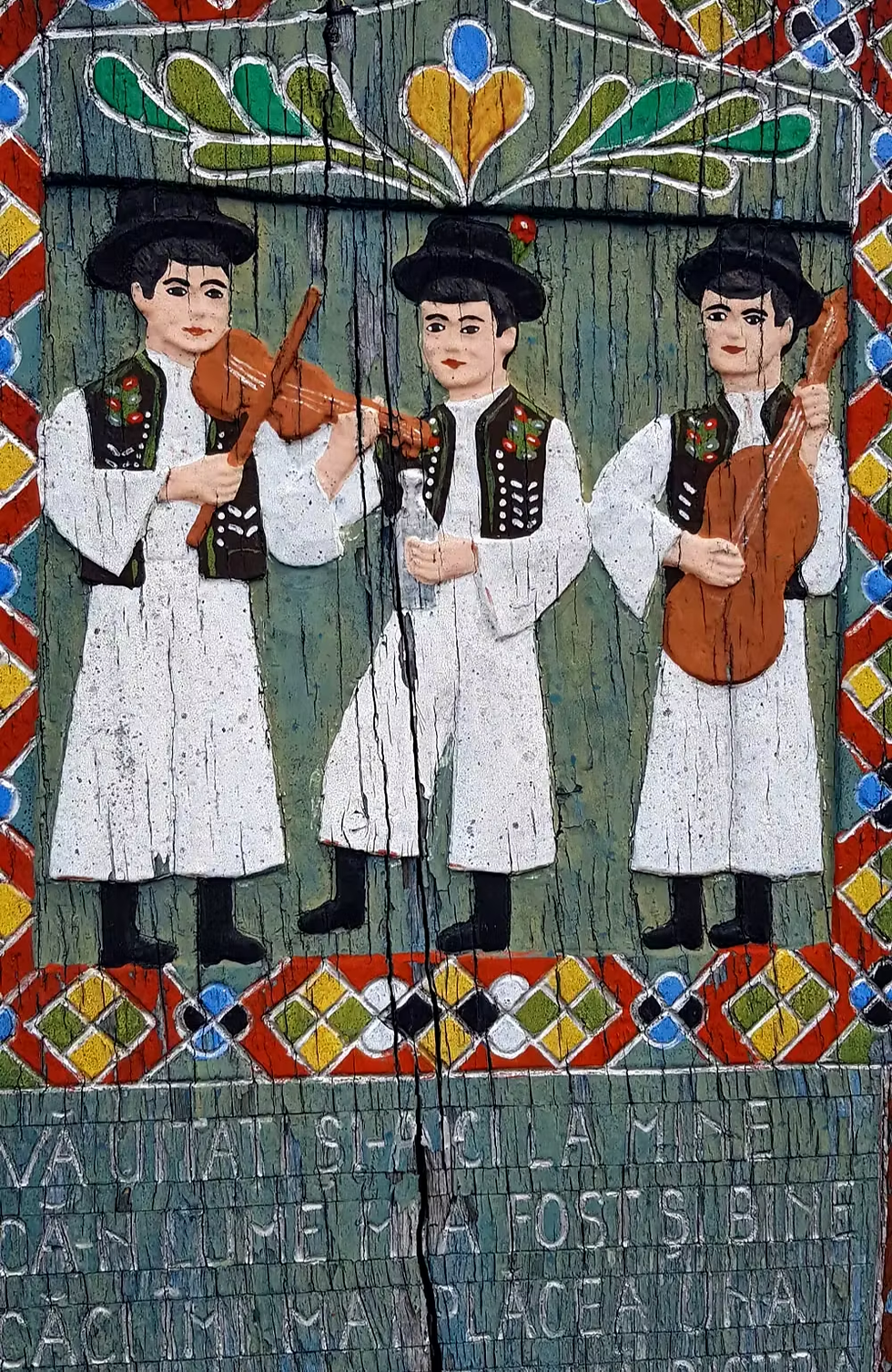
Looking at the crosses, you realise that the Merry Cemetery is not merry because it ignores death. It is merry because it accepts life. With all its imperfections. The people here do not attempt to make death beautiful. They attempt to make life unforgettable. That is the difference. I stop before a cross. A man is depicted working the land. His face carries a discreet smile. Beneath the image are several lines of verse. I do not read them as an epitaph. I read them as a letter. A letter sent from a time when people were not afraid to laugh at their own weaknesses. Around me, tourists discover the same thing. Some smile. Some laugh. Some remain silent. But no one leaves indifferent. Because Săpânța does not show you how people died. It shows you how they lived.

And perhaps this is the true miracle of the place. In a corner of Maramureș, a simple craftsman managed to create something more powerful than a monument. He created a conversation between generations. Between those who have departed and those who are still walking the road. Between past and present. Between earth and sky. And every blue cross seems to say the same thing: 'Do not hurry to mourn us. First, live. First, love. First, tell your stories. Because one day, your story too will search for a place where it can be told'.

After the first few dozen steps through the Merry Cemetery, something difficult to explain begins to happen. At first, you look at the crosses. Then you begin to read them. And after a while... you begin to listen to them. It is the moment when the wood ceases to be merely wood. The paintings cease to be merely images. And the verses carved into the blue crosses become voices arriving from a world that, although it seems distant, is surprisingly close. The cemetery no longer resembles a place of separation. It becomes an old village lane, where people still sit at their gates and tell one another their stories. Only here, the gates are made of oak. And the stories have survived the test of time. In the ordinary world, death is surrounded by heavy words. End. Lost. Gone. Departed from this world. At Săpânța, people choose different words. Memory. Smile. Story. Life. Perhaps this is the greatest lesson of the place: death is not described by what it takes from us, but by what it leaves behind. A person remains in their gestures. In their profession. In the way they speak. In their mistakes. In their jokes. In those small imperfections that make them impossible to confuse with anyone else.

I stop before a cross. In the image, a man stands beside animals. He has the peaceful expression of someone who knows the earth not as property, but as a life partner. He spends his days between the fields and the household. Elsewhere, a musician appears still to be holding a violin beneath his chin. His fingers are captured in the middle of a song. It is as though the melody never ended. Farther on, a woman prepares bread. A simple gesture. Yet it contains the entire history of the village. The fire in the hearth. Tired hands. The family gathered around the table. Festivals. Children. Home. Everything contained in the word “home”.

Then the epitaphs appear. The true treasure of Săpânța. They are not ordinary funerary inscriptions. They are small poems of existence. Written simply, in popular rhyme and with disarming honesty, they speak about people exactly as they were. They do not turn them into saints. They do not idealise them. They do not erase their faults. Because the people of Maramureș understand something essential: a perfect person is not a real person.

A French tourist stands before a cross, trying to understand the translation in his guidebook. He smiles. Then he laughs. He calls his wife. “Come and see this! This man actually dared to say that about himself!” And he is right. Here, people have the rare courage to laugh even when speaking about their own departure. An elderly villager whom I met beside the main path watches the tourists with quiet curiosity. He wears a simple white shirt and a black hat. I ask him: “Why do you think people come from so far away to see this place?” The man smiles. He looks towards the crosses. “Because people are still people here.” He remains silent for several seconds. “In many places, after you die, all that remains is a stone with a name. Here, the story remains.” He gently touches the wood of a cross. "We do not want to keep death close. We want to keep the person close.”

His words are simple. But behind them lies an entire philosophy. Maramureș humour is not mockery. It is not disrespect. It is a form of wisdom. People who live close to nature understand that existence is made of contrasts. After winter comes spring. After rain comes sunshine. After sadness comes joy. And after life comes death. But all of these belong to the same cycle. The Maramureș peasant does not fight this order. He accepts it. And perhaps that is precisely why he allows himself to smile.

Among the crosses, you find stories that seem to have come straight from a village comedy. One man is remembered for his love of wine. Another for his proverbial stubbornness. Another for talking more than he worked. Every fault becomes, after death, a beloved memory. Because when someone is no longer beside you, even the things that once irritated you become reasons for longing. Perhaps this is one of the great truths hidden within Săpânța. We do not love people for their perfection. We love them for their uniqueness.
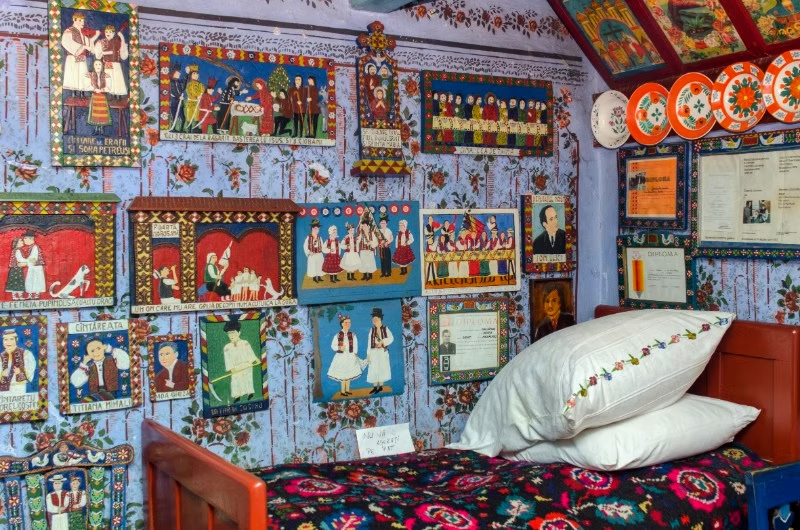
In one corner of the cemetery, a group of children reads the epitaphs aloud. One bursts into laughter. Another asks: “Did someone really write this?” An adult replies: “Yes. Because these people were never ashamed to be themselves.” The children move on. Perhaps without realising it, they have received one of life's most important lessons: never take yourself too seriously.

Later, I enter a workshop near the cemetery. The smell of fresh wood fills the room. Models of crosses hang from the walls. Chisels of different sizes lie on the table. Some are fine, for details. Others are heavy, for the first cuts into the wood. A craftsman works in silence. Every blow is measured. There is no hurry. Because wood does not tolerate haste. “How long does it take to make a cross?” I ask. He thinks for a moment. “It depends.” “On what?” “On the person.” He looks at the work before him. “Some lives are easy to tell. Others need more time.” The answer seems simple. But inside that workshop, among the smell of oak and the sound of chisels, it acquires a different weight.

Evening begins to descend over Săpânța. The light becomes gentler. Tourists leave slowly. Voices fade. But the crosses remain. Blue. Silent. And yet filled with voices. I look back one more time. I begin to understand that these crosses are not about death. They are about the courage to have lived. About the beauty of an ordinary life. About the fact that every person, no matter how simple their existence may appear, leaves behind an entire universe. Săpânța does not teach us how to die. It teaches us how not to be forgotten. And perhaps the most beautiful epitaph that could ever be written would require very few words: He was here. He loved. He laughed. He left a story behind. And that is enough.

The Legacy of Stan Ioan Pătraș
Beyond the paths of the Merry Cemetery, beyond the blue crosses that have travelled around the world, there is another place where the story of Săpânța continues. It is not visited as often. It does not always appear in photographs. It does not attract the crowds of tourists who stop before the painted crosses. It is a quieter place. A workshop. This is where the journey of a cross truly begins. Not in the cemetery. But in a piece of wood waiting to discover its destiny.

The workshop door opens with a soft creak. Inside, the air is different. It smells of forest. Of freshly cut oak. Of sawdust warmed by the light entering through the small windows. Old and new cross designs hang from the walls. Some are almost finished; others are merely sketches drawn onto the surface of the wood. Every piece of wood begins a story that has not yet been told.

On a long table lie the tools. Chisels of every shape. Hammers with handles worn smooth by the craftsman's hands. Thin knives for details. Fine brushes, almost fragile, used for the lines that bring faces to life. They are not merely tools. They are extensions of the hand. And through the craftsman's hand, extensions of memory. In one corner of the workshop, a large piece of oak waits. At first glance, it appears to be nothing more than wood. A cut trunk. A piece of nature taken from the forest. But the craftsman sees it differently. “The wood already has its own story,” he says. He runs his palm across the rough grain. “We only have to discover it.”

It is an old idea in the world of craftsmanship. The material is not an object. It is a partner.
Wood has grain, direction, strength, and fragility. Every fibre must be respected. One wrong blow of the chisel can destroy hours of work. That is why, before making the first mark, the craftsman listens. He looks. He waits. Like someone listening to a story before writing it down.

The choice of oak is not accidental. In Romanian culture, oak has always symbolised strength and continuity. A tree of ancient forests, it watches generations of people pass before it. It is a witness to wars, celebrations, weddings, and farewells. It lives longer than a human being. Perhaps that is why it is chosen to preserve human memory. The wood is prepared long before it becomes a cross. It must be properly dried so that moisture hidden within the fibres does not cause warping or cracking. Good oak must be strong, but also responsive beneath the chisel. Too soft, and it will not retain the details. Too hard, and it becomes difficult to shape. Like people. There must be balance.

The craftsman begins with the drawing. With a simple pencil, he traces the outlines. There is no image yet. Only lines. But those lines already contain the person who is about to emerge. Then come the first blows. The wood falls away slowly. A shape appears. A face. A hand. A tool. An animal. An object from everyday life. With every splinter that falls away, the person begins to return. Not in body. But in memory.
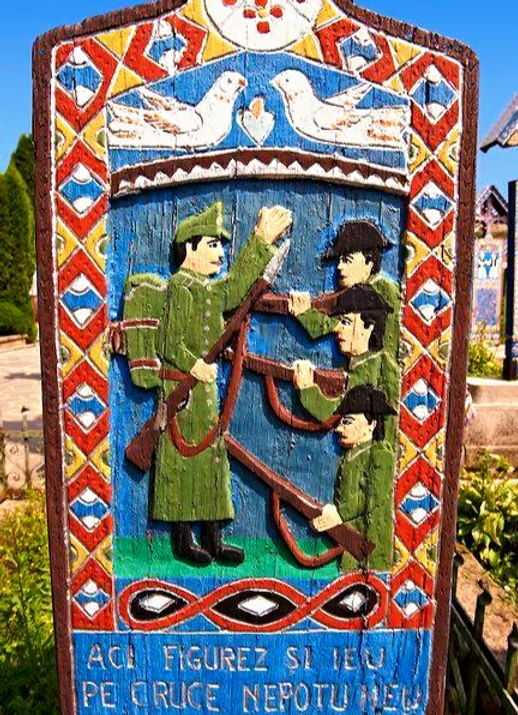
Stan Ioan Pătraș understood the power of wood. He was not merely a sculptor. He was a chronicler. In a world where ordinary people rarely found their way into history books, he created a parallel history. The history of ordinary people. Those who worked the land. Those who raised animals. The women who kept households standing. Craftsmen. Musicians. Children who became adults and then memories. Before him, graves said: “Someone rests here.” After him, the crosses began to say: “Someone lived here.” And that difference changes everything.

Stan Ioan Pătraș possessed a rare talent. He noticed what others overlooked. Not merely great events. But small details. The way a man wears his hat. The way a woman kneads dough. The way a farmer cares for his horse. The way an old man lights his pipe in the evening.Because that is where true identity resides. Not in diplomas. Not in titles. But in gestures.

It is said that before carving a cross, the craftsman seeks to learn the story of the person who has died. He asks the family. He asks the neighbours. He listens to the village. Then he transforms their answers into an image and a few verses. It is a form of portraiture. But a portrait deeper than a photograph. A photograph captures a moment. The cross captures a life.

On a table in the workshop are several colours. Red. Green. Yellow. White. Black. And, of course, blue. The blue that made Săpânța famous. The craftsman takes up his brush and explains: “Every colour says something.” In the traditional world, nothing is accidental. Red brings the energy of life. Green recalls the earth and renewal. Yellow speaks of the sun and abundance. White speaks of cleanliness and the soul. Black of the unknown. And blue... He pauses. He looks towards the window. “Blue is the sky. That is all. But that ‘all’ says everything.”

Painting a cross requires the same patience as carving it. Colour must be applied in layers. Details must be executed with precision. A line that is too thick can change the expression of a face. The wrong shade can alter the entire atmosphere. The craftsman does not paint the wood. He paints memory.

The legacy of Stan Ioan Pătraș does not exist only in the crosses that remain in the cemetery. It exists in the people who continue the tradition. In the young people who learn the craft. In the families who preserve the techniques. In every chisel that touches wood today. Because a craft does not die when its creator disappears. It dies when no one understands why it once existed. And in Săpânța, that meaning is still alive.

Before leaving, I turn once more towards the workshop. From inside comes the regular sound of the chisel. Tap. Tap. Tap. It is the same rhythm that people here have heard for generations. A rhythm resembling the beating of a heart. Perhaps because, in a sense, that is exactly what it is. A wooden heart. A heart that continues to beat for those who are no longer here.

When I leave the workshop and look once again towards the Merry Cemetery, I see the crosses differently. I no longer see only colour. I see labour. I no longer see only sculpture. I see love. I no longer see only monuments. I see people. And perhaps this is Săpânța's greatest gift: in a world where everything seems designed to disappear quickly, there are still craftsmen here who believe that every life deserves to be preserved. In wood. In colour. In story. Because a person leaves. But their story can remain. And sometimes, a story can last longer than the oak from which it was carved.


Comments