
THE CITY AND THE MOUNTAIN
Series: Puy de Sancy – The Great Volcano.
For the summer of 2021, we planned to hike the highest volcano in France, Puy de Sancy, and visit the town of Mont‑Dore, located at its foot. But once we arrived, we had the surprise — and joy — of discovering yet another town worth seeing: La Bourboule!

And one more mountain to climb: Banne d’Ordanche!

How did we end up there? Initially, we were supposed to stay in Mont‑Dore for the entire duration of our holiday. But a series of circumstances forced us to look for another place after the first half of our stay — and we found it in La Bourboule, just a few kilometres away. What could have negatively affected our holiday turned out to be an advantage once we discovered the town and the mountain nearby.

The Origin of the Town — The Legend
In the beginning of time, there was nothing here but a rocky massif, almost impossible to inhabit. The locals implored the Fairies, their protective deities, to help them — and the Fairies agreed. From their granite rock, using their magic wand, they made a plain appear, wide enough for the people to build their homes. And as a reward for their faith, the Fairies also made a “miraculous” spring appear. Since then, the rock has been called Roche des Fées — The Fairies’ Rock. Situated at 945 metres of altitude, it is easily accessible after a gentle 45‑minute walk. Here, a sculpture was erected in honour of the Fairies.

According to legend, the Dordogne River also appeared through the magic of the Fairies’ wand. In geographical reality, it is formed by the union of two mountain streams descending from Puy de Sancy: Dore and Dogne. Regardless of the version, one thing is certain: the river rises near La Bourboule. Locals and tourists can enjoy a peaceful, charming walk along its banks, admiring the beautiful buildings that line its course.

The Fairies’ “Miraculous” Water
Spa activity probably began here in the Gallo‑Roman era. Around 1450, the first Bath House, with its rustic wooden tubs, was inaugurated at the base of the Fairies’ Rock. In 1854, the thermal properties of the waters were scientifically confirmed; as a result, spa establishments were built. The most important and imposing: Choussy in 1872 and Les Grands Thermes, with its neo‑Byzantine domes, in 1877.

Around 1900, the modest village at the foot of the Fairies’ Rock transformed into a true “queen of spa towns”, gaining international renown. Numerous buildings appeared, following the architectural prescriptions of the Belle Époque (1871–1914), a period of intense industrial, cultural, and artistic development in France. Beautiful villas, palaces, a casino whose façade is classified as a historic monument, thermal buildings, the elegant caryatids of the Town Hall — all living testimonies of that era.

A wealthy clientele, along with many celebrities and even royal figures, came here for spa treatments with bicarbonate‑rich, oligoelement‑rich water, ideal for respiratory and dermatological conditions, allergies, and for stimulating children’s development. The high arsenic content of the water earned La Bourboule the nickname “The Queen of Arsenic.” In summer, a guided tour on this theme is organised weekly — an ingenious way to encourage tourists to discover wonderful places and learn their stories.

Another initiative meant to increase the town’s appeal: guided night tours. Their purpose is to offer tourists the chance to admire the elegant buildings magnificently illuminated, while listening to explanations blending historical facts with anecdotes about the buildings or the famous personalities who lived in them.

Such initiatives are more than necessary, because La Bourboule cannot compete with either the winter sports facilities or the hiking possibilities offered by neighbouring Mont‑Dore (see Mont‑Dore, Noble of Sancy). It does not have the advantage of Puy de Sancy, located near the latter.

The Mountain
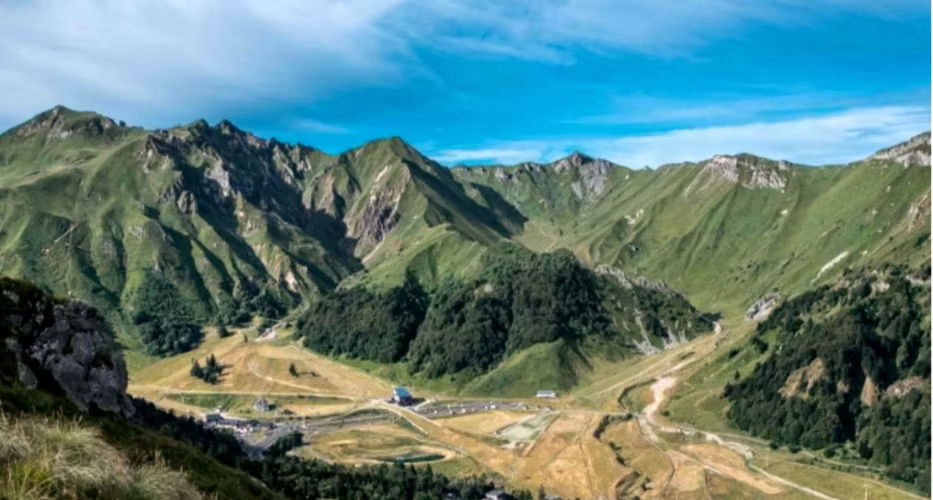
And yet, next to La Bourboule rises Banne d’Ordanche, a volcanic mountain at 1,515 metres. The volcano stopped erupting about two million years ago, then was eroded by glaciers. The rock it is made of is now called “ordonchite”, named after the volcano’s fame. The distinctive silhouette of its peak explains the origin of its name: banne means “horn” in the local Auvergnat dialect, part of the Occitan language once spoken in the region.

There are several hiking trails to explore the mountain and its surroundings. Our magnificent team — myself, Angelo, my wife Irina, and our children Vlad (the younger) and Radu (the older) — chose a beautiful loop trail. It was our last hike of that holiday, a way to end our stay in Sancy “en fanfare” (as told in Puy de Sancy – The Great Volcano). The starting point: the charming village of Murat‑le‑Quaire, at 1,050 metres altitude.

Interesting fact: the mountain has special significance for the Scout movement in France. Before World War II, there was a glider flight centre here; in 1956, it hosted a major gathering of numerous Scout groups. Later, many other groups came for hikes or summer camps. Various facilities built by them were later used by local shepherds.

Banne d’Ordanche is also a summer grazing area. Numerous flocks of Rava sheep are brought here to graze, enjoying the landscape, the lush grass, and colourful flowers such as yellow gentians. Tourist sites even offer advice on how to stay safe when encountering the flocks’ guard dogs. We did not have the “luck” of such an encounter — the sheep were completely absent when we passed through.

To reach the summit, hikers have two options: a dirt path or a wooden staircase. After climbing the staircase twice on Puy de Sancy during our holiday, we chose the dirt path this time. It was also part of our loop, while the staircase was on the opposite side. And we were far too eager to reach the top to make a detour.

Our eagerness was justified by the promise of beautiful views — and so it was. Our effort, a climb neither physically intense nor technically difficult, was rewarded with a magical 360° panorama. An orientation table made of crystallised lava pointed our gaze toward Puy de Sancy and its ridge. We could also see the Chaîne des Puys, the mountains we had climbed the previous year (see Puy de Pariou – The Magnificent Volcano). The only condition: good weather and sunshine.

We were lucky this time. Even if Vlad and Radu may not have agreed 100% that we were “lucky,” they still had to endure Daddy’s photo session — both at the summit and on the descent, this time via the staircase.

The return journey felt longer than the ascent. Of course, it was an illusion — the distance was the same. We were simply walking more slowly, often looking back at the horn‑shaped peak, already nostalgic for it and, more broadly, for our holiday that was ending here.

Before reaching the parking area where we had left the car, we crossed the forest once more. The murmur of the leaves, the birds’ songs, the beauty of the green grass — everything seemed to say: “Goodbye, until next time.”

A video with Bourboule and Banne d'Ordanche regions.

Comments