
WAITONGA FALLS: A JOURNEY THROUGH THE ROOTS OF TIME
The walk to Waitonga Falls begins in the small town of Ohakune, nestled at the south‑western foot of Mount Ruapehu, in the heart of Tongariro National Park — the oldest national park in the country and one of the most spectacular volcanic landscapes in the world.

Known as the “southern gateway” to Mount Ruapehu, the settlement lives in a quiet balance between rural calm and the seasonal energy of visitors drawn by skiing, hiking, and wild nature.

From here, the trail to Waitonga Falls begins like a silent promise, slipping through dense beech forests and marshy zones where the earth breathes slowly and the vegetation seems intent on guarding its secrets.

As we advance, the path becomes an incursion into an increasingly untamed landscape, where roots rise to the surface like the mountain’s veins, and the sound of water begins to insinuate itself, almost imperceptible, into the background. But it is no longer just us and the trail: small human gestures appear, giving rhythm to this quiet.
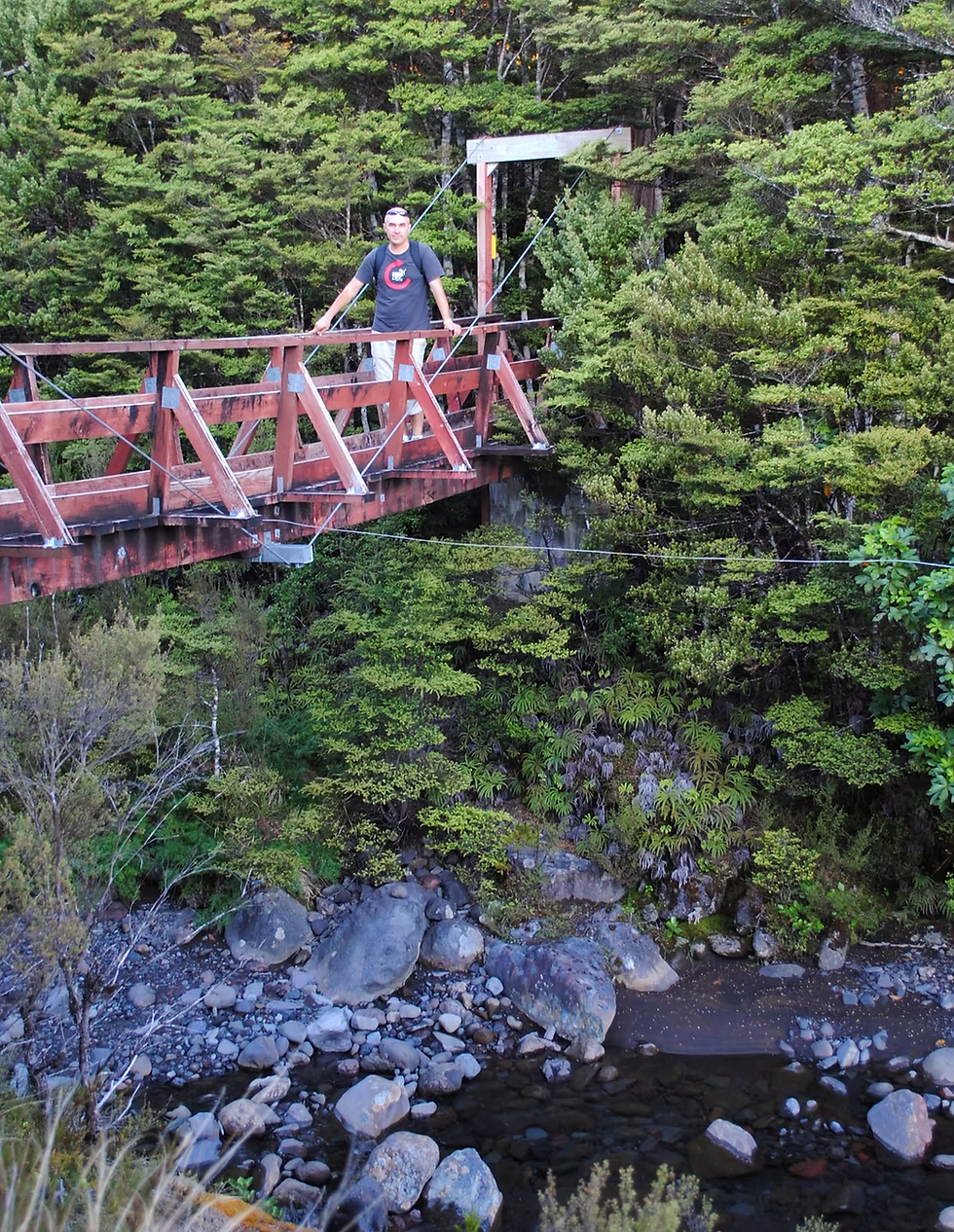
At the first wooden bridge, the planks creak softly under our steps, as if holding the memory of those who passed before. We stop for a moment and look down, where a thin stream — scattered with rounded stones — flows quietly, like an unfinished sentence. I hop lightly over the last plank, careful, as though stepping into a story that demands respect.

Farther on, the path narrows. I instinctively bend down to tie my shoelaces, and this simple gesture takes on an unexpected gravity — an anchoring in the present. Around us, the forest breathes. The trees are covered in thick, dark‑green moss, like ancient cloaks centuries old, and black lichens draw silent, indecipherable maps on the rocks.

Autumn colours flare in discreet patches — muted yellow, rusty red, tired green — like memories refusing to fade.

Light enters in fragments, in thin streaks, and each step seems to take us deeper into a suspended time.

We reach a small clearing and, without saying much, decide to take a break. Ten minutes that stretch. We sit on a damp log, and the silence is no longer silence — it is a presence. We hear the water now, more clearly. We hear the wind. And for a moment, it feels as though the mountain itself is listening to us.

In front of us, Ruapehu appears — laden with snow and mystery — perfectly reflected in a small pool beside the trail. The image is so clear it seems unreal: the mountain is no longer standing before us, but beneath us, inverted in a quiet world where wind does not reach and time disturbs nothing.

We stop without speaking. The water is motionless, like an open eyelid that does not blink. In it, the snow on the peaks looks whiter, the contours sharper, and the silence deeper. It is as if the mountain has left there a double of itself, a liquid memory for those who know how to look. A thread of wind touches the surface and, for a moment, Ruapehu dissolves — breaking into concentric circles, into fragments of light and shadow. Then, slowly, it gathers itself again, as though nothing had happened. We remain there, between two worlds — the solid and the reflected — and no longer know which is more real.

When we set off again, the path winds past small ravines that open suddenly, without warning, like dark thoughts. They are not deep, but deep enough to remind us of the fragility of each step. We adjust our rhythm. We become more attentive. Almost solemn.

Bridge after bridge, root after root, the trail carries us not only forward but inward — into a space where every detail gains meaning: the moss that clothes the silence, the stone that keeps the trace of water, the footsteps that tie the present to something far older.

And somewhere beyond all this, the waterfall awaits — not as a destination, but as an answer we do not yet know we are seeking.

Waitonga Falls does not reveal itself all at once. It does not appear as a spectacle prepared for the viewer, but as a presence that allows itself to be discovered gradually, almost with restraint. We hear it first — a deep murmur that grows step by step, like the mountain’s breath. Then we feel it in the air: the coolness becomes denser, more alive, like an invisible touch on the skin.
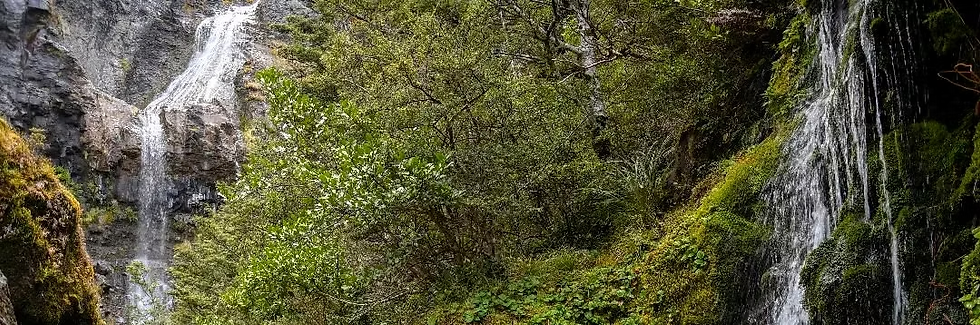
And suddenly, the forest opens. The waterfall drops before us in two tiers, over dark volcanic rock, as though splitting the mountain in two. The water does not flow — it falls, white and continuous, like a column of liquid light descending from the sky. Each thread seems to seek its own path, yet together they become a single force, a single voice.

The rocks it slides over are black, porous, shaped by ancient fires, and the contrast with the white water is so strong it seems unreal — like a photograph where someone forgot to add the middle colour. In places, the water strikes invisible edges and scatters into thousands of fine droplets, turning the air into a suspended rain that never fully falls. Around us, moss wraps everything in a deep, wet green, like a living silence. The trees stand still, but they are not witnesses — they are accomplices. The entire place seems to operate according to its own logic, older than any map.

We approach slowly. Not out of fear, but from an almost ritual instinct, as though entering a space that demands a certain form of respect. The water hits the base of the falls with a muted force, and the sound is no longer just sound — it becomes presence, becomes vibration. You feel it in your chest, in your soles, in the air you breathe.

We remain there speechless. Because in front of Waitonga Falls, words do not disappear — they become unnecessary. There is something in this continuous falling that forces you to think about time differently. Not as a line, but as a flow. The water has been falling for thousands of years, perhaps the same, perhaps differently, but always with the same quiet determination. It does not hurry. It does not stop. It asks for nothing. It simply exists.

And then you understand — perhaps for a moment — that beauty does not lie in spectacle, but in perseverance. In that silent, infinite repetition that shapes the world without asking to be seen. When we leave, we do not detach easily. We look back once more, and the waterfall remains there exactly as it was — indifferent, complete, whole. But we are no longer the same. Because somewhere between roots, stone, and water, we left something of ourselves, and took with us something that cannot be named.


Comments